Florida Tile & Shingle Roof Cleaning Authority Guide
Is Professional Roof Cleaning Worth It in Florida?
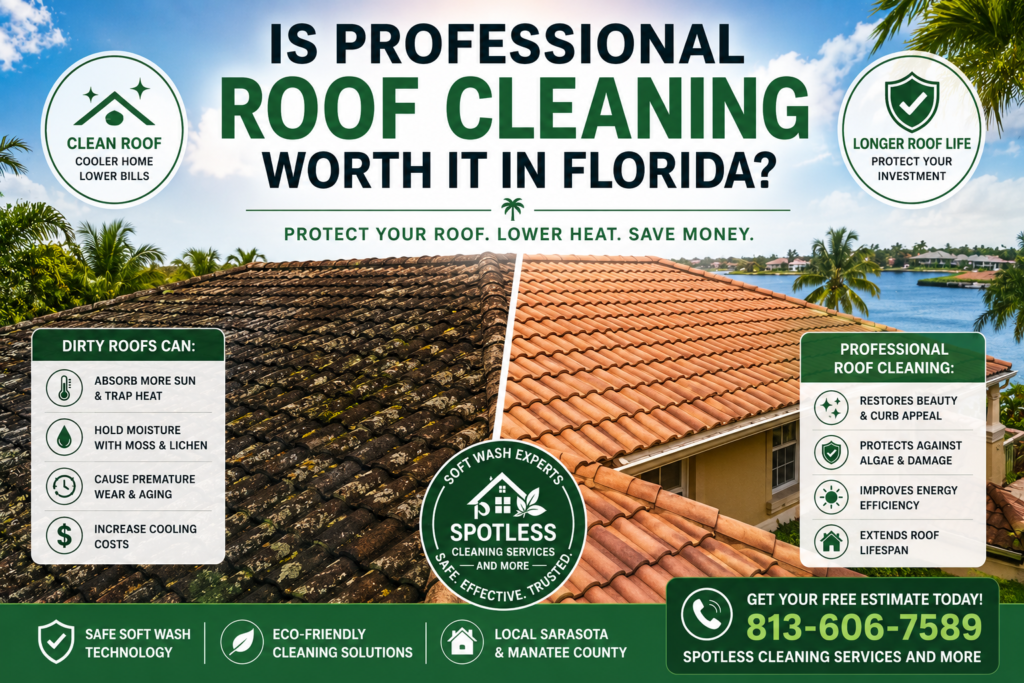
Is Professional Roof Cleaning Worth It in Florida? In Florida, the answer often depends on what is growing on the roof, whether you have tile or asphalt shingles, how much the roof has darkened, and whether the cleaning method protects the roofing material while treating the biological contamination.
This comprehensive guide explains tile-roof soiling and solar heat, asphalt-shingle algae caused by Gloeocapsa magma, moss and lichen, granule loss, soft washing, sodium hypochlorite, DIY risk, Sarasota roof-cleaning costs, curb appeal, and when professional service makes financial sense.
Table of Contents
Is Professional Roof Cleaning Worth It in Florida? Quick Answer
Is Professional Roof Cleaning Worth It in Florida? For many Florida homeowners, professional roof cleaning is worth considering when black streaks, algae, moss, lichen, or other organic growth are changing the appearance of the roof. The value is not simply that someone makes the roof look cleaner. A professional roof-cleaning service brings a roof-specific cleaning method, chemical application equipment, property-protection procedures, experience around delicate roofing materials, and a way to complete a difficult exterior-maintenance project without asking the homeowner to experiment on one of the most expensive systems on the property.
Florida creates an unusually demanding environment for roofs. Warm temperatures, humidity, frequent rain, airborne biological material, shade from mature landscaping, and long cooling seasons all influence what happens on a roof surface. Tile roofs and asphalt-shingle roofs respond differently to contamination, heat, moisture, and cleaning, so a good roof-cleaning plan should start by identifying the roof material rather than treating every roof like a concrete driveway.
At Spotless Cleaning Services and More, we use a soft-wash approach on compatible roof systems. That means relying on appropriate cleaning chemistry and controlled application instead of trying to erase biological staining with aggressive close-range pressure. This distinction matters on both tile and shingles, where the wrong cleaning method can create an unnecessary risk of surface damage.
If your first question is price, read our How Much Does Roof Cleaning Cost in Sarasota, FL? guide. If you already know you want a professional evaluation, visit our Professional Roof Cleaning Services page and request a free property-specific estimate.
Is Professional Roof Cleaning Worth It in Florida? Why Florida Conditions Change the Answer
Is Professional Roof Cleaning Worth It in Florida? In a climate with intense sun, humidity and frequent rain, that question is especially relevant.
Florida roofs spend their lives in a combination of heat, intense solar exposure, humidity, rain, dew, airborne spores, salt in some coastal environments, tree debris, and long periods in which air-conditioning demand is high. Those conditions do not mean every roof needs frequent cleaning, but they help explain why biological staining can become visible so quickly on some properties.
North-facing roof planes, shaded sections, valleys, areas beneath trees, and surfaces that stay damp longer can develop staining differently from sunnier sections. Two neighboring houses can therefore age visually at very different rates even when the roofs were installed at similar times. Roof material, color, slope, ventilation, surrounding vegetation, irrigation, and microclimate all contribute.
For homeowners, the practical question is not whether every dark mark is dangerous. It is whether the material on the roof is treatable contamination, whether it is changing the roof’s appearance or performance, and whether cleaning can be performed without creating more risk than the contamination itself. That is where professional evaluation has value.
Our local roof-cleaning cluster goes deeper into these conditions. See Roof Cleaning Near Me in Sarasota and Bradenton, Roof Cleaning in Humid Climates, and How Soft Washing Protects Your Roof From Algae Damage.
Is Professional Roof Cleaning Worth It in Florida? A Closer Look at Concrete and Clay Tile
Is Professional Roof Cleaning Worth It in Florida? For owners of tile homes, the answer should account for biological growth, roof condition, solar exposure and the cleaning method.
Tile roofs are a major part of the Florida streetscape. Concrete and clay tile can provide a distinctive appearance and long service life when the roof system is properly designed, installed, inspected, and maintained. But tile is not maintenance-free, and the large exposed surface can accumulate dirt, biological growth, atmospheric deposits, and staining that changes both appearance and surface behavior.
A tile roof should never be reduced to the idea that it is simply a hard surface that can take unlimited pressure. Tiles can crack, shift, or already contain age-related defects, and the roof system includes underlayment, flashings, penetrations, valleys, fasteners, ridge components, and drainage details. Cleaning should therefore be planned as roof maintenance, not as concrete pressure washing performed at elevation.
Professional cleaning also allows the contractor to look for conditions that should change the plan. Broken or displaced tiles, fragile areas, prior repairs, solar equipment, skylights, gutters, pool cages, landscaping, painted metal, and difficult drainage paths can all affect how a roof should be approached. A responsible cleaner should be willing to identify limitations instead of promising that every discoloration will disappear.
For compatible tile roofs, Spotless Cleaning Services and More emphasizes controlled soft-wash chemistry. The objective is to treat organic contamination with the cleaning solution rather than depending on destructive force. This can be particularly important on older roofs where unnecessary foot traffic or aggressive cleaning would add avoidable stress.
Is Professional Roof Cleaning Worth It in Florida? What About Sunlight, Heat and Dirty Tile Roofs?
Yes, roof cleanliness can affect solar reflectance, but the size of the effect depends on the roof material, original color and reflectance, type of soiling, amount of biological growth, weathering, and building design. The underlying building-science principle is well established: a roof that reflects more incoming sunlight generally stays cooler than a roof that absorbs more of that solar energy. ENERGY STAR explains that roofs with high solar reflectance stay cooler and reduce the amount of heat transferred into a building.
Lawrence Berkeley National Laboratory has studied roof soiling and weathering and found that natural soiling can reduce the solar reflectance of roofing materials. Its research also notes that deposited particulate matter and microorganisms can absorb sunlight. This is important for Florida tile roofs because a light or reflective roof surface covered by dark biological staining or accumulated soil may no longer behave optically like the cleaner surface beneath it.
That does not mean every dirty roof will produce the same temperature increase or that cleaning guarantees a specific reduction in an electric bill. Cooling energy depends on insulation, attic ventilation, duct location, HVAC efficiency, thermostat settings, roof construction, solar orientation, weather, and many other variables. The U.S. Department of Energy explicitly notes that cool-roof energy savings vary with climate, insulation, roof type, and heating-and-cooling efficiency.
The defensible takeaway is still valuable: roof surface condition can influence solar reflectance, roof temperature, and heat transfer. In a hot, sunny climate such as Florida, preserving the intended reflective characteristics of a roof can be one component of overall thermal performance. DOE guidance even recommends examining roofs regularly and maintaining or cleaning them when necessary and appropriate to assure maximum solar reflectance.
For a homeowner with a light-colored tile roof that has become substantially darker from organic growth and soiling, professional cleaning can therefore have a benefit beyond appearance: it can restore more of the surface’s original cleanliness and potentially its reflective behavior. Whether that translates into a noticeable utility-bill change for a specific house requires building-specific measurement, so we do not promise a fixed percentage of energy savings.
Is Professional Roof Cleaning Worth It in Florida? When Moss, Lichen and Moisture Are Present
Organic growth on tile should be discussed carefully because algae, moss, and lichen are not interchangeable. Algae can create films and discoloration. Moss is a plant that can retain water like a sponge. Lichen is a symbiotic organism involving fungi and algae or cyanobacteria and can adhere tightly to mineral surfaces. Each can affect appearance and cleaning difficulty differently.
Dense moss and lichen can create localized zones that stay damp longer after rain or dew. On a roof, anything that interferes with normal drying, drainage, or surface exposure deserves attention. Repeated wetting and drying, solar heating, nighttime cooling, and seasonal temperature changes create ongoing thermal and moisture cycles. Biological mats can alter the immediate surface environment by shading the material, holding moisture, trapping debris, and changing how quickly the covered area dries relative to a clean exposed tile.
It is tempting to convert that observation into the sweeping claim that any moss or lichen automatically shortens every tile roof by a specific number of years. We do not make that promise. Tile-roof longevity depends on the tile, underlayment, installation, flashings, fasteners, roof slope, weather exposure, maintenance, foot traffic, storm history, and many other factors. What can be said responsibly is that persistent biological growth and trapped debris are maintenance conditions worth addressing rather than ignoring indefinitely.
Cleaning can also make inspection easier. Heavy growth may conceal cracks, displaced pieces, staining patterns, drainage issues, or other conditions. A cleaner surface does not repair those defects, but it can make the roof easier to visually evaluate and helps separate removable contamination from actual material problems.
Is Professional Roof Cleaning Worth It in Florida? What About Black Streaks on Shingle Roofs?
On asphalt-shingle roofs, the familiar dark streaks are commonly associated with Gloeocapsa magma, a hardy cyanobacterium commonly described as blue-green algae. Homeowners often call the streaking mold, mildew, soot, or dirt because that is what it resembles from the ground. GAF and Owens Corning both identify Gloeocapsa magma as a primary cause of common dark algae staining on asphalt shingles.
GAF explains that the organism forms a dark protective sheath that helps protect it from ultraviolet radiation. The staining often becomes more obvious on roof planes that receive less sunlight or stay damp longer. Owens Corning likewise notes that algae staining is especially common in warm, humid areas. Florida therefore provides conditions in which the visual problem can become pronounced.
This matters for SEO and for homeowners because there is a major difference between saying ‘my roof is dirty’ and understanding that the discoloration may be biological. Water pressure alone is not the most intelligent response to biological growth. Appropriate chemistry can treat the organism while allowing the cleaning process to use much lower pressure.
It is also important not to overstate what Gloeocapsa magma does. Manufacturer statements are not perfectly identical. GAF commonly treats blue-green algae staining primarily as an appearance issue, while Owens Corning says the organism is not generally harmful but can be associated with excessive moisture and can cause granule loss over time. Because manufacturers frame the risk differently, we do not claim that algae automatically or drastically destroys every shingle roof. We do treat it as a legitimate maintenance and curb-appeal concern that should be cleaned with a roof-appropriate method.
Is Professional Roof Cleaning Worth It in Florida? Gloeocapsa Magma, Granules and Shingle Life
Granules matter because they are part of the protective surfacing of an asphalt shingle. Excessive granule loss can leave shingles looking bald or worn and can be a sign that the roof needs professional evaluation. But granule loss has many possible causes, including age, weathering, foot traffic, hail, manufacturing characteristics, and mechanical abrasion. It would be misleading to blame every missing granule on algae.
Owens Corning’s homeowner guidance says Gloeocapsa magma is not generally harmful, although it can be a sign of excessive moisture and can cause granule loss over time. GAF, meanwhile, emphasizes the staining aspect and provides a chemical cleaning method. The most responsible conclusion is that algae staining should be addressed as maintenance without turning a nuanced manufacturer discussion into a dramatic claim that every stained roof is rapidly failing.
Moss is different. GAF warns that moss can have a severe impact on shingle durability if left untreated, can collect moisture, can spread beneath shingles, can lift shingles, and can contribute to granule loss. That makes thick moss growth a stronger material-maintenance concern than ordinary blue-green algae staining alone.
There is also an ironic risk in trying to ‘save’ a stained shingle roof with aggressive pressure washing. High-pressure cleaning can mechanically disturb the shingle surface and is not the manufacturer-style approach for algae removal. GAF’s technical bulletin instead describes applying a bleach-based cleaning mixture, allowing dwell time, and rinsing with low-pressure water. In other words, the cleaning method should not create the very surface wear the homeowner is trying to avoid.
For more detail, read our guide to whether pressure washing can damage a roof.
Is Professional Roof Cleaning Worth It in Florida? Why Our Soft-Wash Method Matters
Soft washing is not simply a marketing name for using less water pressure. It is a cleaning strategy in which chemistry, application, dwell time, and controlled rinsing or weathering do more of the work so the contractor does not have to depend on aggressive mechanical force. That is exactly the tradeoff that makes sense for many roof surfaces.
For asphalt-shingle algae staining, GAF’s technical bulletin recommends a bleach-based mixture applied with a garden sprayer, followed by low-pressure water after dwell time, while warning that the wet roof will become slippery and that shrubs below should be protected. That manufacturer guidance illustrates why roof cleaning is fundamentally different from pressure washing concrete.
At Spotless Cleaning Services and More, we evaluate the roof material and property before choosing the cleaning approach. Compatible roofs are treated with an appropriate soft-wash solution designed to address organic contamination. We also plan around gutters, downspouts, landscaping, painted surfaces, metals, pool areas, screens, and other parts of the property that may be affected by runoff or overspray.
Our sales proposition is simple: we want chemistry to do the biological cleaning instead of forcing the roof to absorb unnecessary mechanical punishment. A roof-cleaning company should know when pressure is useful, when it is unnecessary, and when it can become the wrong tool for the material.
Learn more on our Soft Washing Sarasota, FL page and in our Pressure Washing vs Soft Washing guide.
Sodium Hypochlorite and Professional Roof Cleaning
Sodium hypochlorite is widely used in exterior-cleaning chemistry because of its antimicrobial and oxidizing properties. The U.S. EPA identifies sodium hypochlorite as an antimicrobial agent, and registered products can target organisms including algae, fungi, mildew, and mold. Roofing-manufacturer guidance also commonly references chlorine bleach in algae-cleaning procedures for asphalt shingles.
The existence of an effective chemical does not mean more chemical is always better. Product concentration, roof material, contamination level, temperature, sunlight, dwell time, surrounding landscaping, runoff, metals, fabrics, painted surfaces, and label directions all matter. Professional cleaning is partly the process of managing those variables instead of treating the roof as an isolated surface.
This is also why homeowners should be cautious about internet recipes. A mixture that someone used on one roof in another climate is not automatically appropriate for every tile, shingle, coating, metal component, plant bed, or drainage configuration. Chemical compatibility and property protection belong in the job plan.
Our detailed chemistry article, Why Use Bleach / Sodium Hypochlorite When Pressure Washing?, explains the role of sodium hypochlorite across exterior-cleaning applications.
Is Professional Roof Cleaning Worth It in Florida? Professional Service vs DIY
Is Professional Roof Cleaning Worth It in Florida? The DIY comparison is one of the clearest ways to decide.
DIY roof cleaning can look inexpensive when the comparison is reduced to the price of bleach and a sprayer. That is not the full project. A homeowner must identify the roof material, choose a compatible cleaning method, source equipment, handle chemicals, protect landscaping, manage hoses, understand runoff, avoid damaging metals and finishes, and decide how to reach or treat the roof safely.
Roof access is the largest difference between a typical ground-level cleaning project and roof work. OSHA emphasizes that falls from roofs can cause serious injury or death and requires fall-protection planning and equipment in covered workplace situations. Homeowners are not governed by workplace rules in the same way, but the physics of falling do not change. A wet roof can be extremely slippery, and GAF specifically warns about that in its algae-cleaning bulletin.
Pressure equipment creates additional hazards. The CDC warns that pressure-washer spray can cause serious wounds, propel objects, create electrical hazards, and cause other injuries when equipment is used improperly. Those hazards are another reason that a roof-cleaning project should not be approached casually.
A fair DIY-versus-professional comparison therefore includes your time, equipment, protective gear, chemical handling, property protection, roof access, cleanup, and risk tolerance. Sometimes the professional price looks very different after the complete DIY project is priced honestly.
If you are comparing professional pricing, start with our Sarasota roof-cleaning cost guide before assuming the service is outside your budget.
Is Professional Roof Cleaning Worth It in Florida? How the Professional Process Works
1. Roof and property evaluation. We begin by identifying the roof type, visible contamination, access, slope, surrounding landscaping, drainage, gutters, downspouts, pool areas, exterior finishes, and obvious conditions that could affect the cleaning plan.
2. Property preparation. The roof is only one part of the work zone. Plants, exterior surfaces, metals, furniture, screens, vehicles, and other nearby items may require attention before treatment begins.
3. Controlled chemical application. On compatible roofing systems, an appropriate soft-wash solution is applied so the chemistry can act on algae and other organic contamination. We are not trying to compensate for weak chemistry by moving a high-pressure nozzle closer to the roof.
4. Dwell and observation. Organic growth does not always respond identically. Staining level, roof material, temperature, moisture, and growth type can affect how treatment behaves. The process is monitored rather than treated as a blind spray-and-go routine.
5. Roof-appropriate completion. Depending on the roof, treatment, manufacturer guidance, weather, and job conditions, the cleaning process may involve controlled low-pressure rinsing or allowing treated organic material to continue weathering away. The key is that the method is chosen for the roof rather than copied from flatwork cleaning.
6. Final review. We distinguish removable contamination from permanent discoloration, age, oxidation, broken material, prior repairs, or other conditions cleaning cannot fix. Professional cleaning should improve what is cleanable without pretending to be roofing repair.
Is Professional Roof Cleaning Worth It in Florida? How Cost Affects the Decision
Is Professional Roof Cleaning Worth It in Florida? Cost matters, but price should be compared with roof type, access, risk, method and expected improvement.
Roof-cleaning cost depends on much more than the square footage shown on a real-estate listing. Roof area, pitch, height, tile versus shingles, architectural complexity, access, amount and type of growth, landscaping, gutters, solar equipment, pool cages, and the overall scope can all change the labor and materials required.
A straightforward single-story shingle roof with moderate algae staining is a different project from a large multi-level tile roof with steep sections, multiple valleys, mature landscaping, heavy lichen, and difficult access. That is why a property-specific estimate is more useful than a national average pulled from a generic cost website.
Our dedicated pricing page, How Much Does Roof Cleaning Cost in Sarasota, FL?, is designed to capture exactly this high-intent search. It explains the pricing variables in more detail and gives homeowners a natural next step after deciding that professional roof cleaning may be worth the money.
If you prefer to skip the research, visit our professional roof-cleaning service page or call or text 813-606-7589 for a free estimate.
Is Professional Roof Cleaning Worth It in Florida? The Strongest Signs the Answer Is Yes
Your roof has obvious black streaking. When algae staining dominates the view from the street, cleaning can produce one of the most noticeable curb-appeal changes available without replacing building materials.
You have a light-colored tile roof that has become visibly darker. Cleaning may restore more of the original surface appearance and solar-reflective behavior. The exact thermal or energy effect varies by property, but the building-science relationship between solar reflectance and roof temperature is well established.
Moss or lichen is becoming established. Dense biological growth can retain moisture, trap debris, interfere with drainage and drying, and become harder to remove as it matures. On shingles, manufacturer guidance treats moss as a legitimate durability concern.
You are preparing to sell. Buyers see the roof before they understand its age or condition. Heavy staining can make a roof appear neglected or near the end of its life even when the problem is treatable organic growth.
You received an HOA or maintenance notice. In communities with appearance standards, professional cleaning can address visible staining while giving the homeowner documentation that the work was handled by an exterior-cleaning company.
The roof is difficult to access. Height, slope, tile fragility, multiple rooflines, wet surfaces, and chemical handling can turn a seemingly simple project into a high-risk DIY task.
You are already cleaning the rest of the exterior. A clean roof, clean siding, and clean flatwork reinforce each other visually. If multiple surfaces need attention, ask Spotless Cleaning Services and More for a combined exterior-cleaning estimate.
What Roof Cleaning Can and Cannot Do
Roof cleaning can remove or treat appropriate contamination. It can dramatically improve curb appeal, reveal the true color of a stained roof, address biological growth, and make the exterior look better maintained. On reflective roof surfaces, removing soiling may also restore some of the reflectance lost to dirt and biological material.
Roof cleaning is not roof repair. It cannot replace missing shingles, restore failed underlayment, repair leaks, reverse storm damage, fix broken flashing, correct structural problems, or make a worn-out roof new again. Cleaning should never be used to disguise a condition that needs a licensed roofing professional.
Cleaning also cannot guarantee that every stain is removable. Rust, oxidation, manufacturing variation, efflorescence, permanent mineral staining, damaged coatings, weathering, and material deterioration may remain after organic contamination has been treated.
We also avoid promising that cleaning will add a fixed number of years to every roof or produce a guaranteed percentage reduction in electric bills. Those claims sound persuasive but depend on too many variables. The stronger sales message is the truthful one: professional roof cleaning can address treatable organic growth using a roof-appropriate process while improving appearance and helping homeowners maintain the surface they already own.
Is Professional Roof Cleaning Worth It in Florida? Tile Roofs vs Shingle Roofs
Tile and asphalt shingles should not be sold or cleaned as though they are interchangeable. Tile roofs are mineral-based systems whose individual pieces can be brittle, cracked, displaced, or sensitive to foot traffic. Asphalt shingles use a layered mat and protective granule surfacing. The cleaning plan should respect those differences.
On tile, a major objective is treating organic staining while minimizing unnecessary mechanical stress and accounting for drainage, tile condition, and the roof assembly beneath. On shingles, preserving the granulated surface and avoiding aggressive pressure are especially important. In both cases, soft-wash chemistry can reduce reliance on mechanical force.
The type of biological growth also matters. A thin algae film is not the same as thick moss. Lichen can adhere differently from loose debris. Heavy growth may require patience and realistic expectations rather than increasingly aggressive pressure. A professional should be able to explain what is being treated and what the expected visual timeline is.
If you are comparing methods, use our pressure washing vs soft washing guide as the supporting explainer, then return to our roof cleaning service page when you are ready for an estimate.
Is Professional Roof Cleaning Worth It in Florida? What About Cooling Costs and Electric Bills?
It is reasonable to ask whether cleaning a darkened tile roof can reduce cooling costs, especially in Florida. The science supports the direction of the relationship but not a universal savings number. Solar reflectance describes how much incoming sunlight a surface reflects. Higher reflectance generally means less solar energy is absorbed at the roof surface. ENERGY STAR and DOE both connect high-reflectance roofs with lower roof temperatures and reduced cooling loads, particularly in hot climates.
Roof soiling complicates that picture. Lawrence Berkeley National Laboratory research shows that natural soiling and weathering can reduce solar reflectance, and that microorganisms and deposited particles can absorb sunlight. Therefore, if a roof originally has relatively high reflectance and becomes substantially soiled or biologically darkened, cleaning can restore surface cleanliness and may restore some lost reflectance.
However, the electric meter sees the whole building, not just the roof. Attic insulation, radiant barriers, duct leakage, HVAC efficiency, thermostat settings, occupancy, windows, air sealing, roof color, and weather all influence consumption. For that reason, Spotless Cleaning Services and More does not advertise a guaranteed utility-bill reduction from roof cleaning.
The accurate message is still powerful: a clean reflective roof surface can absorb less solar energy than the same surface after significant dark soiling, and maintaining roof reflectance is recognized in federal energy guidance. In Florida’s long cooling season, that is a sensible maintenance consideration in addition to curb appeal.
Is Professional Roof Cleaning Worth It in Florida? When Moss or Lichen Is Growing
Moss and lichen deserve more attention than a thin cosmetic film because they create physical growth on the roof surface. Moss can hold water and debris, and on asphalt shingles GAF warns that it can spread beneath shingles, lift them, interfere with drainage, and contribute to granule loss. Those are concrete reasons not to let thick moss colonization continue indefinitely.
Lichen adheres tightly to mineral and roofing surfaces and can be stubborn. Trying to scrape or blast it away aggressively can create a cleaning problem worse than the growth itself. A chemical treatment that kills or weakens the organism may allow weathering to release remaining material more gradually, depending on the roof and treatment plan.
On tile roofs, dense moss or lichen can alter the immediate moisture environment at the surface by holding water and shading the covered area. The covered tile may dry differently from an exposed tile and experience different local wet-dry and thermal cycles. That is a reasonable maintenance concern, but it should not be turned into a universal claim that every patch of lichen shortens every tile roof by a fixed percentage.
If biological growth is extensive, cleaning should be paired with visual inspection. Broken tiles, displaced pieces, deteriorated flashing, or worn shingles require roofing expertise; cleaning can reveal these conditions but does not repair them.
Are Black Roof Streaks Mold, Mildew or Algae?
This is one of the highest-value homeowner questions because the terms are often used interchangeably. On asphalt shingles, broad dark streaking is frequently associated with Gloeocapsa magma, a cyanobacterium commonly called blue-green algae. That is different from household mold or mildew even though the discoloration can look similar from the ground.
Correct identification changes the cleaning strategy. If the staining is biological, chemistry designed for that contamination can do the work. If the discoloration is rust, oxidation, asphalt bleed, manufacturing variation, or material deterioration, an algae treatment may not solve it. Professional roof cleaning starts with understanding what is likely on the surface.
The black color associated with Gloeocapsa magma is part of the organism’s protective response to ultraviolet light, according to GAF. The staining can spread across roof areas and become particularly obvious on exposures that stay damp longer. This is why a roof can appear to have dark vertical streaks even though the shingles beneath may still have substantial service life.
A stained roof should therefore not automatically trigger replacement, and it should not automatically trigger high-pressure washing either. The sensible next step is evaluation: determine whether the issue is cleanable contamination, roof deterioration, or a combination of both.
Is Professional Roof Cleaning Worth It in Florida? Before Selling a Home
Roof cleaning can be particularly valuable before listing a property because buyers form an opinion about the roof long before they read an inspection report. Dark streaks, moss, lichen, and uneven tile discoloration can make a roof look older from the curb. When the underlying roof is serviceable and the visible problem is treatable contamination, cleaning can improve presentation without pretending to be a repair.
The roof also affects listing photography. Aerial photos, elevated angles, and wide exterior shots make roof staining much more visible than it may seem from the front door. A clean roof can therefore improve the consistency of the entire exterior presentation, especially when paired with house washing, driveway cleaning, paver cleaning, and pool-area cleaning.
Sellers should still avoid using cleaning to conceal defects. If there are leaks, broken tiles, missing shingles, damaged flashing, or other repair issues, those should be handled appropriately. The best pre-sale result is a property that is both clean and honestly maintained.
If you are preparing a Sarasota-area property for market, ask us to quote the roof together with the other exterior surfaces. Bundling the evaluation makes it easier to prioritize the work that will produce the largest curb-appeal improvement before photography or showings.
Roof Cleaning for HOAs and Florida Community Standards
Many Florida communities place a strong emphasis on exterior appearance. Roof streaking can become an HOA concern because it is visible from the street and can make an otherwise maintained home appear neglected. A professional cleaning estimate gives homeowners a practical response when they receive a maintenance notice.
For HOA boards and property managers, consistency matters. Roof materials may vary across a community, and the cleaning method should account for tile, shingles, metal components, landscaping, shared drainage, pedestrian areas, and scheduling. A professional exterior-cleaning company can help create a repeatable process rather than leaving each homeowner to improvise.
Spotless Cleaning Services and More also works with HOAs and commercial properties on maintenance programs. Recurring exterior cleaning can be scheduled around low-traffic periods so curb appeal is maintained with less disruption. Roof cleaning can be coordinated with sidewalks, common-area flatwork, pool decks, walls, entries, and other exterior surfaces where appropriate.
For commercial and association decision-makers, visit our broader exterior-cleaning resources or contact us for a property-specific maintenance discussion.
Is Professional Roof Cleaning Worth It in Florida? How Cleaning Frequency Changes the Value
There is no responsible universal schedule. A roof under heavy tree cover in a humid shaded location may develop visible growth much faster than a roof with full sun and good drying conditions. Tile color, shingle algae resistance, roof orientation, proximity to water, irrigation, airborne debris, and previous cleaning all influence the interval.
The better rule is condition-based maintenance. Watch for expanding black streaks, green films, moss, lichen, debris accumulation, or a meaningful change in roof appearance. Address growth before it becomes thick enough to make cleaning more difficult, but avoid cleaning merely because an arbitrary calendar says the roof is due.
Homeowners should also distinguish cleaning from inspection. A roof may need professional roofing inspection even when it looks clean, and a dirty roof may still be structurally sound. Cleaning and roofing inspection solve different problems.
If you are unsure whether your roof is ready for cleaning, send Spotless Cleaning Services and More photos or request an estimate. A property-specific recommendation is more useful than a generic ‘every X years’ rule.
Roof Appearance, Insurance and Maintenance Documentation
Florida homeowners are understandably sensitive to anything involving roof condition and insurance. A cleaning company should not promise that washing a roof will change underwriting, guarantee renewal, satisfy every carrier, or extend insurable life. Those decisions belong to insurers and are influenced by roof age, material, condition, documentation, inspections, and policy rules.
What professional cleaning can do is remove treatable organic staining that may make the roof look poorly maintained in photographs or visual observations. It can also provide an invoice or service record showing that exterior maintenance was performed. Whether that documentation matters to a specific insurer should be confirmed directly with the carrier or agent.
If an insurer has raised a roof concern, determine whether the issue is appearance, age, physical condition, or a specific defect before ordering cleaning. A roof-cleaning company can address contamination; a licensed roofer may be needed for repair or certification.
How Much Can Roof Cleaning Change Curb Appeal?
Few exterior surfaces occupy as much visual area as the roof. That is why dark roof streaks can make an otherwise clean house look tired. The eye reads the roof as a large field of color, and irregular dark staining breaks that field into patches and streaks that suggest age or neglect.
Professional roof cleaning can therefore create a disproportionate visual improvement compared with the square footage a homeowner consciously notices. When the roof returns closer to its intended color, siding, trim, landscaping, pavers, and driveway cleaning often look better too because the entire exterior reads as more consistent.
This is one reason roof cleaning can be a strong value before selling, after buying a home, before an event, or when completing a broader exterior-maintenance project. It is not necessary to claim that cleaning increases property value by a fixed amount. The visible improvement is often persuasive on its own.
Questions to Ask Before Hiring a Roof Cleaning Company
Ask what method the company plans to use on your specific roof material. A contractor should be able to explain why tile, asphalt shingles, and concrete flatwork are not treated identically. If the answer is simply ‘we pressure wash everything,’ ask more questions.
Ask how landscaping and surrounding surfaces are protected. Roof-cleaning chemistry does not stay magically confined to the roof; runoff and overspray have to be considered. Gutters, downspouts, pool areas, metals, painted surfaces, plants, and neighboring property can all matter.
Ask what the company expects to happen to moss and lichen. Some growth may not disappear instantly even after it is killed or treated. A credible contractor should set realistic expectations rather than promising that every roof will look identical immediately after service.
Ask whether the company is insured and whether the estimate clearly describes the work. Roof cleaning combines heights, chemicals, water, equipment, and expensive property. Professionalism matters before the first hose is unrolled.
Finally, ask what cleaning cannot fix. A company that is willing to say ‘that looks like a roofing issue, not a cleaning issue’ is more useful than one that treats every roof problem as a sales opportunity.
Concrete Tile vs Clay Tile: Why the Difference Matters When Cleaning
Concrete and clay tile are often grouped together in homeowner conversations, but they are not identical materials. Concrete tile is cement-based and can be manufactured in many profiles and colors, while clay tile is fired ceramic material. Surface coatings, age, porosity, previous repairs, color treatments, and weather exposure can all influence how a particular roof responds to cleaning. A professional cleaner should therefore inspect the actual roof instead of relying on the word tile alone.
Concrete tile roofs can accumulate dark organic films that dramatically change the apparent color of the roof. On lighter tiles, this can also change the surface’s solar behavior because dark contamination generally absorbs more sunlight than a clean light surface. Cleaning can restore the visible color and may restore some lost solar reflectance, although the exact thermal benefit depends on the original tile and the rest of the building system.
Clay tile can also accumulate algae, lichen, moss, dirt, and atmospheric deposits. Some clay products have glazes or finishes that deserve special care, and older clay tile may be more fragile under foot. The cleaning plan should minimize unnecessary traffic and mechanical abrasion while still addressing biological contamination effectively.
The underlayment beneath the tile is another reason roof cleaning should be treated as a roof-system project. Tile is the visible weathering surface, but the complete assembly includes underlayment, flashings, penetrations, valleys, fasteners, battens on some systems, and drainage details. Cleaning cannot repair a failed assembly, and water should not be intentionally driven into vulnerable areas with excessive pressure.
Homeowners comparing quotes should ask whether the contractor has actually identified the tile type and condition. A generic promise to pressure wash any tile roof the same way is less reassuring than a contractor who can explain why chemistry, access, runoff, roof condition, and material-specific technique matter.
Dirty Tile Roofs, Moisture Retention and Thermal Cycling
Florida roofs repeatedly heat in the sun, cool at night, get wet from rain or dew, and dry again. This repeated change is part of normal exterior exposure. Roof materials are designed for weather, but local surface conditions can change when thick biological growth or debris remains attached to an area for long periods.
A mat of moss can hold moisture against the surface and shade the material beneath it. Lichen can adhere tightly and create small protected microenvironments. Dark biological films can also absorb more solar radiation than a clean light-colored tile. Together, those effects can mean that a covered patch heats, cools, wets, and dries differently from an adjacent clean patch.
It is reasonable to describe this as an alteration of the local moisture and thermal environment. It is less responsible to claim that this automatically destroys tile or cuts every roof’s life by a known percentage. Concrete and clay tile are durable roofing materials, and roof longevity depends heavily on installation quality, underlayment, flashing, storm exposure, foot traffic, maintenance, and repair history.
From a maintenance perspective, the conclusion is straightforward: persistent moss, lichen, heavy algae, and debris should not be treated as desirable protective layers. Removing appropriate contamination helps return the tile surface to a cleaner state, improves visibility for inspection, and eliminates biological material that can retain water and trap debris.
For homeowners who are primarily concerned about energy, the same caution applies. A cleaner reflective surface can perform differently from a darkened soiled surface, but whole-house electric use is controlled by far more than roof cleanliness. The strongest reason to clean is the combination of maintenance, appearance, surface condition, and potentially restored reflectance rather than a guaranteed utility savings claim.
Asphalt Shingle Granules: Why Roof Cleaning Technique Matters
The mineral granules on an asphalt shingle are not decorative sand sprinkled on top for color alone. They are part of the engineered shingle surface. Homeowners commonly notice loose granules in gutters, but some granule shedding can occur naturally, especially when a roof is new or as it ages. Excessive bald areas, however, deserve roofing evaluation.
Because granules matter, a roof-cleaning method that relies on strong mechanical abrasion is difficult to justify when manufacturer-style algae treatment can rely on chemistry and low-pressure water. The goal should be to remove the biological staining while leaving the roofing surface as undisturbed as practical.
This is also where online claims about Gloeocapsa magma need nuance. Owens Corning says the algae is not generally harmful but can be associated with excessive moisture and can cause granule loss over time. GAF focuses more heavily on the staining problem. Moss receives stronger warnings from GAF because it can collect moisture, grow beneath shingles, lift them, and contribute to granule loss. A credible cleaning company should understand those distinctions rather than using fear to sell service.
If a shingle roof already has widespread bald spots, curling, cracking, missing shingles, active leaks, or obvious age-related deterioration, cleaning may not be the highest priority. A roofer should evaluate whether the roof is still a good candidate for cleaning. Professional exterior cleaning is most valuable when the surface is serviceable and the primary problem is removable biological contamination.
For a serviceable algae-stained roof, soft washing offers a logical balance: use roof-compatible chemistry to treat the organism, avoid unnecessary high-pressure abrasion, protect the surrounding property, and allow the roof to return closer to its intended appearance.
Is Professional Roof Cleaning Worth It in Florida? Understanding the Real ROI
Is Professional Roof Cleaning Worth It in Florida? Return on investment is best measured across appearance, maintenance, convenience and avoided DIY risk.
Homeowners often ask for a simple return-on-investment number, but roof cleaning creates value in several different ways. The most obvious is visual: a roof that no longer has heavy black streaks or dark biological staining can change the appearance of the entire house. That matters for personal pride, neighborhood appearance, HOA compliance, listing photography, and first impressions when selling.
A second category of value is avoided DIY burden. The homeowner does not need to purchase or rent equipment, research chemical compatibility, move hoses around the property, protect landscaping, work around gutters and downspouts, or place themselves near a wet roof edge. The professional price includes transferring that work and complexity to a company that performs exterior cleaning as a business.
A third category is method selection. The roof is expensive. Paying for a contractor who understands that asphalt shingles, concrete tile, clay tile, siding, and concrete flatwork require different approaches can be more valuable than paying someone whose only strategy is to increase pressure until the stain disappears.
A fourth category is maintenance visibility. Removing heavy organic growth can make it easier to see broken tile, damaged shingles, flashing conditions, repairs, or staining that is not biological. Cleaning does not diagnose every roofing defect, but a clean surface is easier to evaluate than one hidden beneath thick growth.
A fifth category may be thermal performance on reflective roofs. Research shows that roof soiling can reduce solar reflectance and that high solar reflectance can lower roof temperature and cooling load. Cleaning a heavily soiled reflective tile roof can restore surface cleanliness and potentially some lost reflectance. Because building energy use is complex, treat this as a potential secondary benefit rather than the sole financial justification.
The best way to evaluate ROI is therefore property-specific. Request a quote, consider how visible the staining is, assess whether DIY is realistically safe and convenient, consider whether the home is being sold or cited by an HOA, and decide how much value you place on restoring the roof’s appearance with a roof-appropriate method.
Is Professional Roof Cleaning Worth It in Florida? For Sarasota and Bradenton Homeowners
Sarasota and Bradenton combine many of the conditions that make roof cleaning a recurring exterior-maintenance topic: strong sun, high humidity, frequent summer rain, mature landscaping, coastal influence in some neighborhoods, tile-heavy architecture, screened pool enclosures, and long air-conditioning seasons. A local cleaning strategy has to account for the roof and the property around it.
Pool cages are a good example. A roof treatment above or near a screened enclosure creates different access, overspray, drainage, and protection considerations than a roof over an open lawn. Dense tropical landscaping creates another. Gutters and downspouts can direct runoff into planting beds, while homes without gutters create different runoff patterns at the roof edge.
Tile roofs are also common in many Sarasota-area communities, including planned developments with HOA appearance standards. That makes roof staining both a maintenance issue and a neighborhood curb-appeal issue. A contractor who routinely works around tile, pool areas, pavers, landscaping, and Florida exterior finishes can plan the job as a complete property rather than an isolated roof surface.
Spotless Cleaning Services and More serves the Sarasota and Bradenton area and can quote roof cleaning together with house washing, driveway cleaning, sidewalk cleaning, pool-area cleaning, pavers, gutters, and other exterior services. For homeowners trying to restore the entire property, that creates a more efficient path than hiring separate companies for every surface.
Local SEO matters here because homeowners rarely search only for the technical name of the organism. They search roof cleaning Sarasota, soft wash roof cleaning near me, black streaks on roof Florida, tile roof cleaning Sarasota, roof algae removal, roof cleaning cost Sarasota, and similar questions. This guide is designed to answer those questions while directing readers to the specific service and pricing pages that help them take the next step.
Is Professional Roof Cleaning Worth It in Florida? As Part of an Exterior Maintenance Plan
Roof cleaning works best when it is considered alongside the rest of the property. Water and organic material move from the roof to gutters, walls, walkways, pavers, pool decks, and landscaping. A roof can be freshly cleaned while the house siding remains covered in algae, or the house can be spotless while a heavily streaked roof dominates the curb appeal. Coordinating exterior maintenance creates a more consistent result.
For residential properties, that may mean pairing roof cleaning with soft-wash house washing and then evaluating flatwork separately. Spotless Cleaning Services and More does not clean every surface with the same method. Sensitive house exteriors and compatible roofs are approached with soft-wash principles, while durable concrete flatwork can use appropriate mechanical cleaning followed by chemical post-treatment when suitable. Matching the method to the material is a core part of professional exterior cleaning.
For HOAs and commercial properties, maintenance planning can also reduce disruption. Work can be scheduled during lower-traffic periods and organized by building, entrance, sidewalk, common area, or service zone. Rather than waiting until every surface looks neglected at the same time, a maintenance program can prioritize the areas that influence curb appeal most strongly and rotate other work as conditions require.
Homeowners do not need to put roof cleaning on an arbitrary annual calendar. Instead, inspect the property periodically, watch how quickly biological staining returns, note which roof planes stay damp or shaded, and schedule service when the visible condition justifies it. The goal is not maximum cleaning frequency; it is appropriate maintenance using a method that respects the material.
When requesting a quote, tell us about the complete property. If the roof, siding, driveway, sidewalks, pool deck, cage, pavers, or gutters all need attention, we can evaluate the scope and help you decide what should be cleaned together and what can wait. That creates a practical maintenance plan instead of turning every dirty surface into a separate emergency.
Ready to See What Professional Roof Cleaning Would Cost?
Spotless Cleaning Services and More provides property-specific roof-cleaning estimates in the Sarasota and Bradenton area. We evaluate the roof material, staining, access, surrounding property, and cleaning scope before quoting the work.
Internal Roof Cleaning Resources
Continue your research or move closer to a property-specific quote.How Much Does Roof Cleaning Cost in Sarasota, FL?
Continue your research or move closer to a property-specific quote.Roof Cleaning Near Me – Sarasota & Bradenton
Continue your research or move closer to a property-specific quote.How Soft Washing Protects Your Roof From Algae Damage
Continue your research or move closer to a property-specific quote.Does Pressure Washing a Roof Damage It?
Continue your research or move closer to a property-specific quote.Roof Cleaning FAQ
Continue your research or move closer to a property-specific quote.Soft Washing Sarasota, FL
Continue your research or move closer to a property-specific quote.Pressure Washing vs Soft Washing
Continue your research or move closer to a property-specific quote.Why Use Sodium Hypochlorite in Exterior Cleaning?
Continue your research or move closer to a property-specific quote.Professional House Washing
Continue your research or move closer to a property-specific quote.How Much Does House Washing Cost in Sarasota?
Continue your research or move closer to a property-specific quote.Request a Free Estimate
Continue your research or move closer to a property-specific quote.
Frequently Asked Questions About Professional Roof Cleaning in Florida
Is Professional Roof Cleaning Worth It in Florida?
For many homeowners, yes. Professional roof cleaning can improve curb appeal, address treatable organic growth, avoid aggressive DIY pressure washing, and transfer a difficult chemical-and-height project to a professional exterior-cleaning company.
What are the black streaks on my shingle roof?
They are often associated with Gloeocapsa magma, a cyanobacterium commonly called blue-green algae. GAF and Owens Corning both identify it as a common cause of dark asphalt-shingle staining.
Is Gloeocapsa magma mold?
No. It is a cyanobacterium commonly described as blue-green algae, although homeowners often mistake the dark staining for mold, mildew, dirt, or soot.
Does Gloeocapsa magma damage shingles?
Manufacturer guidance is nuanced. Owens Corning says it is not generally harmful but can be associated with excessive moisture and granule loss over time; GAF emphasizes the staining problem. It should not be described as automatically destroying every roof.
Does moss damage asphalt shingles?
Moss is a more significant durability concern. GAF says moss can retain moisture, spread beneath shingles, lift them, interfere with drainage, and contribute to granule loss.
Should I pressure wash asphalt shingles?
Aggressive high-pressure washing is not the manufacturer-style method for algae-stained asphalt shingles. GAF describes chemical treatment followed by low-pressure water.
Can tile roofs be soft washed?
Many compatible concrete and clay tile roofs can be cleaned with a controlled soft-wash approach, but roof condition, manufacturer guidance, coatings, repairs, and surrounding property should be evaluated first.
Can a dirty tile roof get hotter?
Soiling can reduce solar reflectance, and lower reflectance means more solar energy can be absorbed. The exact roof-temperature change depends on the roof material, color, contamination, weather, and building conditions.
Can roof cleaning lower my electric bill?
It may restore lost solar reflectance on a soiled reflective roof, which can influence roof temperature and cooling load, but no responsible cleaner should guarantee a specific utility-bill reduction for every house.
Does roof cleaning extend roof life?
Cleaning can remove maintenance-related biological growth, and moss removal can address conditions manufacturers identify as harmful. Roof lifespan still depends on material, installation, age, weather, ventilation, repairs, and many other factors, so a fixed lifespan extension should not be promised.
How much does roof cleaning cost in Sarasota?
Cost varies with roof area, pitch, material, height, access, complexity, growth level, landscaping, and scope. Use our Sarasota roof-cleaning pricing guide or request a property-specific estimate.
How often should a Florida roof be cleaned?
Use condition rather than an arbitrary schedule. Shade, humidity, tree cover, orientation, roof material, algae resistance, and local conditions determine how quickly visible growth returns.
Is roof cleaning safe for landscaping?
Professional planning should include landscaping protection and runoff management. The exact precautions depend on the chemistry, property layout, plants, drainage, and weather.
Why use sodium hypochlorite for roof cleaning?
Sodium hypochlorite has antimicrobial activity and is widely used in exterior-cleaning chemistry. Manufacturer algae-cleaning guidance for shingles commonly references chlorine bleach, but concentration and application must be appropriate for the surface and product.
Can I clean my roof myself?
Some homeowners do, but roof cleaning combines chemical handling, wet and slippery surfaces, height, hoses, runoff, landscaping, and roof-material considerations. Get a professional quote before assuming DIY is the better value.
Will roof cleaning remove lichen immediately?
Not always. Lichen can adhere tightly, and aggressive scraping can damage roofing. Depending on the roof and treatment, dead material may release progressively with weathering.
Will roof cleaning remove moss immediately?
Heavy moss may require treatment and time. The objective is to address the growth without damaging the roof by aggressive mechanical removal.
Can roof cleaning fix faded or oxidized roofing?
No. Cleaning removes appropriate contamination; it does not reverse permanent fading, oxidation, granule loss, coating failure, or material deterioration.
Should I clean my roof before selling my home?
If treatable staining is making the roof look older or neglected, cleaning can substantially improve curb appeal and listing photography. Repair defects separately if they exist.
Can roof cleaning help with an HOA notice?
It can address visible organic staining, but homeowners should read the specific HOA notice and confirm any required standards or deadlines.
Is soft washing the same as pressure washing?
No. Soft washing relies more heavily on chemistry and controlled low-pressure application, while pressure washing relies more on mechanical water force. The appropriate method depends on the surface.
Why does the north side of my roof look dirtier?
Roof planes with less sunlight can remain damp longer, creating conditions favorable to algae and other biological growth.
Are black streaks a sign I need a new roof?
Not necessarily. Dark streaks can be treatable algae staining. Physical damage, leaks, missing material, age, and other roofing conditions should be evaluated separately.
Can roof algae spread?
GAF notes that blue-green algae spores can travel through the air and establish on roofs where moisture and temperature conditions support growth.
Do algae-resistant shingles prevent all staining?
They are designed to resist algae staining, but performance depends on product design, age, exposure, environment, and manufacturer warranty terms.
Can roof cleaning damage solar panels?
Solar equipment changes the cleaning plan. Panels, mounts, wiring, and surrounding roof areas should be accounted for rather than treated as ordinary roofing surface.
Should gutters be considered during roof cleaning?
Yes. Gutters and downspouts influence runoff and can direct cleaning solution toward landscaping or other surfaces, so they should be part of the work plan.
Can I bundle roof cleaning and house washing?
Yes. Bundling roof and house washing can create a more complete exterior improvement. Ask for a combined estimate so both surfaces can be evaluated.
Does Spotless Cleaning Services and More clean tile and shingle roofs?
Spotless Cleaning Services and More evaluates roof material and condition and uses a roof-appropriate soft-wash approach on compatible roofing systems. Contact us for a property-specific estimate.
How do I get a free roof-cleaning estimate?
Call or text 813-606-7589, visit the contact page, or use the Professional Roof Cleaning Services page to request a property-specific estimate in the Sarasota and Bradenton area.
Florida Roof Cleaning Decision Guide: 20 Real-World Scenarios
Black streaks on a five-year-old shingle roof
Do not assume the roof needs replacement. Broad dark streaks may be algae staining. Compare the roof age and physical condition with manufacturer-style algae cleaning and request a soft-wash estimate.
Heavy moss on an older shingle roof
Treat this as more than a cosmetic issue. Moss can retain moisture and interfere with shingles. Consider both professional cleaning and a roofing evaluation if the roof is already near the end of its expected service life.
Light concrete tile roof that has turned dark
Cleaning may create a large curb-appeal change and can restore some of the surface cleanliness associated with its original solar reflectance. Do not assume a fixed electric-bill savings without measurement.
Clay tile with scattered lichen
Avoid aggressive scraping or blasting. Lichen can adhere tightly. A controlled treatment and realistic weathering timeline may be safer than trying to force instant removal.
Roof over a screened pool enclosure
The pool cage, screens, deck, water, furniture and drainage paths should be part of the cleaning plan. Ask how runoff and overspray will be managed.
Roof surrounded by expensive landscaping
Plant protection should be discussed before work begins. Ask how the crew handles pre-wetting, runoff, monitoring and post-rinsing as appropriate to the project.
Two-story roof with steep sections
The value of professional service increases because access and fall risk become more significant. Do not evaluate the project solely by the cost of cleaning chemicals.
Home going on the market next month
Roof cleaning can improve exterior photography and curb appeal if the problem is treatable staining. Schedule early enough to address any areas that need additional weathering or follow-up.
HOA letter about roof appearance
Read the notice carefully, photograph the current condition, request a professional estimate, and confirm whether the association requires a deadline or documentation.
Insurance company asks for roof photos
Determine whether the concern is staining, age, or physical condition. Cleaning can address contamination but cannot change roof age or repair defects.
Solar panels on a dirty roof
The panels, wiring, mounts and roof access routes change the work plan. Make sure the cleaner knows the equipment is present before quoting or treating the roof.
Metal components near a tile roof
Chemical compatibility matters. Flashings, gutters, fixtures and other metals should be considered during application and rinsing.
Roof was recently repaired
Tell the cleaner about the repair and its location. New sealants, coatings, replacement tiles, shingles or flashing may affect how the area should be treated.
Roof has active leaks
Call a qualified roofer first. Cleaning is not leak repair and should not be used as a substitute for diagnosing water intrusion.
Roof has broken or missing tiles
Repair concerns should be addressed before or in coordination with cleaning. A cleaning company should not promise to wash away a structural or material defect.
Homeowner wants the cheapest possible method
Compare total value, not just price. A cheap high-pressure wash that uses the wrong method can be a poor bargain on an expensive roof system.
Roof looks clean except on the north side
This pattern is consistent with areas that stay damp longer and receive less sunlight. Spot treatment or full-roof treatment depends on the material, staining and desired appearance.
Roof has leaves and organic debris in valleys
Debris management and drainage may need attention in addition to biological treatment. Cleaning chemistry is not a substitute for removing accumulated physical debris where appropriate.
Owner wants a guaranteed 10-year life extension
No responsible cleaner can promise that. Roof life depends on material, installation, weather, age, ventilation, repairs and many other factors. Cleaning is maintenance, not a warranty extension.
Owner wants a guaranteed 20% electric-bill reduction
Do not promise it. Roof reflectance affects thermal performance, but household energy use depends on the entire building and HVAC system. Cleaning can restore cleanliness and potentially lost reflectance without guaranteeing a bill reduction.
Roof Cleaning Research, Manufacturer and Safety Sources
These sources support the technical claims in this guide. Manufacturer instructions for the specific roofing product should always take priority over generalized advice.
- GAF Technical Bulletin R-102 – Blue-Green Algae Staining on Shingled Roof Surfaces
- GAF – Roof Moss Removal and Moss Effects on Shingles
- Owens Corning Roof-A-Q – Dark Streaks, Gloeocapsa Magma and Granule Loss
- Owens Corning – Why Are There Dark Streaks on My Roof?
- ENERGY STAR – Cool Roofs, Solar Reflectance and Heat Transfer
- U.S. Department of Energy – Energy-Efficient Cool Roof Products and Roof Cleaning
- Lawrence Berkeley National Laboratory – Roof Soiling and Solar Reflectance
- CDC – Pressure Washer Safety
- OSHA – Fall Prevention and Roof Work
Is Professional Roof Cleaning Worth It in Florida? The Bottom Line
Is Professional Roof Cleaning Worth It in Florida? For many Sarasota-area homeowners, yes – especially when the roof has obvious organic staining, a light tile surface has become heavily darkened, moss or lichen is becoming established, or the homeowner wants to avoid the hazards and uncertainty of DIY roof cleaning.
Tile and shingles deserve different explanations. On tile, accumulated soiling and biological growth can change appearance, reduce solar reflectance, and alter local moisture and drying conditions. On asphalt shingles, black streaking is commonly caused by Gloeocapsa magma, while moss presents a stronger manufacturer-recognized durability concern. In both cases, the solution should be roof-appropriate cleaning rather than treating the roof like concrete.
Spotless Cleaning Services and More uses a soft-wash approach on compatible roofs because we want chemistry to address biological contamination while minimizing unnecessary mechanical force. If you want to compare the investment, visit our Sarasota roof-cleaning pricing guide. If you are ready for service, visit Professional Roof Cleaning Services or call/text 813-606-7589.

No Comments