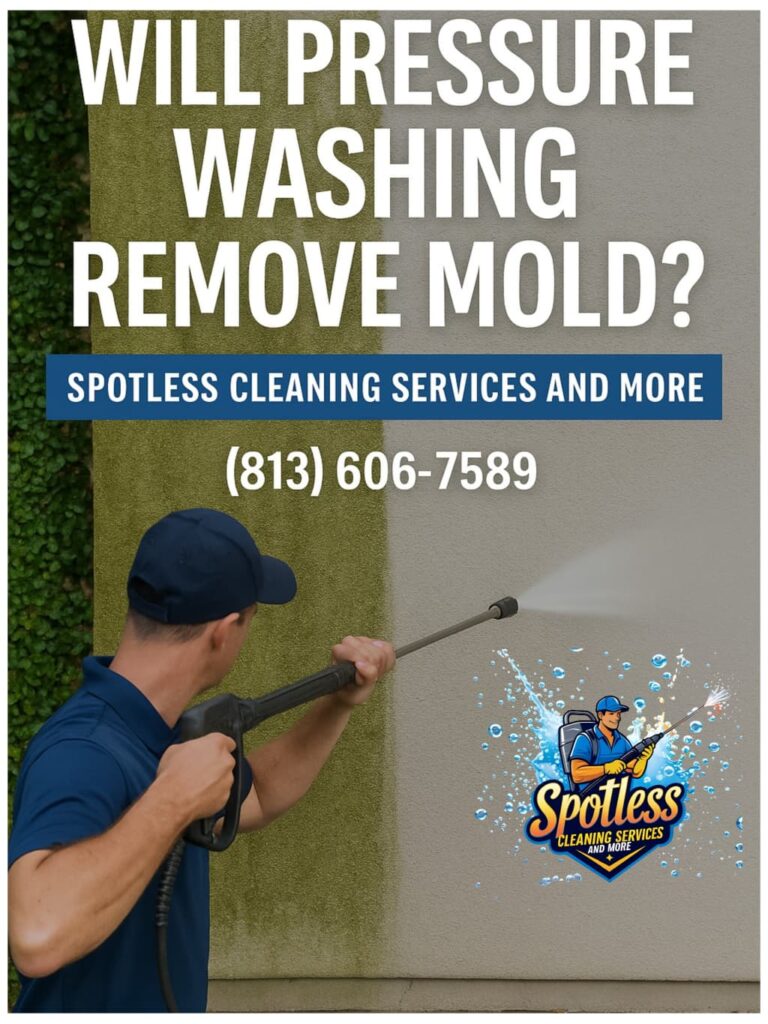
Will Pressure Washing Remove Mold?
Yes, professional exterior cleaning can remove visible mold-like growth, mildew, algae and organic buildup from many exterior surfaces—but high pressure alone is not always the right solution.
Concrete and other durable hard surfaces may be cleaned with controlled pressure washing, while roofs, siding, stucco and painted surfaces often require lower-pressure cleaning methods.
At Spotless Cleaning Services and More, we use pressure washing, soft washing and surface-specific cleaning methods for homes, businesses, HOAs and commercial properties throughout Sarasota County, Manatee County and surrounding Southwest Florida communities.
Quick Answer: Can Pressure Washing Get Rid of Mold?
It can remove visible growth from appropriate exterior surfaces, but the cleaning method matters. Simply increasing pressure can damage concrete, siding, wood, roofing and coatings. Professional cleaning typically considers the surface material, type of growth, moisture conditions and whether pressure washing, soft washing or another treatment is more appropriate.
Why Mold, Mildew and Algae Appear on Florida Properties
Florida exterior surfaces regularly experience heat, humidity, rainfall, irrigation and dense vegetation. Areas that remain damp or shaded can develop visible biological growth and staining faster than dry, sunny areas.
Common places where homeowners notice dark or green buildup include:
- House siding
- Stucco walls
- Concrete driveways
- Sidewalks
- Pool decks
- Pavers
- Fences
- Roofs
- Retaining and landscaping walls
- Commercial walkways and common areas
Not every dark exterior stain is technically mold. Algae, mildew, dirt, environmental residue and other biological growth can look similar from a distance. The important part for exterior cleaning is evaluating the actual material and choosing an appropriate treatment.
Will Pressure Washing Remove Mold From Concrete?
Concrete is one of the surfaces where controlled pressure washing can be particularly useful.
Driveways, walkways, curbs and patios may develop dark organic buildup in shaded or damp areas. Professional concrete cleaning may use a combination of pretreatment, appropriate dwell time, controlled pressure, professional surface-cleaning equipment and rinsing.
The goal should not be to use as much pressure as possible. Excessive pressure can leave wand marks or etch certain concrete surfaces.
For larger hard-surface projects, see our
professional concrete cleaning services
.
If the affected area is your driveway, visit our
driveway cleaning service
.
Pressure Washing vs. Soft Washing for Organic Growth
One of the most important distinctions in exterior cleaning is that not every surface should be pressure washed the same way.
Pressure Washing
Uses greater mechanical force from moving water. It is commonly appropriate for many durable hard surfaces such as concrete, sidewalks and other compatible flatwork.
Soft Washing
Uses much lower pressure along with appropriate cleaning solutions, dwell time and controlled rinsing. This approach is commonly considered for siding, stucco, roofs and other exterior surfaces where aggressive pressure may be inappropriate.
For general exterior-cleaning options, visit our
professional pressure washing services
.
How Professional Exterior Mold and Organic Growth Cleaning Works
A professional cleaning process should be based on the surface rather than a single preset pressure or chemical mixture.
Inspect the Surface
We consider the material, age, condition, coatings and type of buildup before deciding how the area should be cleaned.
Prepare the Surrounding Property
Landscaping, windows, doors, fixtures and surrounding materials are considered before the cleaning process begins.
Apply the Appropriate Treatment
Depending on the material and type of buildup, an appropriate cleaning solution may be applied to help loosen organic contamination.
Allow Appropriate Dwell Time
Cleaning agents often need time to work before rinsing. The appropriate dwell time depends on the product, surface, weather and contamination.
Rinse and Evaluate
The surface is rinsed using a method appropriate for the material, then evaluated to determine whether additional treatment is needed.
Will Pressure Washing Remove Mold From House Siding?
Exterior siding deserves more caution than a concrete driveway.
High-pressure washing can damage certain siding materials, coatings or finishes and may force water behind exterior cladding if used incorrectly.
Manufacturer recommendations matter. For example, James Hardie advises using a low-pressure garden hose and gentle cleaning methods for its siding rather than high-pressure power washing.
For siding, stucco and other exterior walls, see our
professional house washing service
.
Will Pressure Washing Remove Mold From a Roof?
A roof should not automatically be treated like a driveway.
What appears to be “mold” on a roof may actually be algae, mildew, moss or another type of biological growth. Roofing-material guidance should be considered before cleaning.
GAF advises against high-pressure rinsing on certain shingle-cleaning applications because aggressive pressure can damage the shingle surface. Lower-pressure cleaning methods are generally more appropriate for many roofing systems.
Learn more about our
professional roof cleaning services
.
Will Pressure Washing Remove Mold From a Pool Deck?
Pool decks can develop algae and other organic buildup because they are frequently exposed to water, humidity, shade and foot traffic.
The appropriate cleaning method depends on the deck material. Concrete, pavers, coatings and decorative finishes can all have different requirements.
For these areas, see our
pool deck cleaning services
.
Does Pressure Washing Kill Mold Spores?
This question needs a more careful answer than the old version of this article provided.
Pressure washing primarily provides mechanical cleaning. Depending on the surface and treatment being used, professional exterior cleaning may also involve cleaning agents intended to address biological buildup.
However, we would not promise that exterior pressure washing “eliminates every mold spore.” Mold spores are naturally present throughout the environment, and future growth can occur again when moisture and suitable conditions return.
The EPA emphasizes that moisture control is the key to mold control. Exterior cleaning can remove visible surface growth, but it does not repair leaks, drainage problems or other underlying moisture sources.
Can Mold or Algae Grow Back After Cleaning?
Yes.
Exterior cleaning does not permanently prevent future organic growth.
How quickly buildup returns can depend on:
- Shade
- Humidity
- Rainfall
- Irrigation
- Drainage
- Tree coverage
- Surface material
- Roof or wall orientation
- Coastal exposure
A shaded wall that remains damp may need attention sooner than a sunny, well-drained surface.
How Often Should Exterior Mold and Organic Growth Be Cleaned?
There is no universal rule saying that every Florida property must be cleaned every six months or once per year.
Cleaning frequency should be based on the actual condition of the property.
Some areas may remain clean for a long period, while shaded surfaces, irrigation zones or locations surrounded by vegetation may show buildup sooner.
Rather than following an arbitrary schedule, periodically inspect the property and clean surfaces when organic buildup becomes noticeable.
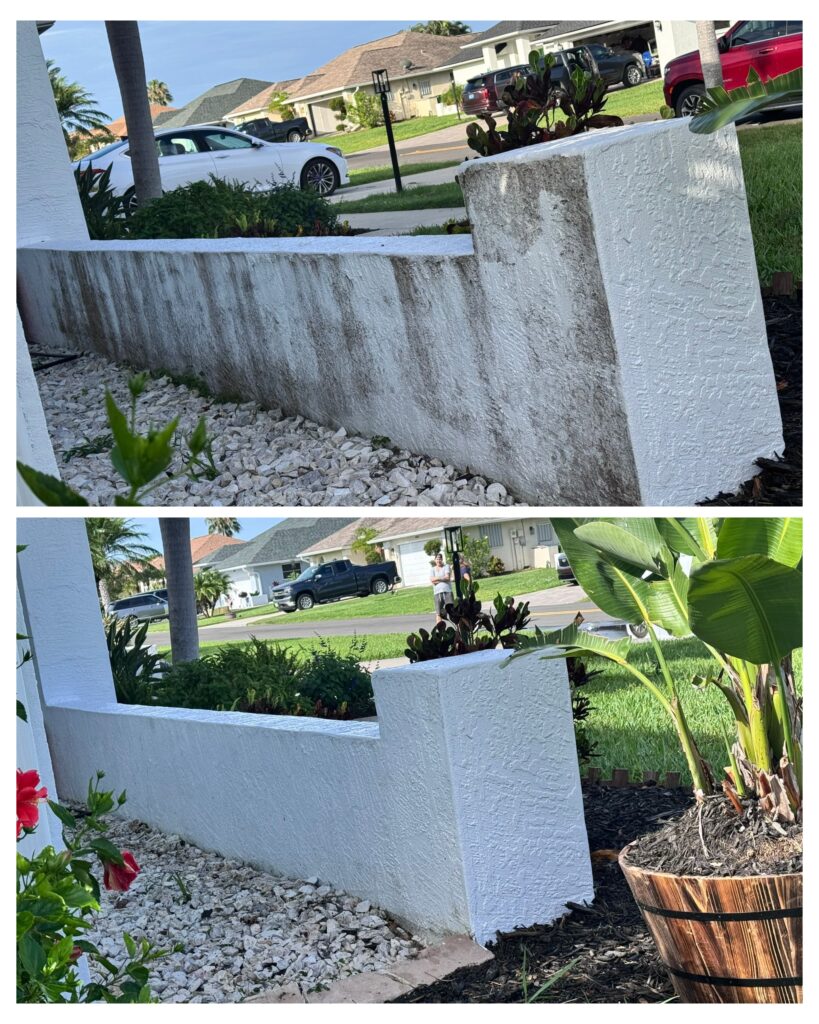
Why Choose Spotless Cleaning Services and More?
Licensed & Insured
Work with a professional local exterior-cleaning company serving residential and commercial properties.
Surface-Specific Cleaning
We choose pressure washing, low-pressure cleaning and other treatment methods based on the material and condition.
Residential & Commercial
From driveways and homes to commercial properties, HOA common areas and scheduled exterior maintenance.
Local Service
Serving communities throughout Sarasota County, Manatee County and surrounding Southwest Florida areas.
Frequently Asked Questions
Will pressure washing remove mold?
Pressure washing can remove visible organic buildup from appropriate hard exterior surfaces. Other surfaces may require low-pressure cleaning or soft washing instead.
Does pressure washing remove mold permanently?
No exterior cleaning method can guarantee that biological growth will never return. Future growth depends heavily on moisture, shade, rainfall, irrigation and other environmental conditions.
Does pressure washing kill mold spores?
Pressure washing primarily provides mechanical cleaning. Professional exterior-cleaning processes may also use cleaning solutions appropriate for organic growth, but it is not realistic to promise elimination of every environmental mold spore.
Is pressure washing safe for roofs?
Aggressive pressure washing is inappropriate for many roofing materials. Roof-cleaning methods should follow the roofing material’s condition and applicable manufacturer guidance.
Is pressure washing safe for siding?
It depends on the material. Some siding manufacturers recommend low-pressure cleaning instead of high-pressure power washing. The surface and manufacturer guidance should be evaluated first.
Can you remove mold-like buildup from concrete?
Yes. Concrete cleaning can remove many types of visible organic buildup and staining. The cleaning method depends on the age, condition and type of concrete.
Can mold or algae return after pressure washing?
Yes. Exterior surfaces remain exposed to moisture and environmental conditions after cleaning, so biological buildup can eventually return.
How often should a Florida home be cleaned?
There is no universal schedule. Cleaning frequency depends on shade, moisture, tree coverage, irrigation, material and how quickly visible buildup develops.
Do you provide mold and algae exterior cleaning in Sarasota and Manatee County?
Spotless Cleaning Services and More provides professional exterior cleaning throughout Sarasota County, Manatee County and surrounding Southwest Florida communities.
Learn More About Mold, Moisture and Exterior Cleaning
These authoritative resources provide additional information about mold cleanup and cleaning exterior building materials:

No Comments