
GUEST ARTICLE
Clean, Replace or Rescreen? What Your Pool Cage Is Telling You
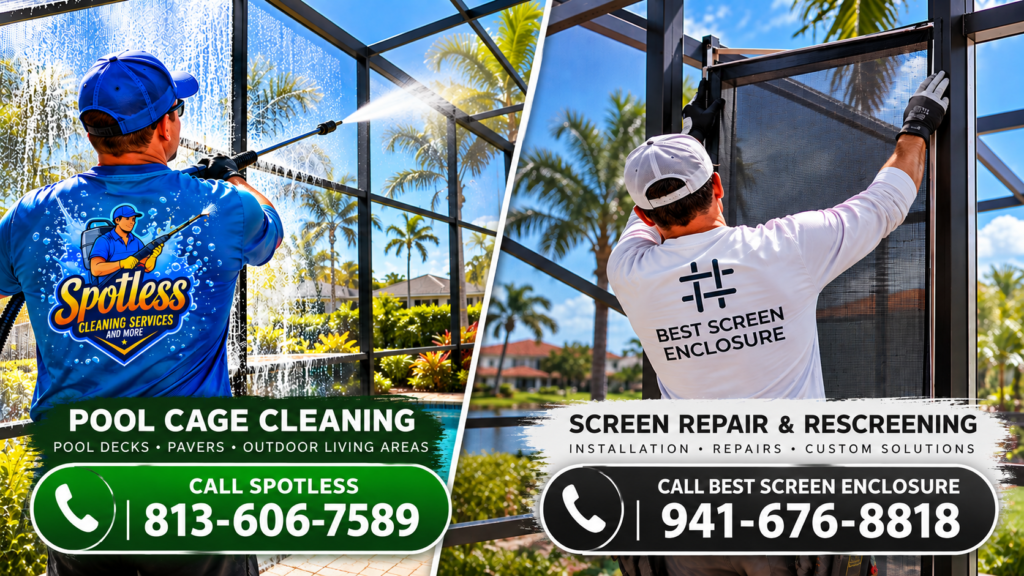
Prepared for Spotless Cleaning Services and More by Best Screen Enclosure, Southwest Florida pool cage installation and rescreening
A freshly cleaned pool cage is the best look you will ever get at its condition.
Dirt, pollen and algae build up so gradually that they hide a lot. A green film can disguise a brittle panel. Grime along the bottom rail can cover a tear that has been growing for months. Rust streaks blend into years of staining. Once all of that is rinsed away, the enclosure tells you exactly what shape it is in, if you know what to look for.
We install, rescreen and repair pool cages across Southwest Florida, so we see the other side of cleaning: the enclosures where buildup was hiding a problem. Here is how to read your cage once it is clean, and what each sign means for your wallet.
The Best Time to Inspect Is Right After a Cleaning
Inspecting a dirty cage is mostly guesswork. You cannot tell discoloration from damage, and small tears disappear into the haze. A clean cage removes the guesswork, so the day it is cleaned is the day to walk around it slowly with a critical eye.
If your enclosure is overdue, Spotless Cleaning Services and More cleans pool cages, screens, pool decks and pavers across Bradenton, Sarasota, Lakewood Ranch and the surrounding area. The family-owned company is a Gold Award Winner for Exterior Cleaning in Bradenton’s Best People’s Choice Magazine and can be reached at 813-606-7589.
Five Things to Look For
1. Small tears and pinholes
Check the lower panels first. They take the most abuse from pets, patio furniture, pool toys and landscaping crews. Look closely around doors too, where hands and hinges wear on the screen. A small tear does not stay small: wind works at the edges, and every storm makes it bigger.
2. Spline pulling out of its channel
Spline is the rubber cord pressed into a groove in the frame that holds each screen panel in place. Florida sun hardens and shrinks it over the years. When it starts to lift out of the channel, the panel loosens with it, and eventually the screen pops free in a strong gust.
3. Sagging or bellying panels
A healthy panel is taut. A loose one flaps in the wind and rubs against the frame, which wears through the mesh along the edge. If several panels on the same wall are sagging, that usually points to aging spline or aging screen across the whole wall rather than a single bad panel.
4. Brittle, chalky or faded screen
Press gently on a panel with a fingertip. Good screen gives and springs back. Screen that crackles, feels stiff, or leaves a chalky residue on your finger has been broken down by UV. This is the one sign cleaning cannot fix, and it rarely affects just one panel: every panel on the cage went up on the same day and has had the same sun since.
5. Frame and fastener trouble
Look for rust streaks running down from screws, white powdery corrosion on the aluminum, loose or missing fasteners, bent members, and gaps where the cage meets the house or the slab. Coastal properties deserve extra attention here, because salt air is hard on fasteners even when the aluminum itself is sound.
Cleaning makes a cage look better. It cannot make a brittle screen strong again, and it cannot straighten a bent beam.
A Few Panels, a Full Rescreen, or the Frame?
What you find on that walk-around usually points to one of three jobs.
A few damaged panels on otherwise healthy screen. Replace just those panels. A torn panel is replaced, not patched, so the new screen matches the tension of its neighbors. With us, a single panel starts at $150 and the work is usually done within a day or two.
Brittle or failing screen across the cage. This is the case for a full rescreen. Screen in Florida typically lasts somewhere between 10 and 20 years depending on sun, shade, salt and care. Once it is brittle everywhere, replacing panels one at a time ends up costing more than doing the whole cage once. A full rescreen on a sound frame does not require a permit.
Damage to the aluminum structure. It depends on how much. Replacing a beam or a few posts is a repair. Once more than half of the structure is being replaced, the job becomes permitted work. That line matters most after a storm, when a job that looked like a repair can grow past it once the damage is fully opened up. It is worth asking about before you sign anything.
Choosing Screen When It Is Time to Rescreen
A rescreen is the moment to rethink what is on your cage, not just put back the same thing. The main options:
18/14 Standard: the traditional choice. Good insect protection, plenty of airflow, economical.
20/20 No-See-Um: a tighter weave that keeps out no-see-ums, gnats and sand flies. Popular near water and wetlands.
16/14 and 17/20 PVC-coated polyester: considerably stronger than fiberglass, for cages that take a beating. The 17/20 adds the finer no-see-um weave.
Privacy screen: a denser weave for homes with close neighbors.
Pet screen: heavy-duty mesh for the lower panels where dogs and cats push and scratch.
Many homeowners mix them: pet screen on the bottom panels, no-see-um everywhere else. You can compare them side by side on our screen types guide.
Cleaning Habits That Shorten Screen Life
The way a cage is cleaned affects how long the screen lasts. The habits we see cost homeowners the most:
Too much pressure straight into the mesh. It stretches the screen and can pull the spline. Aging fiberglass can tear under a stream it would have shrugged off when it was new.
Stiff or wire brushes. They abrade the coating on the mesh and the finish on the aluminum.
Cleaning solution left behind. Residue holds pollen and dirt, so the cage gets dirty again quickly, and it tempts people to clean harder next time.
Sprinklers aimed at the cage. Mineral deposits build up on the screen and the frame. Turn the heads, and the staining stops coming back.
This is where a cleaning company that understands enclosures earns its fee. The right approach is the gentlest method that gets the job done, matched to each surface: screen, painted aluminum, concrete and pavers all need something different. For additional care tips, Best Screen Enclosure also explains how to maintain a pool cage and pool deck in Florida.
After a Storm
After a named storm, check from the ground first. Look for torn or missing roof panels, bent or twisted members, and debris resting on the roof screen. Do not climb onto the roof of the cage, and do not try to re-tension or straighten a bent frame yourself; a damaged member can fail suddenly. Photograph what you see for your insurance company, then have the enclosure evaluated before deciding what it needs.
Who to Call
For cleaning
When the cage, screens, deck or pavers need professional cleaning, Spotless Cleaning Services and More can help at 813-606-7589.
For screens and structure
When panels are torn, spline is failing, the screen has gone brittle or the frame is damaged, Best Screen Enclosure can help at (941) 676-8818.
Knowing which of those two calls you need is most of the battle. Keep the cage clean, look at it closely while it is clean, and deal with small problems while they are still small. A well-kept pool cage will serve your home for a long time.
About Best Screen Enclosure
Best Screen Enclosure is a licensed contractor that installs, rescreens and repairs pool cages, lanai enclosures and screened porches across Southwest Florida, with locations in Sarasota, Venice and Punta Gorda. Estimates are free: we measure on site, then send you a written estimate. Call (941) 676-8818 or schedule an estimate online.

No Comments