SOFT WASHING GUIDE • SARASOTA & MANATEE COUNTIES
How Does Soft Washing Work? A Complete Homeowner Guide
How does soft washing work? Instead of relying primarily on high mechanical water pressure, soft washing uses an appropriate cleaning solution, controlled application, dwell time, and low-pressure rinsing or weather-assisted removal to clean exterior surfaces.
The process is especially useful when algae, mildew, organic staining, and exterior buildup need to be removed from surfaces that should not be aggressively blasted with a pressure washer.
At Spotless Cleaning Services and More, we provide residential and commercial soft washing throughout Sarasota and Manatee Counties for house exteriors, appropriate roofing systems, mobile homes, commercial buildings, and other compatible surfaces.
Quick Answer: How Does Soft Washing Work?
Soft washing works by applying an appropriate exterior-cleaning solution at relatively low mechanical pressure, allowing the solution time to interact with algae and organic contamination, and then completing the cleaning process with a gentle rinse or another surface-appropriate method. The key difference is that cleaning chemistry performs much more of the work than brute-force water pressure.
How Soft Washing Works
3. What Does the Cleaning Solution Do?
4. How Much Pressure Does Soft Washing Use?
5. What Surfaces Can Be Soft Washed?
6. How Roof Soft Washing Works
7. Plant & Property Protection
8. Soft Washing vs Pressure Washing
THE BASIC IDEA
What Is Soft Washing?
Soft washing is an exterior-cleaning method that relies heavily on cleaning chemistry while using substantially less mechanical cleaning force than conventional high-pressure washing.
Instead of trying to physically blast every contaminant from the surface, the cleaning solution is selected to interact with the type of buildup being treated.
This is particularly useful for organic contamination such as algae and mildew.
Lower Mechanical Force
The cleaning process does not depend on aggressively blasting the surface.
Cleaning Chemistry
Appropriate cleaning solutions perform much of the work on organic staining and exterior buildup.
Surface-Specific Application
The exact method should be adjusted according to material, condition, staining, weather, and surrounding property.
For a broader definition, see our separate guide:
What Is Soft Washing?
STEP BY STEP
How Does Soft Washing Work? Our Basic Process
1
Inspect the Surface
We identify the material, condition, organic growth, paint or coating condition, cracks, oxidation, previous repairs, nearby plants, and other factors that affect the cleaning plan.
2
Prepare Surrounding Property
Landscaping, windows, doors, electrical components, outdoor furniture, vehicles, pools, painted surfaces, gutters, and drainage paths are considered before cleaning begins.
3
Apply the Cleaning Solution
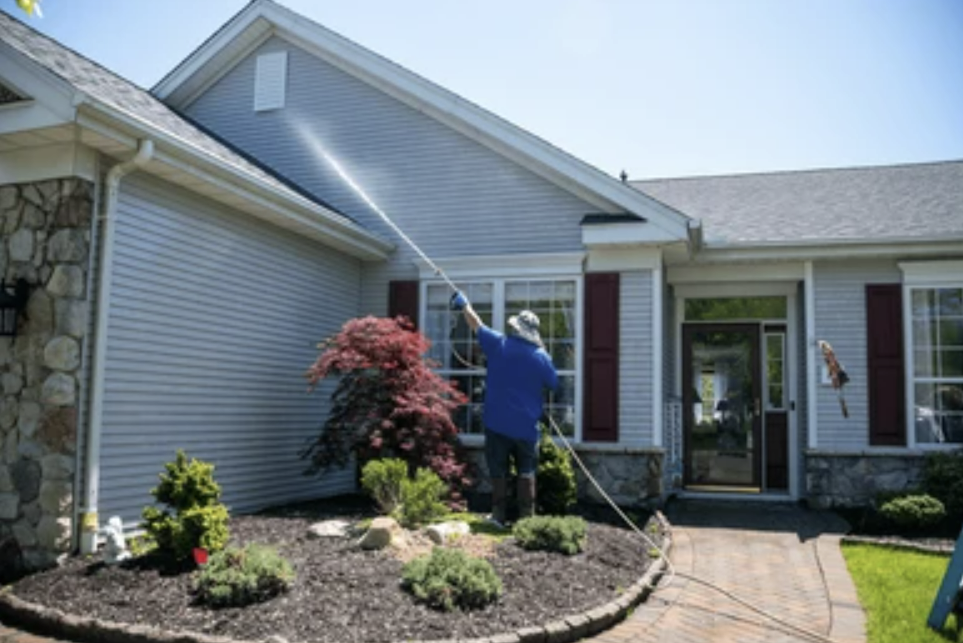
An appropriate exterior-cleaning solution is applied using relatively low mechanical pressure compared with conventional power washing.
4
Allow Appropriate Dwell Time
The cleaner is given time to interact with organic buildup instead of immediately increasing pressure when a stain does not disappear instantly.
5
Rinse or Complete the Surface-Specific Process
Depending on the material and procedure, the surface may be gently rinsed or allowed to complete the cleaning process according to the appropriate method and product instructions.
6
Rinse and Recheck Surrounding Areas
Nearby vegetation and property are inspected and rinsed as appropriate before the project is considered complete.
ALGAE OR DARK STREAKS ON YOUR PROPERTY?
Find Out Whether Soft Washing Is the Right Solution
Send us a photo of the roof, siding, stucco, mobile home, or exterior surface and we’ll help determine the appropriate cleaning process.
WHY CHEMISTRY MATTERS
What Does the Soft-Washing Solution Actually Do?
The cleaning solution is one of the biggest differences between soft washing and conventional pressure washing.
For certain exterior cleaning applications, sodium-hypochlorite-based solutions may be used along with water and appropriate surfactants.
The goal is to allow chemistry to address organic contamination so that excessive mechanical force is unnecessary.
There Is No One Universal Soft-Wash Mixture
Concentration, application method, dwell time, weather, surface material, contamination, landscaping, manufacturer instructions, and product labeling all matter. A mixture appropriate for one project should not automatically be used everywhere.
For more detail about sodium hypochlorite and exterior cleaning, read:
Why Use Sodium Hypochlorite When Exterior Cleaning?
LOW PRESSURE DOES NOT MEAN ONE NUMBER
How Much Pressure Does Soft Washing Use?
You will sometimes see soft washing defined by a single PSI number, but that can be misleading.
The actual mechanical force reaching a surface depends on pump configuration, nozzle, hose, elevation, flow, working distance, spray pattern, and application method.
The more useful distinction is that soft washing relies on far less mechanical cleaning force than conventional high-pressure washing.
Soft Washing Is a Process, Not Merely a PSI Number
A technician still has to understand the surface, cleaning solution, equipment, application method, runoff, dwell time, and surrounding property.
What Surfaces Can Be Soft Washed?
House Exteriors
Many vinyl, stucco, painted, and other exterior wall systems can benefit from a lower-pressure cleaning approach after inspection.
Asphalt Roofing
High-pressure power washing should not be used on asphalt shingles; appropriate gentle chemical cleaning is recommended by roofing-industry guidance.
Mobile Homes
Exterior panels, trim, skirting, windows, seals, and other components benefit from avoiding unnecessary force.
Commercial Building Exteriors
Low-pressure exterior washing can be useful for storefront walls, offices, HOA buildings, and other compatible materials.
Painted Surfaces
Paint condition must be inspected first because chalking, peeling, poor adhesion, and age can change the cleaning approach.
Fences & Other Exterior Features
Surface material and condition determine whether soft washing, controlled pressure, or another method is appropriate.
Explore our
house washing
and
mobile-home soft washing
services.
ROOF CLEANING
How Does Soft Washing Work on a Roof?
Asphalt roofing is one of the strongest examples of why exterior cleaning should not rely on maximum pressure.
The Asphalt Roofing Manufacturers Association identifies algae discoloration as a common issue—particularly in warm, humid regions—and says a sodium-hypochlorite-and-water solution may be used according to shingle-manufacturer instructions.
ARMA also specifically warns against using a power washer on asphalt roofing because high-pressure washing can damage the roof surface.
Roof Cleaning Should Follow Roofing Guidance
ARMA says the solution should be gently applied and the roof gently rinsed, and also recommends trained professionals because working on a roof is hazardous.
Read ARMA’s June 2024 Algae Discoloration of Roofs bulletin
.
Learn about our
professional roof-cleaning services
.
THE REST OF YOUR PROPERTY MATTERS
How Professional Soft Washing Protects Plants and Surrounding Property
Soft washing is not just about what gets sprayed on the house or roof. The surrounding property needs to be considered too.
Pre-Wetting
Vegetation and nearby areas may be watered before application when appropriate for the job.
Application Control
Technicians consider wind, overspray, downspouts, gutters, roof edges, neighboring surfaces, and runoff paths.
Rinsing
Water can be used before, during, and after cleaning to reduce exposure around sensitive areas where appropriate.
No responsible contractor should claim that chemical exterior cleaning carries absolutely zero risk to landscaping. The goal is to manage exposure through preparation, controlled application, monitoring, dilution, and rinsing.
Are Soft-Washing Detergents EPA Safer Choice Approved?
Not automatically.
EPA’s Safer Choice program certifies specific finished products that meet its requirements. Simply containing a biodegradable ingredient or a chemical found on an EPA ingredients list does not make an entire cleaning mixture Safer Choice certified.
EPA currently maintains a searchable database containing thousands of product listings that meet the Safer Choice Standard.
Search EPA Safer Choice-certified products
.
Why This Distinction Matters
A cleaning company should only advertise a particular product as carrying the EPA Safer Choice label when that exact product has actually qualified for the program.
Soft Washing vs Pressure Washing: What’s the Difference?
| Feature | Soft Washing | Pressure Washing |
|---|---|---|
| Main Cleaning Action | Cleaning chemistry + low mechanical pressure | Controlled mechanical water force |
| Common Use | House exteriors, roofs and appropriate sensitive materials | Compatible concrete and durable flatwork |
| Mechanical Force | Relatively low | Higher when the material can safely tolerate it |
| Chemistry | Central to the process | May supplement mechanical cleaning |
| Best Method? | Depends on the material and contamination | Depends on the material and contamination |
For the full comparison, see:
Pressure Washing vs Soft Washing: What’s the Difference?
Why Use Soft Washing Instead of Simply Turning Down a Pressure Washer?
Soft washing is more than holding a pressure-washer wand farther away from the house.
It is a cleaning system built around surface evaluation, chemistry, application, dwell time, lower mechanical force, and property protection.
The CDC describes conventional pressure washers as power tools and warns that high-pressure spray can cause serious wounds, flying-object injuries, and electrical shock when improperly used.
MAINTENANCE
How Often Should You Soft Wash Your Home?
There is no universal rule saying every Florida home should be soft washed every 12 months or every 24 months.
Cleaning frequency varies according to shade, tree coverage, humidity, rainfall, roof or siding material, property orientation, irrigation, nearby vegetation, and how quickly visible organic growth returns.
Heavy Shade
Surfaces that dry slowly may show algae or organic discoloration sooner.
Trees & Vegetation
Nearby vegetation can affect shade, debris, pollen, and moisture conditions.
Visible Growth
Actual surface condition is often more useful than cleaning solely according to a calendar.
Why Choose Spotless Cleaning Services and More?
Residential & Commercial
We provide exterior cleaning for homes, businesses, HOAs, commercial buildings, and other properties.
Soft Washing & Pressure Washing
We do not force one cleaning method onto every material.
Surface-Specific Cleaning
The process is selected according to surface type, condition, staining, and property surroundings.
Plant Protection
Landscaping and nearby exterior materials are part of our planning process.
Fully Insured
Professional insurance coverage is another important consideration when hiring an exterior-cleaning contractor.
Local Florida Experience
We routinely deal with algae, humidity, irrigation staining, roof discoloration, and other Southwest Florida conditions.
Professional Soft Washing in Sarasota & Manatee Counties
Spotless Cleaning Services and More provides residential and commercial soft washing throughout Sarasota, Bradenton, Lakewood Ranch, Palmetto, Parrish, Ellenton, Venice, Siesta Key, and surrounding Southwest Florida communities.
Explore our
Sarasota County service area
and
Manatee County service area
.
FREQUENTLY ASKED QUESTIONS
How Does Soft Washing Work? FAQ
How does soft washing work?
Soft washing works by applying an appropriate cleaning solution using relatively low mechanical pressure, allowing the solution time to interact with organic buildup, and then completing the cleaning process using a gentle surface-appropriate method.
What chemicals are used for soft washing?
Some exterior soft-washing applications use sodium-hypochlorite-based cleaning solutions along with water and appropriate surfactants. The correct formulation depends on the surface, contamination, product instructions, and site conditions.
Does soft washing use high pressure?
No. Soft washing relies on substantially less mechanical cleaning force than conventional high-pressure washing and uses cleaning chemistry to perform much more of the work.
Is soft washing safe for asphalt shingles?
Asphalt Roofing Manufacturers Association guidance warns against high-pressure power washing and describes a gentle chemical-cleaning and rinsing process. Always follow the roofing manufacturer’s requirements.
Is soft washing safe for plants?
Exterior cleaning chemicals can affect vegetation if improperly handled. Professional property protection may include pre-wetting, controlled application, runoff monitoring, dilution, and thorough rinsing.
Does soft washing prevent algae from coming back?
Soft washing can remove or treat existing organic contamination, but no legitimate cleaning process can guarantee algae will never return. Regrowth depends on moisture, shade, climate, surface conditions, and other environmental factors.
How often should a Florida home be soft washed?
There is no universal schedule. Cleaning frequency depends on humidity, shade, tree coverage, property orientation, material, rainfall, irrigation, and how quickly visible buildup returns.
How do I get a free soft-washing estimate?
Call or text Spotless Cleaning Services and More at
(813) 606-7589
or
request a free estimate online
.
SPOTLESS CLEANING SERVICES AND MORE
See What Professional Soft Washing Can Do for Your Property
Get a free residential or commercial soft-washing estimate in Sarasota, Bradenton, Lakewood Ranch, Palmetto, Parrish, Ellenton, Venice, Siesta Key, and surrounding communities.

No Comments