“`html
Picking the Right Pressure Washer: PSI vs. GPM Explained
When people shop for a pressure washer, PSI usually gets all the attention. But professional exterior cleaning is not simply a contest to see who can produce the highest pressure. Gallons per minute, or GPM, can be just as important—and for productivity, rinsing ability and cleaning large areas efficiently, it can often matter even more.
At Spotless Cleaning Services and More, we use commercial-grade exterior cleaning equipment and select the cleaning method according to the surface, contamination and property—not according to whichever machine produces the biggest PSI number.
✓ Licensed & Insured
✓ Residential & Commercial
✓ Commercial-Grade Equipment
You Are Paying for More Than Pressure
faster in many real-world jobs than working with typical residential-grade pressure-washing equipment, based on our experience.
Why? Commercial equipment can provide substantially greater water flow, support professional surface cleaners, improve rinsing speed and reduce the amount of time spent repeatedly passing over the same area.
Actual project time and speed vary by surface size, condition, stains, access, water supply, treatment requirements and other job-specific factors.
PSI Is Only Half of the Pressure-Washing Equation
Walk through the pressure-washer section of a home-improvement store and the largest number printed on the box is usually PSI. A machine advertised at 3,000 PSI can look automatically superior to one advertised at 2,500 PSI. That marketing makes it easy to assume that more pressure means more cleaning power, faster cleaning and better results.
The reality is considerably more complicated. PSI tells you how much pressure the equipment can produce. It does not tell you how quickly that machine can move dirty water, cleaning solution, loosened algae, sand, soil and other contaminants away from a surface. For that, you need to understand GPM—gallons per minute.
A professional exterior-cleaning setup is designed around the relationship between pressure, water volume, nozzle selection, cleaning chemistry, equipment size, surface type and operator technique. Increasing only one of those variables does not automatically improve the finished result.
That distinction matters whether you are cleaning a concrete driveway, paver patio, sidewalk, commercial walkway, pool deck, home exterior or another outdoor surface. It also explains why a professional crew using commercial equipment may finish a project dramatically faster than a homeowner using a small residential pressure washer—even when the PSI numbers printed on the machines do not appear dramatically different.
This guide explains what PSI and GPM really mean, why higher PSI is not always better, how excessive pressure can damage property, why professional equipment improves productivity, and when hiring an experienced, licensed and insured exterior-cleaning company may make more sense than spending an entire day attempting the project yourself.
What You’ll Learn
2. What GPM Actually Means
3. PSI vs. GPM
4. Understanding Cleaning Output
5. Why Commercial Equipment Is Faster
6. The Risks of Too Much PSI
7. Matching the Method to the Surface
8. DIY vs. Professional Cleaning
9. How Professionals Approach a Job
10. Florida Exterior Cleaning
11. Related Cleaning Services
12. Frequently Asked Questions
What Is PSI on a Pressure Washer?
PSI stands for pounds per square inch. In practical terms, it describes the pressure or force at which water is delivered. PSI matters because different cleaning tasks require different amounts of mechanical force. A stubborn deposit on durable concrete can tolerate a very different cleaning approach than painted siding, wood, stucco, roofing or a delicate exterior finish.
The important point is that PSI should be treated as a tool—not as the goal. The objective of exterior cleaning is to remove contamination efficiently while preserving the material being cleaned. Once enough pressure is available to perform the appropriate task, continuing to increase pressure can produce diminishing returns while increasing the chance of damage.
PSI Provides Force
Pressure helps break the bond between certain contaminants and durable surfaces. It is useful, but only when the surface and situation actually call for mechanical pressure.
More Is Not Always Better
Once sufficient pressure is available, additional PSI does not automatically make the project better or dramatically faster. It can simply make mistakes more destructive.
Technique Changes Everything
Nozzle angle, nozzle size, distance from the surface, dwell time, chemicals and operator movement all influence the effective pressure reaching the material.
Why Consumers Often Overvalue PSI
PSI is easy to advertise. A single large number creates a simple comparison between two machines. If one box says 2,000 PSI and another says 3,200 PSI, the second appears much more powerful. But cleaning a large driveway is not simply about producing a narrow, extremely forceful stream of water. You need enough flow to operate the appropriate equipment, rinse the surface and move contamination away.
Imagine trying to rinse mud from a large slab with an extremely forceful but tiny stream. It may cut through the mud where the stream touches, yet clearing the entire area can still take a long time. Increase the useful volume of water and you can move much more loosened material with every pass.
That is one reason professionals pay close attention to GPM instead of judging a machine by PSI alone.
What Is GPM on a Pressure Washer?
GPM stands for gallons per minute. It describes the volume of water a pressure washer moves during operation. If PSI describes how forcefully water hits the surface, GPM describes how much water is available to perform the work and carry loosened contamination away.
For large-area exterior cleaning, this matters enormously. Dirt does not simply need to be separated from concrete or pavers—it also needs to be moved. Cleaning solution needs to be applied or rinsed. Organic material needs to be flushed from the work area. A surface cleaner needs enough flow to operate efficiently. The cleaned area needs to be rinsed after mechanical cleaning.
Higher useful GPM can help with all of those tasks.
Lower-Flow Residential Equipment
- Moves less water per minute
- May require slower passes
- Can require more time for final rinsing
- May struggle to keep larger surface cleaners productive
- Can turn a large driveway into a lengthy weekend project
Higher-Flow Commercial Equipment
- Moves substantially more water across the work area
- Can improve rinsing and debris removal
- Supports professional equipment selected for higher production
- Can cover large exterior areas more efficiently
- Reduces reliance on simply increasing PSI
Why Water Volume Becomes So Important on Driveways
A driveway is an excellent example because it combines substantial square footage with dirt, algae, soil, vehicle residue, leaf debris and other contaminants. Cleaning a small test spot is easy. Cleaning hundreds or thousands of square feet evenly is the real challenge.
Once contamination has been loosened, it must go somewhere. Higher water volume helps move suspended soil and debris toward the appropriate drainage area. It can also reduce the time spent repeatedly chasing dirty water across a slab.
This is why professional productivity cannot be judged by pressure alone.
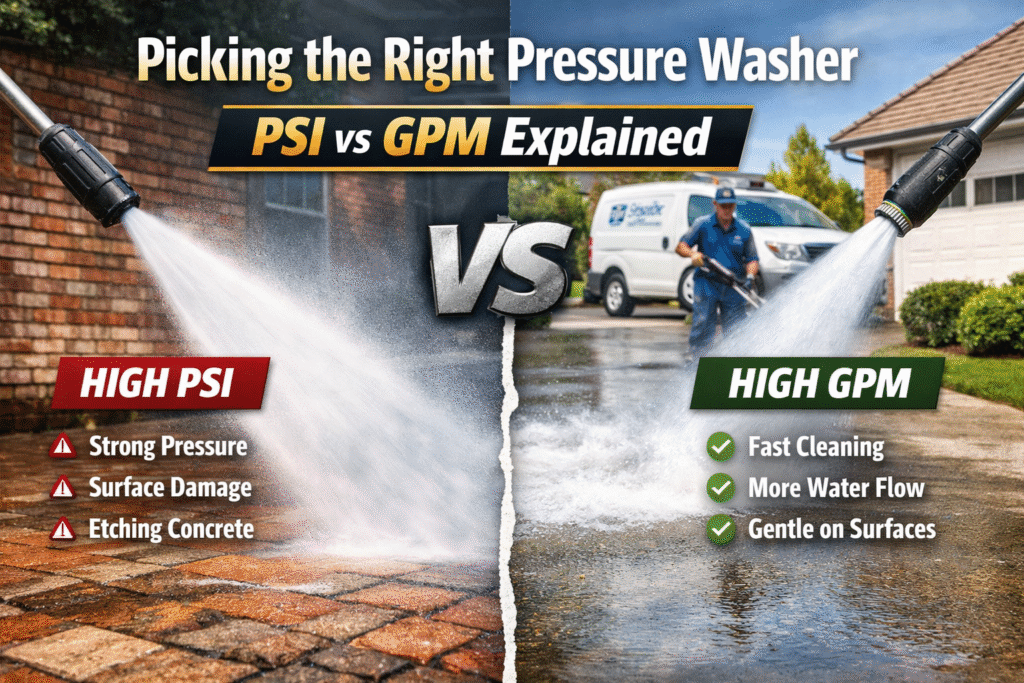
PSI vs. GPM: Which Matters More?
Neither number should be considered in isolation. A pressure washer needs enough pressure for the intended application and enough water flow to perform that application efficiently. The balance changes depending on what is being cleaned.
| Factor | PSI | GPM |
|---|---|---|
| Meaning | Pounds per square inch | Gallons per minute |
| Primary Role | Water pressure / mechanical force | Water volume / flow |
| Helps With | Breaking certain contamination loose | Rinsing, flushing and moving contamination |
| Too Much Can Cause | Surface damage, etching, stripping and water intrusion | Higher water demand and additional runoff-management considerations |
| Large-Area Productivity | Important up to the pressure actually needed | Often a major factor in cleaning and rinsing speed |
| Professional Approach | Use only the pressure appropriate for the surface | Use productive flow while managing water responsibly |
A Simple Example
Consider two hypothetical pressure washers. Machine A produces very high pressure but relatively modest flow. Machine B produces somewhat lower maximum pressure but significantly greater water volume.
If both machines already produce enough pressure for the cleaning task, Machine B may be more productive across a large driveway because it can move more water, rinse more quickly and support equipment designed to cover a wider area efficiently. Machine A’s extra PSI may provide little benefit once the required pressure threshold has already been reached.
This is the key concept homeowners often miss: after you have enough pressure, more pressure is not automatically the answer.
Why Professionals Look at the Whole Cleaning System
You may sometimes see pressure-washer performance discussed using a simple PSI × GPM calculation. Multiplying the two figures can provide a rough comparison of machine output, but professional exterior cleaning involves far more than one mathematical number.
A machine’s specifications do not tell you whether the operator knows how to protect a painted surface, treat organic growth, avoid etching concrete, select the correct nozzle, control overspray, manage runoff, work around landscaping or recognize when pressure should not be used at all.
The professional advantage comes from combining all of those variables correctly. Sometimes that means using pressure. Sometimes it means reducing pressure dramatically and allowing a cleaning solution to do more of the work. Sometimes it means pretreating a driveway, using a professional surface cleaner, rinsing thoroughly and applying a post-treatment where appropriate.
The machine is only one component of the system.
Why Commercial-Grade Pressure-Washing Equipment Can Be So Much Faster
When homeowners compare DIY pressure washing with professional service, price is often the first consideration. But there is another cost that deserves attention: your time.
Renting or buying a small pressure washer may look inexpensive until you consider transportation, setup, hoses, cleaning chemicals, fuel, troubleshooting, the actual cleaning process, repeated passes, rinsing, cleanup and returning rental equipment. A project that looked like a quick Saturday-morning chore can consume a large part of the weekend.
Spotless Cleaning Services and More uses commercial-grade equipment intended for professional production. Based on our real-world experience, our equipment and workflow can allow us to complete many common cleaning projects roughly four to eight times faster than someone working with typical residential-grade pressure-washing equipment.
That is not a promise that every individual project will be exactly four or eight times faster. Property size, staining, access, surface condition, special stain removal, water availability and the services requested all affect project duration. The point is that professional equipment is designed for production, and the difference can be substantial.
1. More Water Can Mean Faster Rinsing
Rinsing is a major part of exterior cleaning. Higher-flow professional equipment can move dirty water and loosened material more efficiently than many small residential machines. That matters on long driveways, sidewalks, pool decks, patios and commercial flatwork.
2. Professional Surface Cleaners Cover More Area
Cleaning a driveway one narrow wand stripe at a time is inefficient and can leave obvious lines. Professional surface-cleaning equipment uses rotating spray assemblies inside a housing to clean a wider, more consistent path. Properly matched to the machine’s output and used by an experienced operator, a surface cleaner can dramatically improve production.
3. Pretreatment Reduces Unnecessary Mechanical Work
Trying to remove every contaminant with pressure alone is often inefficient. Professional cleaners identify what is causing the discoloration and select an appropriate treatment. Organic growth may respond to cleaning chemistry. Rust, oil and tannin staining can require specialized processes. Treating the cause can reduce unnecessary repeated pressure passes.
4. Experience Eliminates Trial and Error
A homeowner performing the job for the first time may spend time adjusting nozzles, figuring out hose placement, learning how fast to move, discovering which stains will not respond to water pressure and correcting uneven passes. Experienced professionals already have a process.
5. Commercial Equipment Is Built Around Workflow
Professional rigs can include longer hose runs, higher-flow machines, dedicated chemical systems, surface cleaners and accessories selected for repeated exterior-cleaning work. The objective is not to create the most aggressive pressure possible. The objective is to complete the job efficiently while maintaining control.
Before You Spend Hours Behind a Residential Pressure Washer, Get a Professional Estimate
See what it would cost to have Spotless Cleaning Services and More handle the cleaning with commercial-grade equipment and a surface-specific professional process.
The Biggest Mistake: Assuming More PSI Means Better Cleaning
One of the most dangerous misconceptions in DIY pressure washing is that stubborn dirt should always be attacked with more pressure. Increasing pressure can make a visible change quickly, but that does not mean the change is desirable.
A pressure washer does not know the difference between unwanted contamination and the material underneath it. If enough concentrated force is applied, water can remove or alter both.
Concrete Etching
A concentrated spray held too close can leave wand marks, lines or permanently altered areas in concrete. Fresh, weakened or already damaged concrete deserves particular caution.
Wood Damage
Excessive pressure can raise grain, gouge boards and create fuzzy or splintered areas that may require sanding or refinishing.
Paint & Coatings
High pressure can remove failing paint and may also damage coatings or finishes you intended to preserve.
Siding Problems
Aggressive spraying can damage vulnerable siding and can drive water into gaps, seams and areas that were not designed for direct high-pressure spray.
Window & Seal Damage
Windows, screens, seals and surrounding trim require care. Direct concentrated pressure can create avoidable problems.
Roof Damage
Roofing should not be treated like a driveway. High-pressure roof washing can damage roofing materials and is not our approach for surfaces requiring soft washing.
Pressure Is Not a Substitute for Chemistry
Organic growth, rust, oil, tannins and general soil are not all the same type of contamination. If a stain has a chemical cause, simply increasing mechanical force may do little except damage the underlying material.
This is why professional exterior cleaning frequently involves pretreatment, appropriate dwell time, controlled mechanical cleaning and rinsing rather than simply pointing the strongest available nozzle at the stain.
For specialty staining, see our professional rust removal services and oil stain removal services.
The Right Pressure Washer Setting Depends on What You Are Cleaning
There is no universal PSI setting that should be used on every exterior surface. The age, condition, material, coating, contamination and surrounding environment all matter. Instead of publishing a single pressure number and encouraging homeowners to treat it as a guarantee of safety, we prefer the more accurate approach: inspect the material and use the least aggressive effective method.
Concrete Driveways & Sidewalks
Concrete is durable, but it is not indestructible. Professional driveway cleaning combines appropriate pressure, flow, surface-cleaning equipment and treatments selected according to the condition of the slab.
Pavers
Pavers require attention to joint material, surface condition, staining and surrounding areas. The cleaning approach should account for the specific installation rather than treating every paver driveway like plain concrete.
House Exteriors
Stucco, siding, soffits, fascia, painted surfaces and trim often benefit from a lower-pressure washing method rather than aggressive direct pressure. Cleaning chemistry can perform much of the work.
Roofs
Roofing requires a completely different mindset from concrete. Spotless uses roof-appropriate soft-washing methods rather than treating shingles or tile like a driveway.
Why Driveway Cleaning Shows the Importance of GPM
A driveway makes the PSI-versus-GPM discussion easy to understand because the job involves both cleaning and moving a significant amount of dirty water across a large surface.
Suppose a driveway has accumulated dark organic growth, tire residue, soil and general weathering. The goal is not merely to carve a bright line through the buildup. The entire slab needs to be cleaned consistently. Edges need attention. The loosened material must be rinsed. Adjacent sidewalks may need cleaning. Dirty water must be moved toward an appropriate drainage area.
A small residential machine may technically produce enough PSI to make a clean mark in the concrete. But if it has limited GPM, the operator can still spend a great deal of time covering the slab and rinsing the resulting debris.
Commercial-grade equipment changes the production equation. Greater useful flow can allow a professional surface cleaner to operate efficiently, help flush loosened contaminants and make final rinsing faster.
That comparison is important when evaluating the true cost of DIY work. If a homeowner spends several hours cleaning what a properly equipped professional can address much more quickly, the difference is not simply the price of the service. It is also the value of those hours.
Want more information about professional driveway service? Visit our driveway cleaning page, our concrete cleaning services page, or read how much driveway pressure washing costs in Sarasota.
DIY Pressure Washing vs. Hiring a Professional
DIY pressure washing can make sense for small, low-risk maintenance projects when the homeowner understands the equipment and surface. But the decision becomes different as the project becomes larger, more contaminated, more delicate or more time-consuming.
| Consideration | DIY / Residential Equipment | Professional Service |
|---|---|---|
| Equipment | Usually smaller consumer or rental equipment | Commercial-grade equipment selected for production |
| Water Flow | Often lower GPM | Higher-flow equipment may be available for faster cleaning and rinsing |
| Experience | Learning during the project | Established workflow and surface-specific technique |
| Specialty Stains | May require research and additional products | Can identify when rust, oil, tannins or organic growth require different treatment |
| Time | Potentially hours or a large part of the day | Commercial production equipment can substantially reduce project time |
| Risk | Homeowner assumes responsibility for mistakes and damage | Licensed and insured professional service |
The Rental Price Is Not the Entire DIY Cost
When comparing a professional estimate with a rental price, remember what the rental price excludes. You still have to pick up the machine, transport it, learn to operate it, obtain any necessary accessories or cleaning agents, connect and move hoses, perform the work, clean the equipment and return it.
If the machine is smaller than the equipment a professional uses, the cleaning itself can take much longer. If a stain does not respond, you may lose additional time experimenting. If the surface is damaged, the cost of the mistake can exceed what professional cleaning would have cost in the first place.
What Is Your Weekend Worth?
Time is one of the most overlooked parts of the comparison. A homeowner may reasonably decide that spending a Saturday cleaning the driveway is worth saving the service charge. Another homeowner may decide that spending those hours with family, working, relaxing or handling another project is worth considerably more.
Our goal is not to say nobody should ever own a pressure washer. It is to give you a realistic comparison. When you hire a professional exterior-cleaning company, you are purchasing equipment, labor, knowledge, workflow and time savings together.
Why Hire a Licensed and Insured Pressure-Washing Company?
Exterior cleaning takes place around some of the most valuable parts of your property: roofing, siding, paint, windows, doors, landscaping, pool areas, vehicles, electrical fixtures and finished hardscapes. Hiring a legitimate professional company adds a level of accountability that is absent when the job is handed to an unknown operator with a pressure washer.
Proper Equipment
Commercial equipment provides the production capacity to tackle larger residential and commercial projects efficiently.
Surface Knowledge
A professional knows that concrete, pavers, stucco, roofing, wood and painted surfaces cannot all be treated the same way.
Insurance
Hiring an insured company provides a level of protection and professionalism that should be part of your contractor-selection process.
Specialty Treatments
Rust, oil, organic growth and other staining can require different products and methods rather than simply more pressure.
Efficiency
Professional workflow and higher-production equipment can dramatically reduce the amount of time needed for many exterior-cleaning projects.
Accountability
You know who is performing the work, how to contact the company and who is responsible for delivering the agreed service.
Ask More Than “How Much PSI Does Your Machine Have?”
If you are comparing exterior-cleaning companies, equipment pressure is not the question that should determine your choice. Ask whether the company is licensed and insured. Ask how it intends to clean your specific surface. Ask whether it uses soft washing where appropriate. Ask how it handles specialty staining. Ask what is included in the estimate.
A contractor who understands exterior cleaning should be able to explain why a particular method is being used—not simply tell you how powerful the machine is.
How a Professional Pressure-Washing Project Comes Together
Evaluate the Property
We consider what is being cleaned, the material, approximate square footage, visible buildup, access, drainage, surrounding property and any specialty staining that may require separate treatment.
Select the Cleaning Method
The correct method may involve pressure washing, soft washing, surface cleaning, pretreatment, post-treatment or a combination of techniques. We do not assume that maximum pressure is appropriate simply because a pressure washer is available.
Prepare the Work Area
Preparation can include moving or protecting appropriate items, planning hose placement, evaluating water flow and accounting for nearby landscaping, structures and other surfaces.
Apply the Appropriate Treatment
When a cleaning solution is appropriate, it can help loosen or treat the material causing discoloration so the job does not depend solely on mechanical pressure.
Clean With Professional Equipment
Commercial-grade equipment allows us to balance PSI, GPM, nozzle selection and production speed according to the job. On flatwork, professional surface-cleaning equipment may be used where appropriate.
Rinse and Review
Cleaning is not finished when the surface cleaner stops moving. Thorough rinsing and a final review are important parts of delivering a professional result.
Will Professional Pressure Washing Cause a Huge Water Bill?
Customers sometimes assume that because commercial equipment can move more gallons per minute, hiring a professional must automatically mean an enormous household water bill. That is not necessarily the case.
Spotless Cleaning Services and More normally brings some water with us, so customers should not automatically expect the entire project’s water demand to come from their home. The exact setup can vary according to the project and site conditions.
There is another important part of the equation: higher flow can improve productivity. A machine that uses more water per minute but completes the work much faster does not necessarily use proportionally more water over the entire job than a low-flow machine operating for many additional hours.
Why Pressure-Washing Technique Matters in Sarasota and Manatee County
Florida’s warm, humid environment creates excellent conditions for algae, mildew and other organic buildup on exterior surfaces. Shade, irrigation, rainfall, trees and landscaping can contribute additional staining. Driveways and sidewalks may darken. Pavers can become discolored. Stucco can develop organic streaking. Roofs can develop black algae staining.
That environment is one reason exterior cleaning here should be approached as more than simply spraying dirt with high-pressure water.
Organic growth often responds better to an appropriate cleaning treatment than to increasingly aggressive pressure. Specialty stains such as rust from irrigation or tannin staining from leaves require their own approach. Oil spots on driveways may also need dedicated treatment.
Spotless Cleaning Services and More serves homeowners and businesses throughout Sarasota and Manatee County, including Bradenton, Sarasota, Lakewood Ranch, Parrish, Palmetto, Ellenton, Anna Maria, Longboat Key, Siesta Key, Venice, Nokomis, Osprey and surrounding communities.
Residential and Commercial Pressure Washing
The PSI-versus-GPM principles apply to commercial properties as well as homes. In fact, water flow and production efficiency become even more important as square footage increases. Large sidewalks, storefront approaches, commercial buildings, restaurant exteriors and other high-traffic surfaces can require substantial cleaning and rinsing capacity.
We provide both residential and commercial exterior cleaning and select the process around the property rather than trying to force every project into the same formula.
Need Pressure Washing in Sarasota or Manatee County?
Tell us what you need cleaned. We can evaluate the surface, condition and project size and provide a free estimate for professional exterior cleaning.
How to Pick the Right Pressure Washer for Your Own Property
If you decide that purchasing a pressure washer still makes sense, do not shop by maximum PSI alone. Think about the actual work you expect the machine to perform.
Consider the Size of the Areas You Will Clean
A small machine may be perfectly adequate for occasional small tasks. But if your main goal is repeatedly cleaning a large driveway, long sidewalks or extensive hardscaping, productivity matters. Pay attention to GPM and whether the machine can appropriately operate the accessories you plan to use.
Consider the Surface
Buying a machine capable of very high PSI does not mean that pressure should be applied to every surface. Some exterior materials should be cleaned with substantially lower pressure or with a soft-washing approach.
Consider the Water Supply
A pressure washer cannot reliably produce more water than the supply system can provide. Higher-flow equipment therefore requires adequate water availability and a setup designed around that demand.
Consider Accessory Compatibility
Surface cleaners, hose lengths, nozzles, chemical injectors and other accessories should be matched to the equipment. A large surface cleaner attached to a machine without sufficient output may perform poorly.
Consider Storage and Maintenance
A pressure washer is an engine, pump, hose system and collection of accessories that must be stored and maintained. Fuel, oil, pump care, winterization where applicable, hose wear and nozzle condition all become part of ownership.
Consider How Often You Will Actually Use It
If you plan to wash a small area frequently, ownership may be practical. If your primary goal is cleaning the entire property once every year or two, paying a professional may be more attractive than purchasing, maintaining and storing equipment that spends most of its life unused.
Why Some Driveway Stains Need More Than a Pressure Washer
Another reason PSI specifications can be misleading is that many stains are not simply loose dirt. Increasing pressure does not magically turn water into a rust remover, oil treatment or tannin remover.
Rust Stains
Orange and brown staining caused by irrigation, metal objects or other sources can require a specialized chemical treatment. Aggressive pressure alone may leave the stain behind while unnecessarily stressing the surface.
Oil Stains
Oil can penetrate porous concrete and pavers. Results depend on the age and severity of the stain, and treatment is different from ordinary organic driveway cleaning.
Tannin & Organic Staining
Leaves, acorns and other plant material can leave discoloration that remains after general surface cleaning. Identifying the stain helps determine the next treatment step.
This is one of the biggest differences between owning a powerful pressure washer and understanding exterior cleaning. A machine produces water pressure and flow. A professional process determines what should be done with them.
Related Spotless Cleaning Services
Professional Pressure Washing Is a Service—and a Time-Saving Tool
It is easy to reduce pressure washing to a comparison between the price of a machine and the price of hiring a company. That comparison ignores the largest advantage of professional service for many customers: you do not have to perform the project.
Consider everything involved in a substantial DIY driveway cleaning. You need to obtain the equipment. You need to prepare the area. You need to learn the machine. You need to clean the edges. You need to make consistent passes. You need to stop and move hoses. You need to deal with stubborn areas. You need to rinse. You may need to apply a post-treatment. Then you need to clean up and put everything away.
A professional has already invested in the equipment and learning curve. We arrive prepared to perform exterior cleaning rather than beginning the day by figuring out how to perform it.
That is why commercial-grade GPM matters so much. It is not simply a specification we can advertise. It translates into real production. More useful water volume can help us clean and rinse large surfaces more efficiently. When combined with professional surface cleaners, treatment systems and experience, the time difference can become significant.
For a homeowner who enjoys doing exterior projects, DIY may still be satisfying. For someone who values their weekend, wants the property cleaned efficiently or does not want to risk learning pressure-washing technique on their own concrete, siding or pavers, professional service can be the better value.
Frequently Asked Questions About PSI, GPM and Professional Pressure Washing
What is more important on a pressure washer, PSI or GPM?
Both are important, but they perform different jobs. PSI represents pressure or force, while GPM represents water volume. Once enough pressure is available for a particular surface, higher useful GPM can often improve productivity by helping clean and rinse larger areas more efficiently.
Does higher PSI mean a pressure washer will clean faster?
Not necessarily. Higher PSI provides more force, but cleaning speed also depends heavily on GPM, nozzle selection, surface-cleaner size, cleaning chemistry, the type of contamination and operator technique. Excess pressure can also damage surfaces.
Why can GPM matter more than PSI for driveway cleaning?
Driveways have substantial square footage and require both cleaning and rinsing. Greater water volume helps move loosened dirt and contaminants away and can support professional equipment designed to clean larger areas efficiently.
Can too much PSI damage concrete?
Yes. Concentrated high-pressure spray can etch or mark concrete, particularly when the wrong nozzle is used, the wand is held too close, the concrete is vulnerable or the operator remains in one location too long.
Can pressure washing damage siding?
Improper technique can damage vulnerable exterior materials or force water into areas where it should not go. House exteriors often call for lower-pressure cleaning methods rather than aggressive direct pressure.
Should you pressure wash a roof?
Roofs should not be treated like concrete driveways. Spotless Cleaning Services and More uses roof-appropriate soft-washing methods for compatible roofing systems rather than relying on damaging high pressure.
What is soft washing?
Soft washing is a cleaning approach that relies on controlled low pressure and appropriate cleaning solutions rather than aggressive mechanical pressure. It is commonly used for surfaces where high pressure is unnecessary or potentially damaging.
How much faster is professional pressure washing?
Project times vary, but based on our real-world experience, our commercial-grade equipment and workflow can make us approximately four to eight times faster on many common jobs than someone working with typical residential-grade pressure-washing equipment. This is an estimate rather than a guarantee because property size, surface condition, stains, access and requested services all affect cleaning time.
How long does professional driveway pressure washing take?
A typical driveway cleaning may take around an hour, give or take. Larger driveways, heavier buildup, difficult access or specialty services such as rust or oil-stain treatment can require additional time.
Will professional pressure washing make my water bill very high?
Not necessarily. Spotless Cleaning Services and More normally brings some water with us, so customers should not assume all project water will come from their home. Total water use also depends on operating time, not simply GPM.
Can pressure washing remove rust stains?
Ordinary pressure washing may not remove rust completely because rust often requires a specialized chemical treatment. Increasing pressure can risk surface damage without addressing the chemistry of the stain.
Can pressure washing remove oil from a driveway?
Oil staining can require specialty treatment because oil can penetrate porous concrete and pavers. The age, depth and severity of the stain affect the result.
Why should I hire a licensed and insured pressure-washing company?
A licensed and insured professional company provides greater accountability and protection while bringing experience, commercial equipment and surface-specific cleaning methods to the property. Insurance and professional credentials should be part of your contractor-selection process.
Does Spotless Cleaning Services and More provide commercial pressure washing?
Yes. We provide residential and commercial exterior-cleaning services throughout Sarasota and Manatee County and surrounding Southwest Florida communities.
How do I get an estimate?
Call or text Spotless Cleaning Services and More at (813) 606-7589 or use our free estimate form.
Pressure-Washer Safety Should Never Be an Afterthought
Pressure washers are powerful tools. High-pressure water can cause serious injury and can damage property when equipment is handled incorrectly. Never direct a pressure-washer stream toward people or animals, and use appropriate protective equipment and safe operating practices.
For additional safety information, review guidance from the
National Institute for Occupational Safety and Health (NIOSH/CDC).
If you are uncertain whether a surface can safely tolerate pressure washing, professional evaluation is generally a better option than testing increasingly aggressive pressure on the material.
Let Commercial-Grade Equipment Do the Heavy Lifting
You do not have to spend your weekend moving a small pressure washer a few feet at a time. Spotless Cleaning Services and More provides professional residential and commercial exterior cleaning throughout Sarasota and Manatee County using equipment and methods selected for the property.
Get a free estimate and compare the cost of professional cleaning with the equipment, effort, risk and hours required to tackle the project yourself.
Spotless Cleaning Services and More • Bradenton, Sarasota, Lakewood Ranch, Parrish and surrounding Sarasota & Manatee County communities
“`

No Comments