
COMPOSITE DECK CLEANING • SARASOTA & MANATEE COUNTIES
Will Pressure Washing Damage Composite Decking?
Pressure washing composite damage can happen when the wrong pressure, nozzle, distance, cleaner, or technique is used on a composite deck. The important detail is that not every composite decking product has the same cleaning instructions.
Some modern capped composite products can be cleaned with a pressure washer when manufacturer limits are followed. Other products—especially certain older composite boards—may specifically prohibit power washing.
At Spotless Cleaning Services and More, our approach is simple: identify the material first, follow the manufacturer’s cleaning requirements whenever they are available, and use the least aggressive effective cleaning method.
Quick Answer
Yes, improper pressure washing can damage composite decking. But the safe cleaning method depends heavily on the manufacturer and product line. Trex allows pressure washing on some newer products under specific conditions, while TimberTech publishes different limits and says power washing is not its preferred method. Always identify the decking before selecting pressure, nozzle, cleaner, and technique.
Composite Deck Cleaning Guide
2. Can Pressure Washing Damage It?
3. Trex vs TimberTech Guidelines
KNOW THE MATERIAL FIRST
What Is Composite Decking?
Composite decking is generally made from a combination of polymer material and wood fiber, although construction varies by brand and product line.
Many modern composite boards include a protective outer cap or engineered surface designed to resist staining, moisture, fading, and normal outdoor exposure.
That protective surface is one reason proper cleaning matters. A deck can be durable while still being vulnerable to permanent cosmetic damage from inappropriate cleaning methods.
Capped Composite
Modern boards often have a protective polymer cap over the composite core.
Early-Generation Composite
Older products may have very different cleaning limitations than today’s capped products.
PVC Decking
PVC and composite are not identical materials, and manufacturer cleaning instructions can differ.
YES, DAMAGE IS POSSIBLE
How Pressure Washing Composite Damage Happens
Composite decking damage does not come from PSI alone.
Actual cleaning force depends on pressure, spray pattern, nozzle type, distance from the board, water flow, how long the spray stays in one place, and the condition of the decking.
Even an otherwise acceptable pressure setting can become damaging when the tip is held unnecessarily close to the surface.
A narrow or pinpoint stream concentrates force into a small area and can leave visible marks.
Holding the spray in one location can create uneven texture, discoloration, or permanent cleaning marks.
A chemical incompatible with the decking can discolor or alter the surface even when water pressure is low.
The Key Point
There is no responsible universal statement such as “all composite decking is safe below 1,200 PSI.” Different manufacturers publish different instructions, and some older composite products should not be power washed at all.
FOLLOW THE DECK MANUFACTURER
Trex vs TimberTech: Why One PSI Number Does Not Work
| Manufacturer / Product | Current Published Guidance |
|---|---|
| Trex Transcend®, Enhance® & Select® | Trex says these high-performance products can be pressure washed using a fan attachment, no greater than 3,100 PSI, and the fan tip no closer than 8 inches from the decking. |
| Early-Generation Trex | Trex says power washing is not recommended for early-generation products such as Accents®, Origins®, Brasilia®, Profiles®, and Contours®. |
| TimberTech | TimberTech says pressure washing is not its preferred cleaning method but allows it with a maximum-rated 1,500 PSI machine, a fan tip, proper distance, and spraying with the grain. |
This Is Why Identification Matters
A cleaning company should not simply look at a deck, assume “composite is composite,” and use the same setup on every property.
NOT SURE WHICH COMPOSITE DECK YOU HAVE?
Send Us Photos Before Cleaning
If you know the brand or product line, include that information. Manufacturer-specific cleaning instructions can make a major difference.
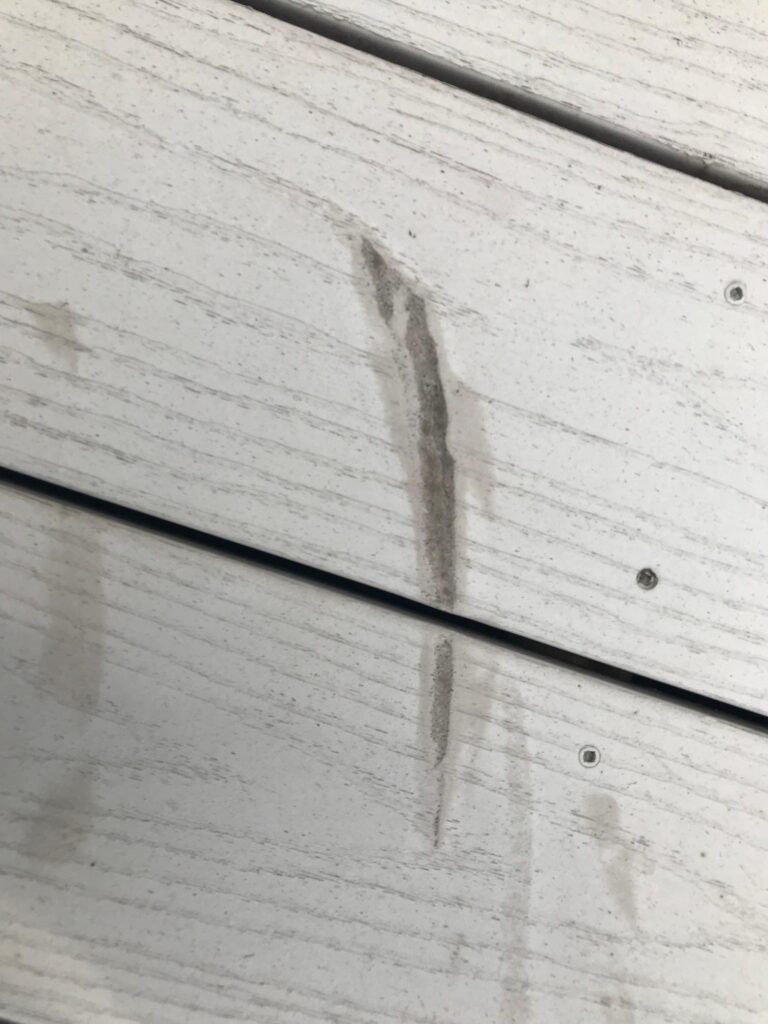
Signs of Pressure Washing Composite Damage
Damage can be subtle immediately after cleaning and become much more noticeable when the deck dries or sunlight hits the surface.
Straight or curved cleaning marks that remain after drying can indicate uneven mechanical cleaning.
A visibly altered or roughened surface may indicate the exterior finish was mechanically affected.
Localized changes in gloss can appear where concentrated force or incompatible chemicals affected the board.
Chemical incompatibility or aggressive cleaning may leave areas that appear lighter or darker than surrounding boards.
If the surface has already been damaged, additional pressure washing is usually not the correct solution. The manufacturer should be consulted before attempting repair, resurfacing, coating, or replacement.
OUR APPROACH
How We Reduce the Risk of Composite Deck Damage
Identify the Decking
Brand, age, capped versus uncapped construction, and manufacturer instructions matter.
Inspect Existing Condition
We look for previous damage, staining, mildew, discoloration, scratches, repairs, and unusual surface wear.
Choose the Cleaner First
Manufacturer-approved soap, water, or composite-cleaning products may remove buildup without relying heavily on mechanical pressure.
Use Controlled Mechanical Cleaning
If pressure washing is allowed, nozzle, distance, spray direction, equipment rating, and technique are adjusted to the manufacturer’s instructions.
Rinse Thoroughly
Cleaning residue and dirty water should not be allowed to dry back onto the surface.
What Cleaning Products Are Safe for Composite Decking?
The safest answer is the product recommended or approved by the decking manufacturer.
Trex recommends soap, warm water, and a soft-bristle brush for many routine cleaning situations. TimberTech recommends its own DeckCleaner and also identifies several other cleaners in its current care guidance.
That is more defensible than assuming every “eco-friendly” detergent is automatically compatible with every composite surface.
EPA Safer Choice Does Not Mean “Safe for Every Deck”
EPA’s Safer Choice label identifies products that meet the program’s human-health and environmental criteria. It does not replace the decking manufacturer’s compatibility instructions.
7 Ways to Avoid Pressure Washing Composite Damage
Never assume every composite board has identical care instructions.
Cleaning requirements can vary between product generations.
A narrow stream concentrates mechanical force.
Do not move closer simply because a stain is difficult to remove.
Appropriate soap and dwell time can reduce the need for aggressive pressure.
Follow manufacturer guidance regarding spray direction and brush technique.
When manufacturer instructions allow it, a small test can reveal compatibility issues before cleaning the entire deck.
Composite Deck Cleaning in Florida
Composite decking is popular in Florida because it can offer lower maintenance than traditional wood, but outdoor exposure still creates cleaning needs.
Humidity, pollen, tree debris, shade, rain, food spills, pool areas, and normal foot traffic can all leave visible buildup.
The correct response is not automatically stronger pressure. Often the better starting point is debris removal, an approved cleaner, appropriate brushing, and thorough rinsing.
Spotless Cleaning Services and More serves residential and commercial customers throughout Sarasota, Bradenton, Lakewood Ranch, Palmetto, Parrish, Ellenton, Venice, Siesta Key, and surrounding communities.
Explore our
Sarasota County service area
and
Manatee County service area.
FREQUENTLY ASKED QUESTIONS
Pressure Washing Composite Damage FAQ
Can pressure washing damage composite decking?
Yes. Improper pressure, nozzle selection, working distance, technique, or cleaning products can permanently alter some composite decking surfaces.
What PSI should composite decking be pressure washed at?
There is no universal PSI limit for all composite decking. Trex and TimberTech publish different limits, and some early-generation composite products should not be power washed. Always follow the specific manufacturer’s care instructions.
Can Trex decking be pressure washed?
Trex says certain high-performance products such as Transcend, Enhance, and Select can be pressure washed under its published conditions. Trex does not recommend power washing certain early-generation composite products.
Can TimberTech decking be pressure washed?
TimberTech says power washing is not its preferred cleaning method but permits it when its published requirements are followed, including a maximum-rated 1,500 PSI pressure washer and fan tip.
Should composite decking be sealed after cleaning?
Many modern composite and PVC decking products do not require the same sealing process used on traditional wood. Follow the decking manufacturer’s maintenance instructions before applying any coating or sealer.
Can bleach be used on composite decking?
Cleaning-product compatibility depends on the manufacturer and product line. Use the cleaner and concentration recommended by the decking manufacturer rather than assuming a generic exterior-cleaning mixture is compatible.
What is the safest way to clean composite decking?
Start with the manufacturer’s care guide. Routine cleaning often involves removing debris, using an approved cleaner or mild soap, brushing with the appropriate brush, and rinsing thoroughly. Pressure washing should only be used when permitted.
How do I request a composite deck cleaning estimate?
Call or text Spotless Cleaning Services and More at
(813) 606-7589
or
request a free estimate online.
SPOTLESS CLEANING SERVICES AND MORE
Clean the Deck Without Guessing at the Pressure
Tell us the deck brand if you know it, send us photos, and we’ll evaluate the surface before selecting the cleaning approach.

No Comments