Will Pressure Washing Remove Rust?
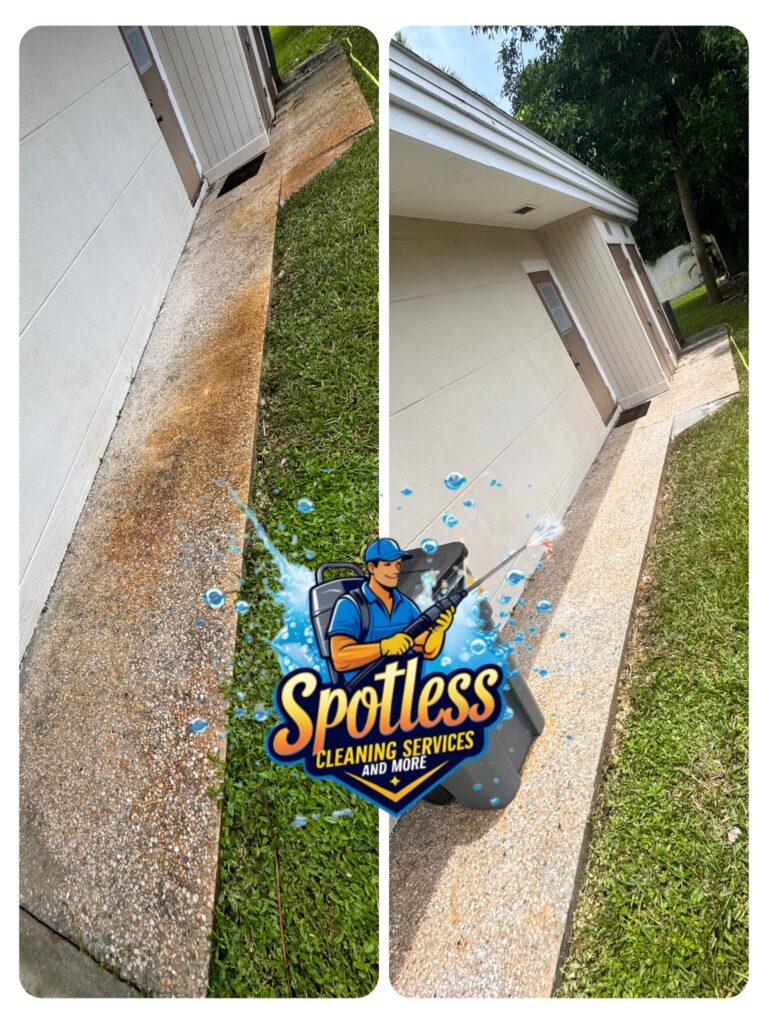
Pressure washing alone usually is not enough to remove stubborn rust stains from concrete, pavers and other porous exterior surfaces. Rust is a chemical stain, so successful removal often requires a rust-specific treatment followed by appropriate rinsing or pressure washing.
Orange and reddish-brown staining can come from irrigation water, fertilizer, patio furniture, metal hardware, exposed rebar and other iron-containing materials. The correct treatment depends on what caused the stain and what material is underneath it.
Spotless Cleaning Services and More provides professional rust-stain and exterior cleaning services throughout Sarasota County, Manatee County and surrounding Southwest Florida communities.
Quick Answer: Can a Pressure Washer Remove Rust Stains?
Pressure washing can help rinse away loosened rust residue, but water pressure by itself often will not dissolve an embedded rust stain. Rust-specific cleaners are commonly used to chemically break down the iron-related discoloration before the surface is rinsed. Results depend on the stain source, age, depth and surface material.
Why Rust Stains Form on Concrete and Pavers
Rust is associated with iron reacting with oxygen and moisture. The resulting iron compounds can create the familiar orange, reddish or brown staining seen on exterior surfaces.
Concrete and many pavers are porous, which means rust-colored contamination can move into tiny pores rather than remaining only on the surface.
Common sources include:
- Iron-rich irrigation or well water
- Metal patio furniture
- Rusting tools or outdoor equipment
- Fence posts, railings or hardware
- Fertilizers containing iron
- Metal planters or decorative items
- Exposed reinforcing steel in damaged concrete
- Iron-containing aggregate or mineral deposits
Identifying the source matters. If the underlying cause continues—for example, a sprinkler repeatedly spraying iron-rich water across a wall—the stain can eventually return even after successful cleaning.
Why Pressure Washing Alone Often Does Not Remove Rust
Ordinary dirt can often be loosened mechanically with water pressure. Rust staining is different.
Concrete Network explains that stubborn rust generally requires a cleaner capable of dissolving the rust rather than relying on detergents and pressure washing alone.
That means simply increasing PSI is often the wrong approach.
Excessive pressure can:
- Etch concrete
- Leave visible wand marks
- Disturb paver joint material
- Damage coatings or sealers
- Change the appearance of decorative surfaces
treat the rust chemically with a product appropriate for the material, then use controlled rinsing or pressure washing as part of the removal process.
How Professional Rust Stain Removal Works
Identify the Surface and Likely Stain Source
Concrete, pavers, stucco, masonry and sealed surfaces can react differently to rust-removal products. The likely source of the staining should also be considered before treatment.
Test an Appropriate Rust Treatment
Rust-specific cleaners can contain acidic ingredients formulated to react with iron staining. Product choice, concentration and dwell time should match the surface and stain.
Allow the Cleaner to Work
Appropriate dwell time allows the treatment to react with the rust stain. The manufacturer’s instructions should control rather than using an arbitrary time on every project.
Rinse Using the Appropriate Method
Once the rust has been treated, controlled rinsing or pressure washing can remove loosened contamination and cleaning residue from compatible surfaces.
Evaluate the Result
Some stains respond to one treatment while older or deeper staining may require additional work. Final results depend on the source, surface porosity, previous coatings and stain age.
Can Rust Be Removed From a Concrete Driveway?
Yes, many driveway rust stains can be substantially improved or removed when the correct treatment is used.
Driveway rust often comes from irrigation water, fertilizers, metal objects or vehicle-related sources.
The concrete’s age, finish, porosity and whether it has been sealed can all affect how the stain responds.
For larger driveway projects, see our
professional driveway cleaning service
.
What About Irrigation Rust?
Irrigation rust is common when sprinkler systems use water containing dissolved iron.
Repeated sprinkler overspray can create orange or reddish staining on:
- Driveways
- Sidewalks
- Curbs
- Stucco
- Exterior walls
- Fences
- Pavers
Removing the existing stain does not stop the sprinkler system from depositing more iron. If the source continues, staining can recur.
For dedicated residential treatment, visit our
rust stain removal service
.
Can Rust Be Removed From Pavers?
Rust stains can often be treated on pavers, but the paver material and existing sealer need to be considered.
Some acidic rust-removal products can alter coatings, expose differences in color or react with particular masonry materials. That is why testing and product selection matter.
For broader paver maintenance, see our
paver cleaning services
and
paver sealing services
.
Can Acid-Based Rust Removers Damage Concrete?
They can if the wrong product, concentration or technique is used.
Acidic cleaners can react with cementitious surfaces and may affect:
- Concrete color
- Decorative finishes
- Sealers and coatings
- Natural stone
- Nearby metals
That is why I would not describe all professional rust cleaning simply as “acid washing.” Rust removal is more accurately a surface-specific chemical stain treatment. The chemistry should be selected for the substrate and stain.
Will Rust Removal Damage Concrete Sealer?
It can.
Some rust-removal chemicals can affect topical sealers or coatings. Concrete Network specifically warns that stronger acidic rust cleaners can strip concrete stains and coatings.
If the concrete or pavers are sealed, that should be identified before treatment so expectations can be established.
If you want to understand this issue in greater detail, read our guide:
Will Pressure Washing Remove Concrete Sealer?
What Results Can You Expect From Rust Removal?
Results can range from dramatic improvement to complete removal, but no responsible cleaner should guarantee every rust stain will disappear before evaluating it.
Factors affecting results include:
- How long the stain has been present
- What caused the stain
- Surface porosity
- Previous cleaning attempts
- Existing sealer or coating
- Surface age and condition
newer surface stains may respond quickly, while deeply embedded or recurring irrigation-related rust can require more treatment and may return if the source is not corrected.
Rust Removal for Commercial Properties
Rust staining is not limited to residential driveways.
Commercial properties may develop iron-related staining around:
- Irrigated sidewalks
- Storefront entrances
- Curbs
- Parking areas
- HOA common areas
- Walls and masonry
Spot treatment can sometimes be incorporated into a broader commercial exterior-cleaning project when appropriate.
Why Runoff Management Matters
Exterior cleaning should account for where cleaning residue and wash water can travel.
Florida DEP explains that stormwater running across paved areas can pick up pollutants, including chemicals and sediment, and carry them into stormwater systems and waterways.
The appropriate runoff-management method can vary by property, municipality, product and project conditions.
That is why I would avoid the old blanket claim that every project is simply “neutralized” and automatically complies with all Florida requirements. Compliance depends on the actual job conditions and applicable local requirements.
Why Choose Spotless Cleaning Services and More?
Work with a professional local exterior-cleaning company for residential and commercial projects.
Rust is treated as a specialty stain rather than simply increasing pressure and hoping it disappears.
Concrete, pavers, coatings, stucco and masonry can require different treatment strategies.
Serving Sarasota County, Manatee County and surrounding Southwest Florida communities.
Frequently Asked Questions
Will pressure washing remove rust?
Pressure washing may remove loose residue, but stubborn rust stains often require a rust-specific chemical treatment to dissolve or loosen the iron-related staining before rinsing.
Can pressure washing remove rust from concrete?
Rust on concrete can often be substantially improved or removed with the correct rust-treatment chemistry followed by appropriate rinsing or pressure washing.
Why doesn’t pressure washing alone remove rust?
Rust is a chemical stain rather than ordinary loose dirt. Increasing mechanical force does not necessarily dissolve the iron compounds causing the discoloration.
Can rust remover damage concrete?
Some acidic rust-removal products can change the appearance of concrete, coatings, sealers, masonry or decorative surfaces when used incorrectly. Product selection and testing matter.
Can irrigation rust be removed?
Yes, irrigation-related iron stains can often be treated. However, the stains can recur if iron-rich sprinkler water continues to hit the same surface.
Can you remove rust from pavers?
Many rust stains on pavers can be treated, but the paver material and any existing sealer should be evaluated before applying a rust-removal product.
Can rust treatment remove concrete sealer?
Some stronger acidic cleaners can affect concrete coatings and sealers. If the surface is sealed, that should be considered before treatment begins.
Will old rust stains come out completely?
Sometimes, but complete removal cannot be guaranteed. Stain age, depth, source, porosity, previous cleaning attempts and coatings can all affect the final result.
Do you provide rust stain removal in Sarasota and Manatee County?
Yes. Spotless Cleaning Services and More provides specialty exterior rust-stain cleaning throughout Sarasota County, Manatee County and surrounding communities.
Learn More About Rust Stains and Exterior Cleaning

No Comments