
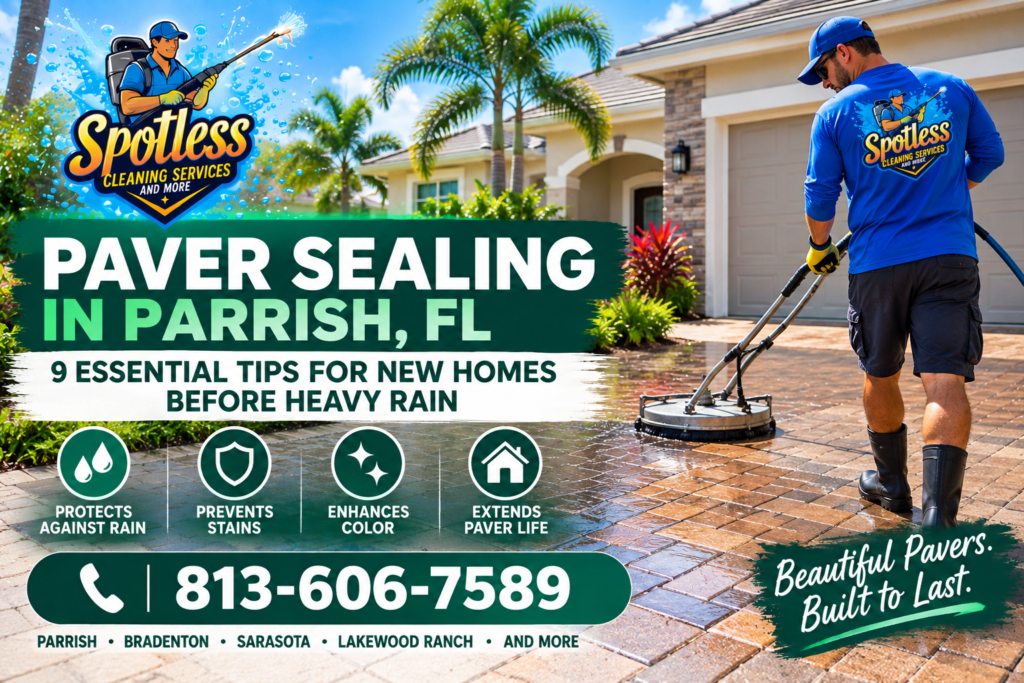
PARRISH PAVER CLEANING & SEALING GUIDE
Paver Sealing in Parrish, FL: 9 Essential Tips for New Homes Before Heavy Rain
New homes across Parrish often feature paver driveways, walkways, patios and pool areas that look sharp on day one. Florida heat, irrigation, vehicle traffic, weeds, organic growth and repeated heavy rain can change that appearance quickly if the surface is not maintained correctly.
Paver sealing in Parrish, FL can help protect properly prepared pavers, improve color consistency, reduce water absorption and make future maintenance easier. But sealing too soon, sealing dirty pavers, trapping moisture, using the wrong product or ignoring joint sand can create problems instead of preventing them.
Paver Sealing in Parrish, FL: Quick Answer for New Homeowners
Dirt, algae, construction residue and stains should be addressed before a sealer locks in the appearance.
Moisture trapped beneath some sealers can contribute to hazing, whitening or poor adhesion.
Cleaning can remove or disturb sand. Joints may need to be replenished before sealing.
Heavy rain shortly after application can interfere with curing, so dry conditions matter.
In This Parrish Paver Sealing Guide
Why New Parrish Homeowners Consider Paver Sealing in Parrish, FL
Parrish has seen extensive residential growth, and many newer homes use concrete pavers because they create a more finished look than plain slab concrete. A paver driveway or patio can become one of the most visible surfaces on the property, especially when the color and joint lines are still crisp.
Paver sealing in Parrish, FL is not a maintenance-free solution. It can, however, help protect the surface from water intrusion, make some stains easier to clean, reduce surface wear and enhance color depending on the sealer selected. A quality application can also help stabilize properly prepared joint sand.
Before thinking about sealer, start with the condition of the surface. Our paver cleaning service addresses dirt, algae and buildup before sealing is considered, while our dedicated paver sealing service covers the protective finishing stage. Homeowners can also review our broader pressure washing services to understand how durable exterior surfaces are evaluated and cleaned.
Why Heavy Florida Rain Matters When Sealing Pavers
Florida rainfall is not just a scheduling inconvenience. Paver systems are built around drainage, base preparation and the joints between units. The Florida Department of Environmental Protection describes permeable paver systems as pavement designed to allow stormwater to move through joints and into underlying aggregate. The U.S. Environmental Protection Agency similarly explains that permeable interlocking concrete pavement manages rainfall through openings and aggregate layers beneath the surface.
Not every decorative driveway in Parrish is a true permeable pavement system, but the same lesson is useful: water movement matters. Before sealing, the installer needs to know whether the pavers are fully dry, whether drainage is working correctly and whether the product is appropriate for the specific paver system.
If heavy rain hits before a sealer has cured, results can vary by product. Moisture can interfere with bonding or appearance, and some sealers may haze or turn cloudy when water becomes trapped. Professional application should follow the manufacturer’s requirements for surface moisture, air temperature, paver temperature and cure time.
Do Not Rush Paver Sealing Before Rain
The goal is not to seal pavers the day before a storm. The goal is to clean, dry, sand and seal during a suitable weather window so the product has the cure time it needs before heavy rain returns.
UF/IFAS recommends using porous pavers or aggregates where appropriate to support stormwater drainage. That resource is focused on landscape design rather than sealer selection, but it reinforces why drainage and the function of the hardscape should be understood before coating the surface.
Need Paver Cleaning or Sealing in Parrish?
Spotless Cleaning Services and More can evaluate the paver condition, existing sealer, joint sand, stains and weather window before recommending the next step.
How to Prepare New Pavers Before Sealing
One of the biggest mistakes with new construction is assuming “new” means “ready to seal.” Pavers can collect construction dust, tire marks, irrigation stains, efflorescence, mud, mortar residue and landscaping debris before the homeowner ever moves in.
Look for chipped units, settling, drainage issues, efflorescence, rust, oil, polymeric haze, paint or existing coating.
Do not assume a builder left the pavers unsealed. Applying a new product over an incompatible old coating can create whitening, peeling or uneven appearance.
Appropriate cleaning removes organic growth, dirt and construction residue so those contaminants are not trapped beneath sealer.
Cleaning residue should be removed from paver faces, joints and surrounding surfaces.
Joints that are low after cleaning may need compatible sand before sealing.
Pavers should meet the sealer manufacturer’s moisture requirements before application.
If your new Parrish driveway has ordinary dirt and organic buildup, our driveway cleaning service may be part of preparation. For adjacent slab concrete, see our concrete cleaning service. Patio pavers can also be coordinated with patio cleaning.
Construction Residue Requires Special Attention
Pressure washing alone does not solve every construction stain. Cement residue, paint, rust and mineral deposits may need specialty treatment, and aggressive pressure can damage the paver surface without fully removing the contaminant. If orange irrigation staining is present, our rust removal service explains why targeted chemistry is different from routine washing.
Joint Sand: The Part Homeowners Often Miss
The joints between pavers are part of the system. Sand helps support the edges of individual units and contributes to interlock. Heavy cleaning can displace loose joint material, especially when pavers have not been maintained for some time.
Before sealing, inspect the joint depth. If the sand is too low, fresh compatible material may be needed. The correct sand and application process depend on the installation and the sealer being used. Sealing over empty or poorly filled joints does not correct a weak base or major settlement.
For homeowners comparing cleaning methods, our pressure washing vs. soft washing guide explains why different materials require different approaches. Pavers are durable hardscape, but joint condition still matters when selecting pressure, nozzle distance and cleaning technique.
Wet Look, Natural Look & Other Paver Sealer Choices
Sealer selection affects both appearance and performance. Some products deepen the color and create a richer “wet look.” Others leave the surface looking more natural. There are also differences in sheen, breathability, chemistry, solids content and compatibility with previous coatings.
Do not choose a product only from a photo online. New Parrish homes can have different paver manufacturers, colors and surface finishes. A sealer that looks excellent on one driveway can change the tone of another more than expected. A small test area can help confirm the appearance.
Pool areas deserve extra care because slip resistance, splashing and constant moisture are part of the environment. If your project includes pool pavers or a lanai, see our pool deck cleaning service before deciding on the final coating approach.
9 Essential Paver Sealing Tips for New Parrish Homes
- Do not seal dirty pavers. Dirt, algae and stains can become visually locked beneath the coating.
- Do not seal damp pavers. Trapped moisture can contribute to haze, whitening and adhesion problems.
- Confirm whether old sealer is present. Incompatible layers can create peeling, cloudiness or uneven gloss.
- Do not overapply sealer. More product is not automatically better.
- Use a suitable weather window. Rain and high surface moisture can interfere with curing.
- Check joint sand before coating. Low joints may need fresh compatible sand.
- Test the appearance. Color enhancement and sheen can vary by paver.
- Fix drainage or settlement first. Sealer is not a structural repair.
- Follow the product manufacturer’s instructions. Dry time, cure time and application limits vary.
If you are considering doing the entire project yourself, review our professional pressure washing vs. DIY guide. Cleaning and sealing involve different equipment and products, but preparation quality has a major effect on the final result.
Should New Pavers Be Sealed Immediately?
Not automatically. Some pavers may need time for initial moisture and efflorescence to move through the system, and manufacturer guidance can vary. If the installer, builder or paver manufacturer specifies a waiting period, follow that guidance.
New construction can also hide issues that become obvious only after the first few rains: low spots, poor drainage, settlement, irrigation overspray or construction residue. Sealing should not be used to hide those conditions. Correcting the cause first usually creates a better long-term result.
How to Maintain Sealed Pavers After the Job
Sealed pavers still need routine cleaning. Leaves, dirt, vehicle residue, irrigation stains and organic buildup can accumulate on top of the sealed surface. A properly selected and maintained sealer may make future cleanup easier and reduce how deeply some contaminants penetrate.
- Remove leaves and organic debris before they decompose into the joints.
- Correct sprinkler heads that repeatedly hit the driveway or patio.
- Address oil and vehicle leaks sooner rather than later.
- Watch for white haze, peeling or unusual gloss changes.
- Inspect joint sand and settlement instead of assuming sealer will hold a failing paver system together.
- Clean pavers before heavy organic growth becomes established.
For wider exterior maintenance, Parrish homeowners can use our Parrish pressure washing service-area guide and our Manatee County exterior cleaning guide. If other areas of a newer home are developing algae, our house washing service and roof cleaning service cover those surfaces separately.
What Does Paver Cleaning and Sealing Cost?
Pricing depends on square footage, paver condition, existing sealer, stains, joint-sand needs, access, product selection and the amount of preparation required. A new-looking driveway with clean joints is different from a surface with failed old sealer or extensive construction residue.
For a broader look at exterior-cleaning pricing factors, see our pressure washing cost guide. It is not a paver-sealing price sheet, but it explains why square footage alone does not determine every exterior-cleaning estimate.
Authoritative Resources on Pavers, Drainage & Stormwater
For background on how paver systems interact with rainfall and drainage, review the Florida Department of Environmental Protection’s permeable paver information, the U.S. EPA’s green infrastructure and permeable pavement guidance, and UF/IFAS guidance on using porous pavers and hardscape to support stormwater drainage.
Get a Parrish Paver Cleaning & Sealing Estimate
Tell us whether the pavers are new, previously sealed, stained or showing joint-sand problems. Photos can help us understand the starting condition before the project is scheduled.
Paver Sealing in Parrish, FL FAQ
Should I seal new pavers right after my Parrish home is finished?
Not automatically. Confirm manufacturer or installer guidance, inspect for efflorescence and drainage issues, and make sure the surface is properly cleaned and dry before sealing.
Do pavers have to be pressure washed before sealing?
They need to be properly cleaned, but the exact method depends on surface condition. The goal is to remove dirt, organic growth and residue without damaging the pavers or unnecessarily removing joint material.
What happens if it rains after paver sealer is applied?
The effect depends on the product and how far curing has progressed. Rain too soon can interfere with appearance or adhesion, which is why the manufacturer’s dry-time and cure-time requirements matter.
Do paver joints need new sand before sealing?
They may. If cleaning or normal wear has lowered the joint material, compatible sand can need to be added before the sealing process is completed.
Will paver sealer stop weeds forever?
No. Proper joint preparation and sealer can reduce some conditions that favor weed growth, but seeds can still settle on top and grow where moisture and debris accumulate.
Can sealing fix white or cloudy old pavers?
Not necessarily. White or cloudy appearance may come from efflorescence, trapped moisture or failed sealer. The cause should be identified before another coating is added.
How often should pavers be resealed in Parrish?
There is no universal interval. Product type, traffic, sun, irrigation, cleaning methods and the condition of the existing coating all affect when resealing is appropriate.
Do you provide paver cleaning and sealing in Parrish?
Yes. Spotless Cleaning Services and More serves Parrish and surrounding Manatee County communities. Call or text 813-606-7589 for an estimate.
Protect the Pavers Before Problems Get Sealed In
The best paver sealing result starts with the condition beneath the coating. Clean pavers, stable joints, proper drying and a suitable weather window matter more than rushing to apply sealer.

No Comments