Pressure & Water Flow
Cleaning performance is not simply a matter of choosing the highest pressure. Water flow, nozzle selection, distance, technique, chemistry, and the surface itself all affect the process.
4301 32nd St W, Bradenton, Florida
Professional vs DIY Exterior Cleaning Guide
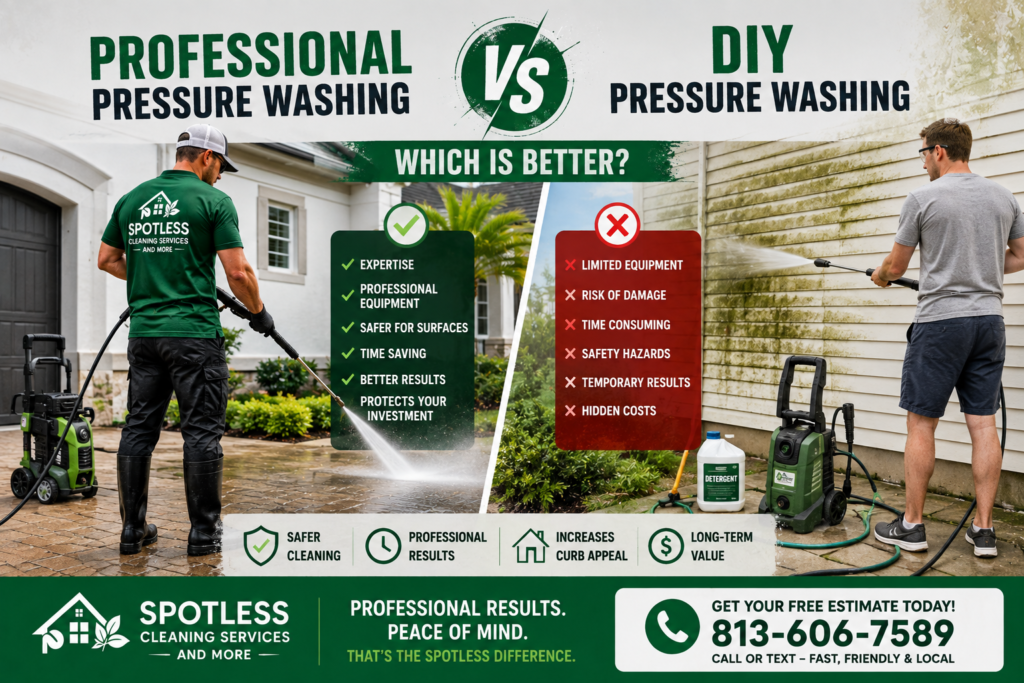
Professional Pressure Washing vs DIY: Which Is Better? The answer depends on the size of the project, the surface being cleaned, your equipment, your experience, the type of buildup or staining, and how much time and risk you are willing to take on yourself.
DIY pressure washing can make sense for smaller, straightforward projects when you understand the equipment and the surface. Professional exterior cleaning becomes more attractive when the job is large, involves delicate materials, requires specialty chemistry, includes elevated areas, or would require you to buy or rent equipment you may rarely use.
This guide compares professional pressure washing and DIY cleaning across cost, time, equipment, safety, cleaning methods, surface knowledge, results, and convenience so Sarasota-area property owners can make an informed decision.
DIY pressure washing can be a reasonable option for small, accessible, durable surfaces when you already have suitable equipment, know how to use it, and understand the material you are cleaning. Professional pressure washing is often the stronger choice for larger jobs, delicate surfaces, specialty stains, roofs, commercial properties, or projects where professional equipment and experience can save significant time.
The decision should not be based on the rental price of a pressure washer alone. Compare the complete DIY investment—equipment, accessories, cleaning solutions, setup, labor, cleanup, learning time, and the possibility of mistakes—with the complete professional quote.
If your main question is value, read Is Professional Pressure Washing Worth the Money?. If price is the deciding factor, start with How Much Does Pressure Washing Cost in Sarasota, FL?.
At a Glance
| Factor | DIY Pressure Washing | Professional Pressure Washing |
|---|---|---|
| Upfront cost | Can be lower if you own suitable equipment | Service price includes labor and professional setup |
| Time | You handle research, setup, cleaning, and cleanup | Experienced workflow can be more efficient |
| Equipment | Buy, borrow, or rent equipment and accessories | Contractor supplies its equipment and tools |
| Surface knowledge | Depends on your research and experience | A qualified contractor should match methods to surfaces |
| Specialty stains | May require additional products and knowledge | May be available as specialty treatment |
| Delicate surfaces | Greater learning curve | Soft-wash/lower-pressure methods can be selected where appropriate |
| Convenience | You perform all labor | Contractor performs the service |
| Best fit | Small, simple, low-risk projects | Large, complex, delicate, elevated, or specialty projects |
The Real Cost Comparison
DIY can absolutely cost less in some situations. If you already own an appropriate machine, accessories, and cleaning supplies—and the project is small—the direct cost may be modest. But homeowners starting from zero should compare more than the machine rental or purchase price.
A DIY project can involve a pressure washer, hose, nozzles, surface cleaner, extension equipment, cleaning solutions, protective gear, fuel or electricity, transportation for rental equipment, setup, and cleanup. Specialty stains can add separate chemicals and application requirements.
Your time also has value. A project that takes a professional crew a relatively short period can take a first-time DIY user considerably longer because of setup, learning, repositioning hoses, working in sections, and cleanup.
Before deciding that DIY is cheaper, compare your full DIY plan against what the professional estimate includes. Our What Is Included in Professional Pressure Washing? guide helps make that comparison.
Professional pricing also varies according to the property and scope. Read How Do Pressure Washing Companies Price a Job? and Pressure Washing Cost Per Square Foot in Florida to understand why two jobs can have different prices.
Tools Change the Job
Cleaning performance is not simply a matter of choosing the highest pressure. Water flow, nozzle selection, distance, technique, chemistry, and the surface itself all affect the process.
On suitable flatwork, a surface-cleaning attachment can improve consistency and efficiency compared with trying to clean an entire driveway using only a narrow wand pattern.
Organic buildup and specialty staining can require cleaning solutions rather than additional pressure. Professionals may have systems designed to apply and rinse appropriate chemistry.
Roofs, siding, painted materials, and other sensitive surfaces can require lower-pressure cleaning. Learn more in our Pressure Washing vs Soft Washing guide.
Irrigation rust, oil, grease, paint, gum, and graffiti may require different products and processes from ordinary organic buildup.
Larger properties can require substantial hose management and repeated repositioning. Professional setups are often designed around efficient movement across larger work areas.
Do Not Treat It Like a Garden Hose
A pressure washer is a power tool. The CDC warns that high-pressure spray can cause serious wounds that may initially appear minor, and that the spray can throw objects capable of injuring people nearby. The CDC also warns against using gasoline-powered pressure washers in enclosed spaces or near openings because of carbon-monoxide risk.
Electrical equipment introduces another consideration around water. Product design and condition matter as well; CPSC maintains pressure-washer recalls and safety warnings. Before using any machine, check the manufacturer’s instructions and current recall information for the specific model.
DIY users should also think about slippery wet surfaces, hoses across walking paths, nearby people and pets, electrical connections, ladders, and elevated work. The safest decision can change dramatically when a project moves from ground-level concrete to a roof or difficult-access area.
Also read our Dangers of DIY Pressure Washing guide.
Get a professional estimate first. Knowing the professional price and proposed cleaning method gives you a much better basis for comparing DIY.
One Method Does Not Fit Everything
Ground-level concrete is one of the more approachable DIY categories, but technique still matters. Professional surface-cleaning equipment can improve consistency on larger areas. Compare professional pricing in How Much Does Driveway Pressure Washing Cost in Sarasota?.
Stucco, siding, paint, trim, windows, and doors should not be treated like driveway concrete. Lower-pressure methods and chemistry may be more appropriate. See How Much Does House Washing Cost in Sarasota, FL?.
Roof cleaning combines material-specific methods with elevated-access concerns. This is a strong category for considering professional service. See How Much Does Roof Cleaning Cost in Sarasota, FL?.
Paver cleaning involves the paver surface, joints, sand, existing sealer, and drainage. Compare paver cleaning costs and paver sealing costs.
Pool-area surfaces and screened enclosures require care. Screens should not be blasted at close range. Review pool deck cleaning costs and pool cage cleaning costs.
Gutter cleaning can introduce access and ladder considerations in addition to debris removal. If you are comparing professional service, see How Much Does Gutter Cleaning Cost in Sarasota?.
DIY Can Be Reasonable
A limited area of durable, accessible flatwork is generally easier to evaluate than a multi-surface project involving a roof, siding, screens, and specialty stains.
DIY economics improve when you already own suitable equipment and do not need to buy or rent multiple accessories for a one-time project.
Knowing how to start conservatively, test an inconspicuous area, select appropriate accessories, and follow the manufacturer’s instructions matters.
DIY is more attractive when you enjoy doing the work and do not mind setup, cleaning, equipment management, and cleanup.
DIY does not have to mean “use maximum pressure.” Sometimes the right DIY decision is to use a gentler cleaning approach—or to stop when you encounter a surface or stain outside your experience.
When Experience Has More Value
Long driveways, extensive sidewalks, multiple elevations, large pool areas, or whole-property cleaning can turn a DIY project into a major time commitment.
Roofs, screens, painted surfaces, siding, and other sensitive materials can benefit from a contractor who understands lower-pressure and soft-wash methods.
Rust, irrigation staining, oil, grease, paint, gum, and graffiti can require specialized chemistry rather than more pressure.
When a cleaning project introduces roofs, ladders, or difficult access, the personal-safety side of the DIY equation changes substantially.
Businesses and associations may need vendor documentation, lower-traffic scheduling, multiple work zones, recurring maintenance, and careful coordination.
Hiring a professional can make sense simply because you would rather spend your time elsewhere and have the cleaning handled for you.
If you have reached the point where professional service makes more sense, the next question is who to hire. Use Pressure Washing Company Near Me: What Should I Look For? as your next-step guide.
Compare the Numbers
Before choosing DIY solely to save money, compare the professional price for the actual service you need.
If You Choose Professional
Choosing professional pressure washing does not mean choosing the first company you find. Compare the written scope, insurance, reviews, relevant experience, cleaning methods, specialty-stain capabilities, communication, and overall value.
Ask how the contractor plans to clean each surface. A professional should be able to explain why concrete, siding, roofs, pavers, and pool cage screens may require different methods.
Also make sure you understand what the estimate includes. A cheaper quote may represent less work, while a higher quote may include additional surfaces or treatments. Compare scope before price.
Compare Before You Decide
A free property-specific estimate gives you a real number to compare against equipment rental, supplies, your time, and the scope of the project.
Related Resources
Independent Safety Resources
The CDC warns that high-pressure spray can cause serious wounds and can propel objects toward people nearby. It also provides electrical and carbon-monoxide precautions for pressure-washer users. Read CDC pressure-washer safety guidance →
CPSC maintains current pressure-washer recall and product-safety information. DIY users should check the specific equipment they own or plan to use. Check CPSC pressure-washer information →
Frequently Asked Questions
DIY can make sense for small, low-risk cleaning jobs when the homeowner has appropriate equipment, understands the surface, and can work safely. Professional service is often the stronger choice for larger projects, delicate surfaces, roofs, specialty stains, commercial properties, or situations where experience, efficiency, and surface-specific methods matter.
DIY can have a lower upfront cost, especially if you already own suitable equipment. The real comparison should also consider equipment or rental costs, cleaning solutions, accessories, time, setup, cleanup, and the possibility of needing specialty treatment or correcting surface damage.
Improper technique can leave visible marks or contribute to surface damage. Concrete condition, nozzle choice, distance, pressure, and cleaning technique all matter.
Roof cleaning combines surface-specific cleaning requirements with work at height. Homeowners should carefully consider both the roof material and personal safety. Professional roof cleaning is generally a better fit when specialized methods or elevated access are required.
Neither method is universally better. Pressure washing can be appropriate for durable surfaces, while soft washing or lower-pressure methods can be more suitable for roofs, siding, screens, painted surfaces, and other materials where aggressive pressure is inappropriate.
Screens should not be blasted at close range with high pressure. A careful cleaning approach can use cleaning solution and rinsing, with only controlled force where needed for stubborn webs or debris.
Equipment varies by company and job, but professional exterior cleaners may use commercial pressure-washing equipment, surface cleaners, hoses and reels, chemical application systems, specialty stain treatments, and soft-wash or lower-pressure methods.
Professional service can offer stronger value when the project is large, time-consuming, difficult to access, requires specialty chemistry, involves delicate surfaces, or would require the homeowner to rent or buy multiple pieces of equipment.
Pricing can depend on size, surface type, access, buildup, specialty stains, cleaning method, and scope. The best way to compare prices is to compare what each estimate actually includes.
Insurance is an important risk-management consideration. Ask what coverage a contractor carries and request current proof when appropriate for your project or property requirements.
For many larger projects, a professional setup and experienced workflow can reduce cleaning time. Actual time depends on property size, buildup, access, surfaces, and required treatments.
Compare clear scope, insurance, reviews, relevant experience, surface-specific cleaning methods, communication, specialty-stain capabilities, and overall value rather than price alone.
Call or text 813-606-7589 or use the website contact page to request a free property-specific estimate.
Final Verdict
Professional Pressure Washing vs DIY: Which Is Better? DIY can be a good choice for a small, straightforward, ground-level project when you have suitable equipment, understand the surface, and are comfortable doing the work. Professional pressure washing becomes increasingly valuable as the property gets larger, the surfaces become more delicate, the access becomes more difficult, or specialty stains and cleaning methods are involved.
The best comparison is not simply “rental cost versus professional quote.” Compare the entire project: equipment, accessories, cleaning solutions, time, setup, cleanup, safety, surface knowledge, and the expected result.
If you are leaning toward professional service, continue with Is Professional Pressure Washing Worth the Money?, then review How Much Does Pressure Washing Cost in Sarasota, FL? and How to Choose a Pressure Washing Company in Sarasota.
Spotless Cleaning Services and More provides residential, commercial, and HOA exterior-cleaning services in the Sarasota area. Call or text 813-606-7589 or request a free estimate online to compare a professional quote against your DIY plan.

Explore Related Topics
Browse the topics connected to this cleaning guide.
No Comments