Property Exposure
Cleaning takes place around concrete, paint, siding, roofs, pavers, pool cages, landscaping, doors, windows, and other surfaces. Insurance can be one layer of protection if a covered incident occurs.
4301 32nd St W, Bradenton, Florida
Pressure Washing Hiring Guide
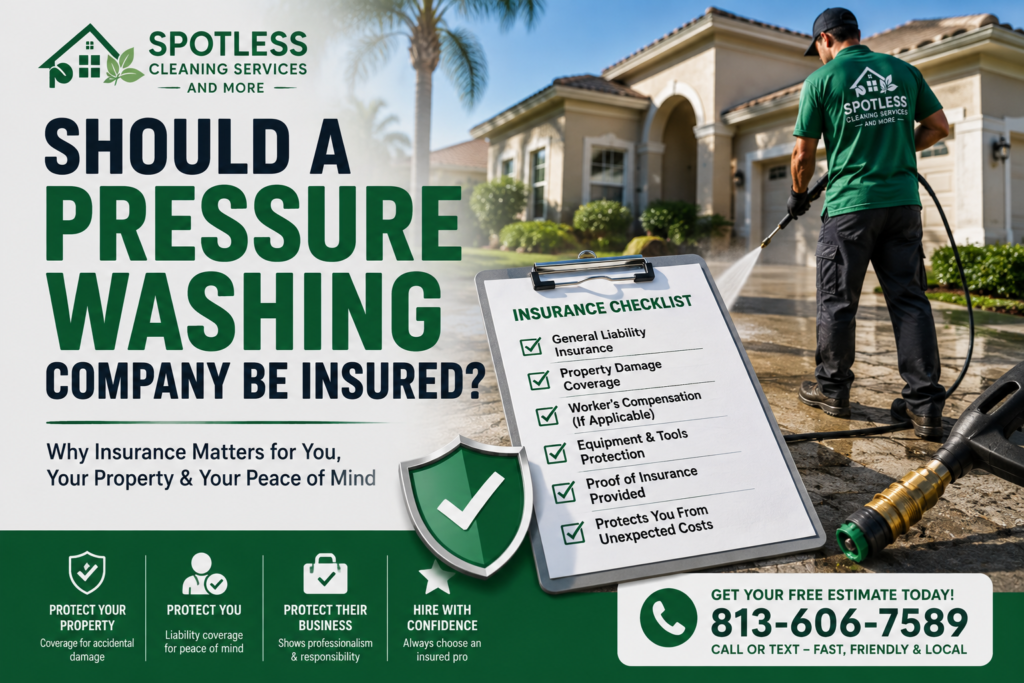
Should a Pressure Washing Company Be Insured? Yes—insurance is an important risk-management consideration when you hire a contractor to work around your home, business, HOA common areas, concrete, pavers, siding, roofs, pool cages, landscaping, doors, windows, and other exterior surfaces.
Insurance does not automatically prove that a pressure washing company does excellent work, but it is still an important question to ask. A professional contractor should be able to explain what coverage it carries and provide current documentation when that is appropriate for your project.
This guide explains Should a Pressure Washing Company Be Insured?, what insurance can and cannot tell you, which questions to ask, how insurance fits into the hiring decision, and what else you should compare before choosing a pressure washing company.
Should a Pressure Washing Company Be Insured? In most hiring situations, insurance is a sensible and important question to ask. Pressure washing and exterior cleaning involve equipment, hoses, water, cleaning solutions, vehicles, and work around valuable property surfaces. For commercial properties and HOAs, insurance documentation may also be part of vendor requirements.
Insurance is not the only thing you should check. A company can be insured and still use poor cleaning methods, communicate badly, or provide an unclear scope. The strongest hiring decision combines insurance with relevant experience, reviews, clear estimates, surface knowledge, soft-wash capability where appropriate, and realistic expectations.
For a broader contractor checklist, also read Questions to Ask Before Hiring a Pressure Washing Company and How to Choose a Pressure Washing Company in Sarasota.
Risk Management
Insurance matters because exterior cleaning happens directly on and around customer property.
Cleaning takes place around concrete, paint, siding, roofs, pavers, pool cages, landscaping, doors, windows, and other surfaces. Insurance can be one layer of protection if a covered incident occurs.
Pressure washing uses hoses, machines, pumps, reels, cleaning solutions, and sometimes ladders or elevated access. Professional businesses should manage those operational risks carefully.
Property managers, HOAs, and businesses may require vendor documentation before work begins. Asking about insurance early can prevent scheduling delays later.
What to Ask
Customers do not need to become insurance experts, but they should be comfortable asking basic questions. Start with: “What insurance coverage does your company carry?” Then ask whether the coverage is current and whether proof can be provided when needed.
Coverage can vary from one business to another and according to the work being performed. General liability coverage is a common topic because it relates to third-party property damage and bodily injury claims, subject to the actual policy terms. Depending on the company and project, customers may also ask about other coverage relevant to employees, vehicles, or commercial operations.
A trustworthy contractor should not be offended by a reasonable insurance question. For commercial or HOA work, ask about documentation before scheduling so the property manager can verify whether vendor requirements are satisfied.
Verification
Yes, when documentation matters to your decision or property requirements, ask for current proof rather than relying only on a verbal claim. This is especially reasonable for larger residential projects, roof cleaning, commercial properties, HOA work, or jobs where a property manager has formal vendor requirements.
The goal is not to create unnecessary paperwork. It is to verify that the company is willing and able to document the coverage it says it carries.
For businesses and associations, discuss whether any specific certificate wording, property-manager information, or additional documentation is required before the service date.
Do not treat insurance as a substitute for everything else. Verify insurance, then continue evaluating the contractor’s cleaning methods, scope, reviews, communication, and experience.
Use the insurance and hiring questions in this guide, then compare them with a property-specific estimate from Spotless Cleaning Services and More.
Keep Perspective
Insurance is important, but it does not guarantee quality, professionalism, or the right cleaning technique. An insured company can still use too much pressure, provide a vague quote, communicate poorly, or misunderstand sensitive surfaces.
That is why Should a Pressure Washing Company Be Insured? should be treated as one question in a larger hiring process. Also ask what is included in the quote, how each surface will be cleaned, whether soft washing is used where appropriate, how specialty stains are handled, and what results are realistic.
Our Is Professional Pressure Washing Worth the Money? guide helps evaluate the overall value of professional service, while Questions to Ask Before Hiring a Pressure Washing Company provides a broader interview checklist.
Technique Still Matters
Suitable concrete can often be cleaned with professional surface-cleaning equipment and controlled pressure. See our concrete cleaning services.
Stucco, siding, paint, trim, doors, and windows should not automatically receive the same pressure used on durable flatwork. See our house washing service.
Roofs and screens often require lower-pressure or soft-wash methods. Review our roof cleaning services and pressure washing vs. soft washing guide.
Insurance does not make close-range high pressure appropriate for pool cage screens. Screens should be cleaned with a careful method that can include cleaning solution and controlled rinsing, using only enough force where necessary for stubborn spider webs and debris.
Commercial & HOA
Commercial and HOA work often makes insurance documentation even more important because property managers may have formal vendor requirements. Ask early whether the contractor can provide the documentation needed for your property.
Also ask about scheduling, customer traffic, multiple work zones, recurring maintenance, and lower-traffic service times. Spotless Cleaning Services and More offers recurring maintenance programs for commercial businesses and HOAs, including monthly service options where appropriate.
Related services include plaza and storefront cleaning, restaurant exterior cleaning, gas station cleaning, and commercial warehouse cleaning.
Hiring Decision
Ask what coverage is carried and request proof when appropriate.
Make sure you know what surfaces and treatments are included.
Confirm the company understands pressure washing, soft washing, and surface-specific methods.
Read recent detailed reviews for patterns in reliability, communication, and workmanship.
Look for experience with the surface or staining condition you actually need cleaned.
Compare the scope and professionalism, not only the final price.
For more buyer-intent guidance, see How to Choose a Pressure Washing Company in Sarasota, Questions to Ask Before Hiring a Pressure Washing Company, and Is Professional Pressure Washing Worth the Money?.
Compare With Confidence
We want you to understand the work being quoted. Contact us with your property details and use the questions in this guide while comparing contractors.
Internal SEO Resources
Real-World Hiring Situations
A project involving a driveway, siding, walkways, pool area, pavers, and other exterior surfaces creates more points where equipment, water, hoses, and cleaning solutions interact with the property. That makes it reasonable to verify the contractor’s insurance before work begins.
Roof work deserves additional attention because access, height, roofing materials, gutters, landscaping, and nearby surfaces can all affect the job. Insurance should be part of the hiring conversation, but so should the roof-cleaning method and the contractor’s experience with your roofing material.
Commercial and association-managed properties may have formal vendor requirements. Property managers should verify documentation before scheduling and confirm that the cleaning scope, service windows, and work zones fit the property’s operating needs.
So, Should a Pressure Washing Company Be Insured? The larger, more complex, or more operationally sensitive the project becomes, the more important it is to make insurance verification part of your contractor-selection process. Insurance does not remove every risk, but asking about it is a practical step before allowing a company to begin work.
Documentation
You do not need to interpret every line of an insurance document to ask sensible questions. Start by confirming that the document identifies the business you are hiring and that the coverage shown is current. If your property manager, HOA, or commercial organization has specific requirements, send those requirements to the contractor before the service date.
For more complex jobs, you can also ask the company to explain what the document represents and who to contact if your property-management team needs additional information. The purpose is verification—not trying to become the contractor’s insurance agent.
Be cautious about screenshots or vague statements that do not clearly identify the business or current coverage. When documentation matters, ask for a current certificate or other appropriate proof supplied through the contractor or its insurance representative.
After verifying insurance, continue evaluating the written scope, cleaning method, reviews, communication, experience, preparation, and realistic expectations. A strong contractor should perform well across the entire hiring checklist.
Avoid a Common Mistake
One of the most important distinctions on this page is that insurance and cleaning technique solve different problems. Insurance is a risk-management tool. Proper technique is how the contractor reduces the chance of causing damage in the first place.
An insured contractor should still understand that a screened enclosure should not be blasted at close range, that roof materials require a different approach from driveway concrete, and that siding or painted surfaces can require lower-pressure cleaning. The best outcome is not relying on insurance after something goes wrong; it is hiring a company that uses an appropriate method from the beginning.
That is why customers researching Should a Pressure Washing Company Be Insured? should also ask, “How will you clean my surfaces?” Our pressure washing vs. soft washing guide and pressure washing safety guide explain this distinction in more detail.
Before You Schedule
Do not assume. Ask directly and request current proof when insurance documentation matters to your project.
Know exactly which surfaces, work areas, and specialty treatments are included before comparing prices.
Make sure the contractor understands that pressure washing, surface cleaning, soft washing, and chemical treatment have different roles.
Ask about projects similar to yours, especially roofs, pavers, pool cages, specialty stains, commercial properties, or HOA common areas.
Look for patterns in communication, professionalism, reliability, care around the property, and quality of work.
Choose based on the complete scope and level of service rather than automatically selecting the lowest quote.
Independent Resources
The SBA provides general information about common types of business insurance and why businesses use insurance to manage risk. Read SBA business-insurance guidance →
CPSC maintains product-safety and recall information related to pressure washers. View CPSC pressure-washer information →
OSHA’s general-industry standard addresses clean and orderly walking-working surfaces, drainage where wet processes are used, and correction of hazardous surface conditions. Review OSHA 1910.22 →
Frequently Asked Questions
Yes. Insurance is an important risk-management consideration when hiring a pressure washing or exterior-cleaning contractor. Ask what coverage the company carries and request current proof when appropriate for your property or project.
Coverage can vary by business and project. Customers commonly ask about general liability coverage and may also ask about other policies that apply to employees, vehicles, or commercial work. The contractor should be able to explain its current coverage.
Exterior cleaning involves equipment, hoses, water, cleaning solutions, ladders or elevated work in some cases, and work around property surfaces. Insurance can be one layer of risk management if an accident or covered loss occurs.
No. Insurance is important, but it does not guarantee quality. Also compare reviews, experience, communication, cleaning methods, scope, and how the company handles delicate surfaces.
Yes. For larger projects, commercial properties, HOAs, or whenever documentation matters to you, ask for current proof rather than relying only on a verbal statement.
No. Compare the scope, methods, experience, reviews, communication, and exclusions in addition to insurance and price.
Commercial properties and HOAs often have vendor requirements. Ask what documentation the contractor can provide before scheduling.
Yes. Insurance does not replace proper technique. Sensitive surfaces such as roofs, siding, screens, and some painted materials may require soft washing or other lower-pressure methods.
Insurance does not make aggressive pressure appropriate. Pool cage screens should not be blasted at close range. Cleaning solution and careful rinsing are generally more appropriate, with only controlled force where needed.
Ask what is included, what method will be used, how delicate surfaces are handled, whether specialty stains are included, what preparation is required, what results are realistic, and how scheduling works.
Use a consistent checklist that includes insurance, written scope, methods, reviews, local experience, communication, and value. Compare the same questions across companies.
Call or text 813-606-7589 or use the contact page to request a free property-specific estimate.
Final Takeaway
Should a Pressure Washing Company Be Insured? Yes, insurance should be part of your contractor-selection checklist. Ask what coverage the company carries, request current proof when appropriate, and make sure any commercial or HOA documentation requirements are discussed before work begins.
At the same time, insurance should not be treated as a shortcut for evaluating quality. Also compare the written scope, surface knowledge, pressure washing versus soft washing methods, reviews, communication, specialty-stain experience, and overall value.
If you are comparing exterior-cleaning contractors in Sarasota or surrounding communities, Spotless Cleaning Services and More provides residential, commercial, and HOA pressure washing and exterior-cleaning services. Call or text 813-606-7589 or request a free estimate online.

Explore Related Topics
Browse the topics connected to this cleaning guide.
No Comments