
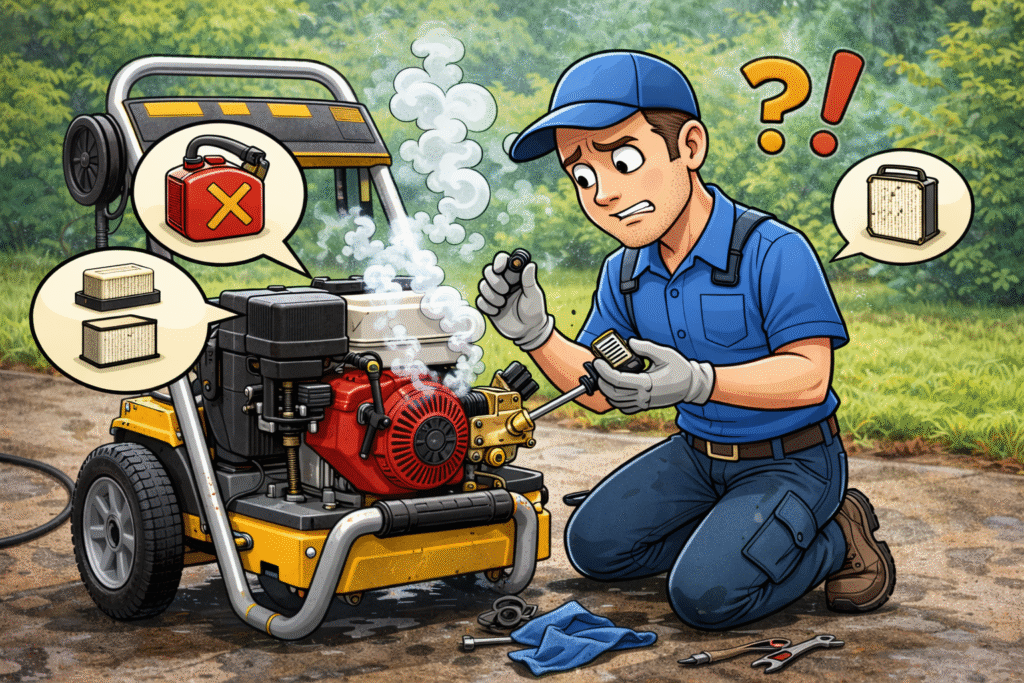
PRESSURE WASHER TROUBLESHOOTING • GAS & ELECTRIC • QUICK CHECKLIST
13 Things to Troubleshoot When My Pressure Washer Won’t Start
Looking for things to troubleshoot when my pressure washer won’t start? Start with the basics: fuel, engine switch, choke, spark plug, air filter, oil level, carburetor, water supply, and—on electric machines—the outlet and GFCI protection.
A pressure washer that refuses to start does not automatically have a failed engine or pump. Gas-powered machines commonly experience fuel, ignition, airflow, or carburetor problems, while electric machines have a different set of electrical and water-supply checks.
This guide walks through 13 pressure washer troubleshooting checks, what each symptom can mean, and when it makes more sense to stop troubleshooting and contact a qualified repair professional.
Quick Answer: What Should I Check First When My Pressure Washer Won’t Start?
For a gas pressure washer, check that the engine switch and fuel valve are on, verify fresh fuel, set the choke correctly, inspect the spark plug and air filter, confirm the oil level, and consider whether stale fuel has affected the carburetor. For an electric pressure washer, check the power source, GFCI/reset device, breaker, cord requirements, water supply, and the instructions in your specific owner’s manual.
GAS ENGINE
Fuel + Spark + Air
These are logical places to begin when a gasoline engine will not start.
ELECTRIC
Power + GFCI
Electrical machines require a different troubleshooting sequence.
IMPORTANT
Check Your Manual
Starting procedures and maintenance requirements vary by manufacturer and model.
Pressure Washer Won’t Start Troubleshooting Checklist
Before You Start: Safety
1. Check the Engine Switch & Fuel Valve
2. Check the Fuel
3. Check the Choke
4. Inspect the Spark Plug
5. Inspect the Air Filter
6. Check Engine Oil
7. Consider Carburetor Problems
8. Check Water Supply
9. Relieve Pump Pressure
10. Check Fuel-Cap Venting
11. Troubleshoot an Electric Pressure Washer
12. If It Starts Then Dies
13. Know When to Stop Troubleshooting
Pressure Washer Troubleshooting FAQ
SAFETY FIRST
Before Troubleshooting a Pressure Washer
Before removing covers, inspecting components, or working around the engine, read the owner’s manual for your specific pressure washer and engine.
Shut the machine off and disconnect the spark-plug lead before performing maintenance where the manufacturer instructs you to do so.
Unplug the unit before inspection or maintenance.
Follow the manufacturer’s procedure for safely relieving pressure before disconnecting hoses or accessories.
Operate gasoline-powered equipment only where the manufacturer permits and where engine exhaust cannot create a carbon-monoxide hazard.
CHECK #1
Check the Engine Switch and Fuel Valve
Start with the controls. Depending on the model, a gasoline pressure washer may have an engine switch, fuel shutoff valve, throttle control, choke, or combination of these.
A pressure washer can appear completely dead when a simple control is still in the OFF or CLOSED position.
- Engine switch in the RUN/ON position
- Fuel valve open, if equipped
- Throttle positioned according to the owner’s manual
- Correct starting sequence for your engine
CHECK #2
Check for Fresh, Correct Fuel
Stale or contaminated gasoline is one of the most useful places to look when a small engine has been sitting unused.
Briggs & Stratton notes that stale untreated gasoline begins breaking down after about a month and identifies stale fuel, dirt, and debris as common causes of outdoor power equipment starting and running problems.
Has the machine been sitting for weeks or months with fuel in it?
Check for contamination and confirm you are using fuel that meets the manufacturer’s requirements.
Use the manufacturer’s instructions for draining or replacing old fuel.
CHECK #3
Make Sure the Choke Is Set Correctly
A cold gasoline engine may require choke during startup, while an already-warm engine may require a different procedure.
Leaving the choke in the wrong position can make starting difficult and can contribute to an overly rich fuel mixture.
Use the choke and throttle positions specified in the manual for your exact engine.
CHECK #4
Inspect the Spark Plug
A disconnected, dirty, fouled, worn, or damaged spark plug can cause hard starting or prevent ignition.
Remove and inspect the plug only according to the engine manufacturer’s procedure.
Heavy deposits or fouling can interfere with reliable ignition.
Cracked porcelain or damaged electrodes can indicate the plug should be replaced.
Spark-plug gap should match the specification for your particular engine.
CHECK #5
Inspect the Air Filter
A gasoline engine needs the correct air-fuel mixture. A severely dirty or oil-soaked air filter can restrict airflow and contribute to poor engine performance.
Different filter types require different service procedures, so check your manual before cleaning or replacing the filter.
Do not assume every foam or paper filter should be cleaned the same way. Follow the filter and engine manufacturer’s instructions.
CHECK #6
Check the Engine Oil Level
Check the engine oil according to the manufacturer’s instructions, with the machine positioned as directed in the manual.
Some engines incorporate low-oil protection systems. An incorrect oil level can therefore be more than a maintenance issue—it may affect operation on certain engines.
Use the oil type, checking procedure, and fill level specified for your particular engine.
CHECK #7
Consider a Dirty or Restricted Carburetor
If a gas pressure washer sat with old fuel in it, the carburetor deserves attention.
The carburetor controls the engine’s air-fuel mixture. Deposits, debris, restricted passages, or sticking components can cause starting and running problems.
Symptoms That Can Point Toward Fuel-Delivery Problems
- Engine cranks or pulls normally but will not start
- Engine starts and quickly dies
- Engine runs poorly or surges
- Problems appeared after long-term storage
Check the owner’s manual and manufacturer service information. Carburetor work can involve fuel leakage, small parts, adjustments, and model-specific procedures.
PRESSURE WASHER WON’T START ON CLEANING DAY?
You Can Fix the Machine—or Skip the Weekend Project
If the pressure washer was supposed to clean your driveway, patio, sidewalk, house, or other exterior surface, compare the time and repair cost with a free professional cleaning estimate from Spotless Cleaning Services and More.
CHECK #8
Check the Water Supply and Inlet
Pressure washers are designed to operate with an adequate water supply. Before operation, confirm the water-supply setup required by your machine.
Confirm the supply valve is fully open when required.
Look for kinks, restrictions, or an undersized supply arrangement.
Check the inlet/filter screen as directed by the manufacturer.
Briggs & Stratton’s pressure-washer troubleshooting guidance specifically includes checking the water inlet and filter screen when diagnosing pressure problems.
CHECK #9
Relieve Pressure Before Pulling the Starter Again
If the starter rope is unusually difficult to pull, trapped pressure in the pump or hose system may be contributing to the resistance.
Follow the manufacturer’s procedure for relieving pressure. On many machines, that involves shutting the unit off and squeezing the spray-gun trigger, but you should use the procedure specified for your equipment.
Stop forcing it. Mechanical problems, pump problems, or engine problems can require professional diagnosis.
CHECK #10
Consider Fuel-Tank Venting
The fuel system needs to deliver gasoline consistently. A venting problem can interfere with fuel flow on some engine designs.
If you suspect a fuel-cap or tank-vent problem, consult the engine manual rather than modifying the cap or operating the machine in a way the manufacturer does not recommend.
CHECK #11
Electric Pressure Washer Won’t Start? Check These Items
An electric pressure washer does not have gasoline, a carburetor, or a spark plug, so don’t use the gas-engine checklist.
Verify the outlet has power using a safe method.
Follow the machine’s instructions for its GFCI or reset device.
Check whether the applicable circuit breaker has tripped.
Use an extension cord only when the manufacturer allows it and only to the required electrical specifications.
Some equipment may shut down when overheated. Consult the manual for reset or cool-down procedures.
Do not use damaged electrical equipment or defeat built-in electrical protection.
The U.S. Consumer Product Safety Commission has specifically warned about shock and electrocution hazards involving electric pressure washers without appropriate GFCI protection.
CHECK #12
What If the Pressure Washer Starts Then Dies?
A pressure washer that starts briefly and then stops gives you a different clue than an engine that never fires at all.
On a gas engine, investigate the fuel supply, carburetor, choke position, air filter, ignition system, and other items specified in the engine manufacturer’s troubleshooting guide.
- Old or contaminated fuel
- Restricted fuel delivery
- Dirty carburetor
- Incorrect choke position
- Dirty or restricted air filter
- Ignition problem
CHECK #13
Know When to Stop Troubleshooting
Basic checks such as verifying controls, fuel condition, oil level, air-filter condition, water supply, and the condition of a replaceable spark plug may be reasonable for many owners.
More advanced troubleshooting can involve ignition testing, carburetor disassembly, compression diagnosis, internal engine repair, electrical diagnosis, or pump repair.
If the basic checks do not identify the problem—or you are not comfortable performing the procedure—use a qualified small-engine or pressure-washer repair professional.
Honda’s current service guidance similarly recommends determining whether the problem is with the engine or the equipment being powered and directs owners toward appropriate servicing dealers when needed.
Pressure Washer Won’t Start: Symptom Guide
| Symptom | Start By Checking |
|---|---|
| Gas engine does nothing | Engine switch, fuel valve, starting procedure, fuel |
| Engine pulls but won’t fire | Fuel, choke, spark plug, ignition, carburetor |
| Starts then dies | Fuel delivery, carburetor, choke, airflow |
| Starter rope is very hard to pull | Stored pressure, pump/engine condition, manufacturer’s troubleshooting procedure |
| Electric unit completely dead | Outlet, GFCI/reset, breaker, approved cord setup |
| Engine runs but no pressure | Water supply, inlet screen, nozzle, hose, pump-related troubleshooting |
Pressure Washer Won’t Start vs Pressure Washer Has No Pressure
These are two different problems.
If the engine or electric motor will not run, troubleshoot the power source or engine first.
If the engine runs normally but the washer produces little or no pressure, the problem may instead involve the water inlet, inlet screen, nozzle, high-pressure hose, pump, or another part of the pressure-producing system.
This distinction can save considerable troubleshooting time.
Briggs & Stratton’s pressure-washer troubleshooting guidance recommends checking items including engine speed, nozzle selection, the water inlet/filter screen, and high-pressure hose when diagnosing low or no pressure.
SARASOTA & MANATEE COUNTIES
Was the Pressure Washer Supposed to Clean Your Property Today?
You don’t necessarily need to repair or replace a pressure washer just to get your exterior cleaning finished. Spotless Cleaning Services and More provides professional residential and commercial exterior cleaning throughout Sarasota and Manatee Counties.
PRESSURE WASHER TROUBLESHOOTING FAQ
Frequently Asked Questions
What are the first things to troubleshoot when my pressure washer won’t start?
For a gas machine, verify the controls and starting procedure, fresh fuel, choke, spark plug, air filter, oil level, and fuel delivery. For an electric machine, begin with the power source, GFCI/reset system, breaker, and manufacturer’s electrical requirements.
Why won’t my pressure washer start after sitting?
Stale fuel and fuel-system deposits are important possibilities on gasoline machines that have been stored. Inspect the fuel and follow the engine manufacturer’s storage and carburetor troubleshooting instructions.
Can a bad spark plug keep a pressure washer from starting?
Yes. A fouled, damaged, improperly gapped, or otherwise faulty spark plug can contribute to starting problems in a gasoline engine.
Can old gas cause a pressure washer not to start?
Yes. Stale or contaminated fuel can contribute to starting problems and can leave deposits in the fuel system and carburetor.
Why does my pressure washer start and then die?
Possible causes include fuel-delivery problems, carburetor restrictions, incorrect choke position, restricted airflow, or ignition problems. Use the troubleshooting procedure for your particular engine.
Why is my pressure washer starter cord hard to pull?
Stored pressure may increase resistance on some setups. Follow the manufacturer’s pressure-relief procedure. If the starter remains abnormally difficult to pull, stop forcing it and investigate possible mechanical or pump problems.
Why won’t my electric pressure washer turn on?
Check the outlet, GFCI or reset device, circuit breaker, approved cord configuration, water setup, and any thermal-protection procedure described in the owner’s manual.
Can low oil keep a pressure washer from starting?
Some gasoline engines use low-oil protection systems. Check the oil level and the documentation for your specific engine.
Why does my pressure washer run but have no pressure?
If the engine or motor runs but pressure is low, investigate the water supply, inlet/filter screen, nozzle, high-pressure hose, and pump-related troubleshooting specified by the manufacturer.
When should I take my pressure washer to a repair shop?
If basic maintenance checks do not solve the problem, or diagnosis requires carburetor disassembly, ignition testing, compression testing, electrical repair, or internal pump or engine work you are not qualified to perform, consider professional service.
SPOTLESS CLEANING SERVICES AND MORE
Skip the Pressure Washer Troubleshooting and Get the Cleaning Done
If your real goal is a clean driveway, sidewalk, patio, house, or commercial property, let our professional equipment handle the project. We serve Sarasota and Manatee Counties and surrounding Southwest Florida communities.

No Comments