
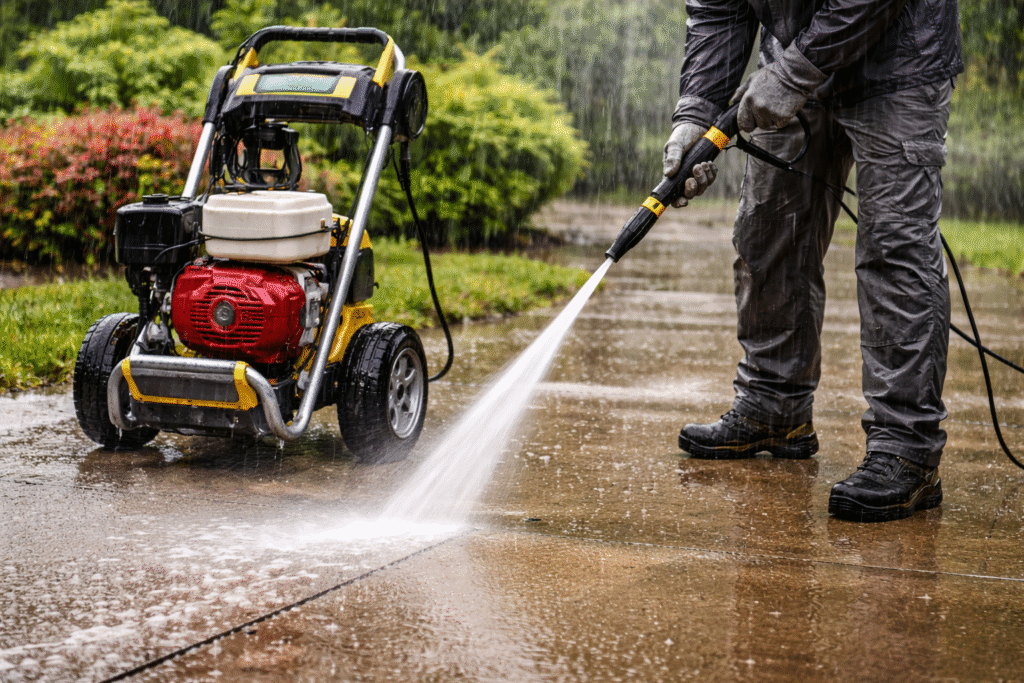
RAINY WEATHER • PRESSURE WASHING SAFETY • FLORIDA EXTERIOR CLEANING
Should You Pressure Wash in the Rain? Safety, Results & Best Practices
Should you pressure wash in the rain? Light rain by itself does not always make exterior cleaning impossible, but the answer depends on the weather, equipment, surface, cleaning chemistry, visibility, footing, and what you plan to do after cleaning.
A light Florida drizzle is very different from a thunderstorm. If there is thunder, lightning, strong wind, unsafe footing, poor visibility, or an electrical hazard, pressure washing should be postponed.
At Spotless Cleaning Services and More, we provide residential and commercial pressure washing throughout Sarasota and Manatee Counties and adjust our cleaning schedule and process around actual weather conditions—not simply whether a few raindrops are falling.
Quick Answer: Can You Pressure Wash in the Rain?
Sometimes. Light rain with no lightning, no strong wind, safe footing, good visibility, and equipment suitable for the conditions may not prevent certain exterior-cleaning work. However, you should stop or postpone the job during thunderstorms, lightning, heavy rain, strong wind, flooding, unsafe footing, or conditions that interfere with electrical safety or the required cleaning process. Projects followed by painting, staining, or sealing generally need adequate drying time afterward.
LIGHT DRIZZLE
May Be Workable
Only when visibility, traction, equipment safety, and the cleaning process remain acceptable.
THUNDER OR LIGHTNING
Stop Immediately
The National Weather Service says there is no safe place outdoors when thunderstorms are nearby.
PAINT / STAIN / SEALER
Drying Matters
Cleaning may be only one step; coatings often require a properly dried surface afterward.
Pressure Washing in the Rain Guide
2. When Light Rain May Be Acceptable
4. Electric Pressure Washer Risks
5. Rain, Detergent & Dwell Time
6. Driveways, Houses, Roofs & Decks
7. Painting, Staining & Sealing
MORE THAN RAINFALL
Why Weather Matters During Pressure Washing
Pressure washing already introduces water onto surfaces, so rain itself is not automatically the problem.
The bigger issue is what the weather does to safety, visibility, traction, chemical performance, runoff, and the next stage of the project.
Visibility
Heavy rainfall can make it harder to inspect the surface and see missed areas or irregular cleaning.
Traction
Algae, wet concrete, painted surfaces, decks, ladders, and slopes can become more hazardous.
Chemical Performance
Heavy rain can dilute or remove cleaning solution before it has enough time to work.
Runoff
Rainfall can increase water movement and complicate control of dirty water and cleaning solution.
Wind
Wind can carry overspray and cleaning solution toward unintended surfaces, landscaping, vehicles, or neighboring property.
Drying
Persistent rain and humidity can delay projects that require a dry surface afterward.
LIGHT DRIZZLE
Can You Pressure Wash in Light Rain?
In some situations, yes.
A very light drizzle without thunder, lightning, strong wind, standing water, or visibility problems may not prevent certain pressure-washing projects.
In fact, the surface being wet is not inherently unusual during exterior cleaning—the cleaning process itself wets the property.
Light Rain Is Not the Same as a Thunderstorm
The decision should be based on the entire weather situation. A few raindrops may be manageable. Lightning, gusty wind, poor traction, heavy runoff, and dangerous electrical conditions are not.
A Light-Rain Job May Be Reasonable When:
- There is no thunder or lightning
- Wind is mild
- Visibility remains good
- The work area has safe footing
- Water is draining normally
- The equipment is being used according to manufacturer instructions
- The cleaning chemistry can still perform properly
- No immediate coating or sealing step requires a dry surface
HARD STOP
Never Pressure Wash Outdoors During a Thunderstorm
This is the clearest weather rule in the entire article.
The National Weather Service states that there is no safe place outdoors when thunderstorms are in the area and advises people to move indoors when thunder is heard.
That means the issue is not whether rain is falling heavily at your exact location.
If you hear thunder, stop the outdoor work and move to an appropriate shelter.
Thunder = Stop the Job
The National Weather Service recommends staying in safe shelter for at least 30 minutes after the last sound of thunder before resuming outdoor activities.
ELECTRICAL SAFETY
What About an Electric Pressure Washer in the Rain?
Corded electric pressure washers deserve additional caution because water and electricity are being used in the same work area.
Follow the manufacturer’s instructions for the specific machine, including its GFCI or immersion-protection system, approved outlets, extension-cord rules, and weather limitations.
Do not defeat or bypass electrical protection devices.
The U.S. Consumer Product Safety Commission has issued multiple 2026 pressure-washer recalls and warnings involving electric machines that lacked integral ground-fault circuit-interrupter protection because of shock and electrocution hazards.
Best Homeowner Rule
If you are uncertain whether your electric pressure washer, outlet, cord, GFCI protection, or connections are appropriate for wet conditions, postpone the job rather than improvising around an electrical hazard.
FLORIDA WEATHER CHANGES FAST
Let Us Handle the Cleaning Schedule
Get a free residential or commercial exterior-cleaning estimate. We can evaluate the surface, cleaning method, and weather conditions for your project.
How Rain Affects Detergent and Dwell Time
Professional exterior cleaning is not always about water pressure.
Cleaning products frequently need time on the surface before rinsing. That period is often called dwell time.
Light moisture may be manageable, but steady or heavy rain can dilute a cleaning solution or wash it off before it has enough time to work.
Organic Buildup
Soft-washing chemistry often needs controlled contact with the surface.
Oil & Grease
Degreasers may need sufficient contact time to loosen contamination.
Rust Treatments
Specialty chemistry should be applied according to its product instructions rather than during uncontrolled rainfall.
Rain Can Also Work the Other Direction
Bright sun and high surface temperatures can cause some cleaning products to dry too quickly. Professional cleaners monitor temperature, sunlight, rain, wind, and dwell time together rather than assuming that “dry weather” automatically means ideal cleaning conditions.
Read:
Why Sodium Hypochlorite Is Used in Exterior Cleaning →
Does the Surface Change Whether You Can Clean in the Rain?
Absolutely.
Different surfaces require different cleaning methods, and rain may affect each process differently.
Concrete Driveways
Light rain may not automatically prevent mechanical cleaning, provided footing, visibility, runoff, and equipment operation remain safe.
House Washing
Heavy rainfall can affect chemical concentration and application control. Wind can also create unwanted overspray.
Roofs
Wet roofing already creates significant footing concerns. Roof cleaning should not be treated like ordinary driveway cleaning, especially during unstable weather.
Wood Decks
Cleaning may be possible under appropriate conditions, but staining afterward requires the wood to reach the moisture condition required by the coating manufacturer.
WHAT COMES NEXT?
Pressure Washing Before Painting, Staining or Sealing
The cleaning portion of the job may be possible under damp conditions, but that does not mean the next step can begin immediately.
Paints, stains, and sealers have their own surface-preparation and moisture requirements.
EPA mold guidance also emphasizes cleaning moldy hard surfaces and drying them completely before painting or caulking.
Do Not Use a Generic “24–48 Hour Rule” for Every Coating
Drying time depends on the material, rainfall, humidity, airflow, temperature, shade, and the product being applied. Follow the paint, stain, or sealer manufacturer’s moisture and application requirements.
EPA: Mold, Moisture and Drying Guidance →
Related guides:
Pressure Washing Before House Painting
and
Pressure Washing Before Deck Staining
.
When You Should NOT Pressure Wash in the Rain
Thunder or Lightning
Stop outdoor work and move to appropriate shelter.
Heavy Rain
Poor visibility and uncontrolled runoff can make the job impractical or unsafe.
Strong Wind
Overspray and chemicals can move toward unintended surfaces.
Unsafe Footing
Slippery surfaces, slopes, ladders, and roofs require additional caution.
Electrical Uncertainty
Do not improvise around wet cords, outlets, plugs, or missing electrical protection.
Chemistry Is Washing Away
If the treatment cannot remain on the surface as required, continuing may waste product and reduce cleaning performance.
PROFESSIONAL DECISION PROCESS
How Professionals Evaluate a Rainy Pressure-Washing Day
1
Check for Thunderstorms
Lightning risk overrides the cleaning schedule.
2
Evaluate Wind & Visibility
Determine whether spray can be controlled and the work area can be inspected properly.
3
Evaluate Footing
Consider concrete, tile, algae, roofs, decks, slopes, stairs, and standing water.
4
Evaluate the Cleaning Chemistry
Decide whether rain will interfere with concentration, dwell time, application control, or runoff management.
5
Consider What Happens After Cleaning
If staining, painting, sealing, or another moisture-sensitive process follows, drying conditions matter.
6
Reschedule When Conditions Stop Making Sense
Finishing a job today is never more important than completing it safely and correctly.
Pressure Washing in Florida’s Rainy Climate
Sarasota and Manatee Counties frequently experience fast-changing weather, particularly during Florida’s warmer and wetter months.
A property can move from sunshine to a passing shower and back again quickly.
That is why professional scheduling should consider the type of project instead of assuming every chance of rain requires cancellation—or that every rainy day is safe to continue working through.
Read more about
the effects of Florida humidity on exterior surfaces
and
why mold and algae grow quickly in Sarasota
.
SARASOTA & MANATEE COUNTIES
Don’t Let Florida Weather Turn Into a DIY Headache
Get a free estimate for driveway cleaning, house washing, roof cleaning, concrete cleaning, commercial pressure washing, and other exterior services.
FREQUENTLY ASKED QUESTIONS
Should You Pressure Wash in the Rain? FAQ
Should you pressure wash in the rain?
Light rain may be workable for some exterior-cleaning projects if there is no lightning, strong wind, unsafe footing, electrical hazard, visibility problem, or interference with the cleaning process. Heavy rain and thunderstorms are good reasons to postpone.
Can you pressure wash in light drizzle?
Potentially, depending on the surface, equipment, wind, traction, visibility, cleaning chemistry, and manufacturer instructions.
Should you pressure wash during a thunderstorm?
No. The National Weather Service states that there is no safe place outdoors when thunderstorms are in the area. If you hear thunder, move indoors and wait at least 30 minutes after the last thunder before resuming outdoor activity.
Can I use an electric pressure washer in the rain?
Follow the manufacturer’s specific instructions and electrical requirements. Because pressure washing combines electricity and water, do not use equipment with damaged cords, unsafe connections, missing GFCI protection, or conditions outside the manufacturer’s intended use.
Does rain ruin pressure washing results?
Not automatically. Light rain may have little effect on some mechanical cleaning, while heavier rain can reduce visibility, increase runoff, dilute detergents, and interfere with chemical dwell time.
Can you pressure wash a driveway before rain?
Yes, depending on the cleaning method and what happens after the cleaning. If the driveway will be sealed or coated afterward, the surface needs to meet the sealer or coating manufacturer’s moisture requirements.
Can you pressure wash a house before rain?
Potentially. However, heavy rain or wind may interfere with cleaning chemistry, overspray control, inspection, and rinsing.
Should I pressure wash my deck before rain?
The cleaning itself may be possible depending on conditions, but if staining or sealing follows, the deck must meet the coating manufacturer’s drying and moisture requirements first.
Does rain wash pressure-washing detergent away?
Heavy or sustained rainfall can dilute cleaning products or wash them away before the intended dwell time is complete.
How do I get a professional pressure-washing estimate?
Call Spotless Cleaning Services and More at
(813) 606-7589,
text us for an estimate, or
request a free estimate online.
SPOTLESS CLEANING SERVICES AND MORE
Rain or Shine, the Cleaning Method Still Has to Make Sense
Let us evaluate the property, surface, contamination, cleaning process, and weather conditions instead of guessing whether today’s conditions are right for the job.

No Comments