
Professional Driveway Cleaning • Sarasota & Manatee County
How Long Does It Take to Pressure Wash a Driveway?
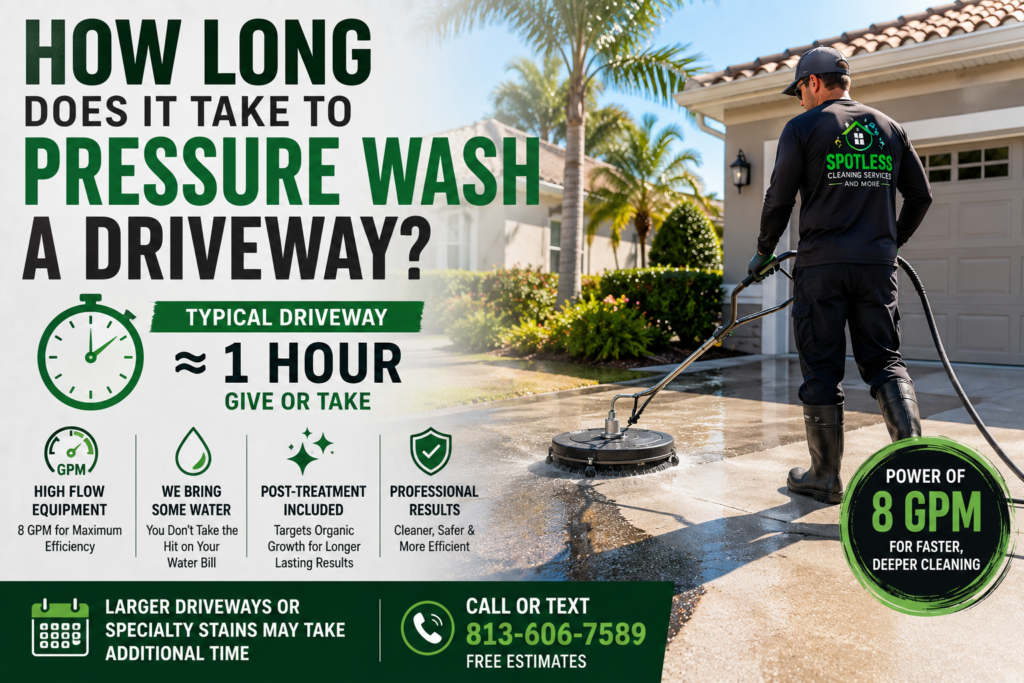
How long does it take to pressure wash a driveway? For Spotless Cleaning Services and More, a typical residential driveway commonly takes approximately 1 hour, give or take, to professionally pressure wash and clean.
That does not mean every driveway takes exactly one hour.
A larger driveway, unusually heavy organic buildup, extensive sidewalks, difficult access, oil staining, rust staining or other specialty stain-removal work can increase the amount of time required.
One of the biggest reasons professional driveway-cleaning times can be different from DIY cleaning times is equipment.
And when discussing pressure-washing equipment, homeowners should look at more than PSI.
Gallons per minute—or GPM—is extremely important for cleaning efficiency and speed.
Spotless Cleaning Services and More uses commercial-grade pressure-washing equipment capable of substantially greater water flow than many smaller homeowner machines. Greater GPM gives us significantly more water volume for cleaning and rinsing large flat surfaces such as concrete driveways.
We also normally bring some water with us, so customers shouldn’t assume the entire water demand of the project will necessarily be placed on their home’s water supply.
How Long Does It Take to Pressure Wash a Driveway? Quick Answer
Typical Driveway
A typical residential driveway will commonly take us approximately one hour, give or take, depending on the property.
Larger Driveway
Larger driveways naturally have more square footage and may require additional cleaning and rinsing time.
Specialty Stains
Rust, oil and other specialty stains may require separate treatments beyond normal driveway pressure washing.
For a normal residential driveway, approximately one hour, give or take, is a reasonable expectation for the professional process used by Spotless Cleaning Services and More. Larger driveways, unusually dirty concrete and specialty stain-removal treatments can require additional time.
If you’re also comparing price, read our guide to how much driveway pressure washing costs in Sarasota.
Table of Contents
- How Long Does It Take to Pressure Wash a Driveway?
- What Affects Driveway Pressure Washing Time?
- Why GPM Matters for Driveway Cleaning Speed
- PSI vs. GPM: What’s More Important?
- Professional vs. Homeowner Equipment
- Why Professional Surface Cleaners Matter
- How Driveway Size Changes Cleaning Time
- Rust, Oil and Specialty Stain Removal
- Why We Post-Treat Concrete
- Will Pressure Washing My Driveway Increase My Water Bill?
- Our Professional Driveway Cleaning Process
- Professional vs. DIY Driveway Cleaning Time
- Driveway Cleaning in Sarasota & Bradenton
- Frequently Asked Questions
What Affects How Long It Takes to Pressure Wash a Driveway?
When homeowners ask how long does it take to pressure wash a driveway, the size of the driveway is usually the first thing they think about.
Size certainly matters, but it isn’t the only factor.
Driveway Size
A two-car residential driveway requires less surface-cleaning time than an oversized driveway with a large parking area.
Concrete Condition
Heavy organic buildup and neglected concrete can require additional treatment and attention.
GPM
Water-flow capacity has a major impact on how efficiently large flat surfaces can be cleaned and rinsed.
Additional Flatwork
Sidewalks, walkways, patios and other concrete added to the project increase total cleaning area.
Rust & Oil
Specialty stains can require additional chemistry and procedures beyond standard pressure washing.
Access
Vehicle placement, equipment access, drainage and the overall property layout can affect workflow.
That’s why we don’t promise every driveway will take exactly 60 minutes.
Approximately one hour is a useful typical estimate—not a one-size-fits-all guarantee.
Why GPM Matters When Determining How Long It Takes to Pressure Wash a Driveway
This is one of the most important concepts for homeowners to understand.
People frequently compare pressure washers based almost entirely on PSI.
PSI matters—but PSI is only part of the equation.
GPM means gallons per minute.
It measures the amount of water the pressure-washing system can move every minute.
When you’re cleaning a large flat surface such as a driveway, water volume matters tremendously.
You need enough pressure to perform the work appropriately, but you also need sufficient water flow to move contaminants and rinse the surface efficiently.
Typical Example of Smaller Equipment
Approximately 180 gallons of theoretical flow capacity per hour if operated continuously at 3 GPM.
Spotless Commercial Equipment Example
Approximately 480 gallons of theoretical flow capacity per hour if operated continuously at 8 GPM.
Mathematically, an 8 GPM system has approximately 2.67 times the water-flow rate of a 3 GPM system.
That does not mean an 8 GPM machine automatically cleans every driveway exactly 2.67 times faster.
Real-world production depends on equipment configuration, surface-cleaner size, pressure, nozzle selection, concrete condition, operator technique, water supply, chemistry and other factors.
But the comparison demonstrates why professional water-flow capacity matters.
Cleaning a driveway isn’t simply about generating the highest possible PSI. Moving a greater volume of water can make large-area surface cleaning and rinsing considerably more efficient.
For a deeper explanation, read our guide to PSI vs. GPM and choosing the right pressure washer.
PSI vs. GPM: Which Matters More for Driveway Pressure Washing?
Neither specification should be considered completely by itself.
PSI stands for pounds per square inch and describes pressure.
GPM stands for gallons per minute and describes water flow.
A common misconception is that more PSI automatically means faster cleaning.
That’s not necessarily true.
Once you have appropriate pressure for the surface and cleaning method, additional water volume can become extremely valuable for production efficiency.
Think about rinsing a large concrete driveway.
A tiny stream of water under significant pressure may have force, but it doesn’t necessarily move a large volume of dirty water efficiently.
Professional equipment combines the appropriate pressure with substantial flow.
That combination helps us clean large areas efficiently instead of relying solely on excessive pressure.
Concrete is durable, but improper pressure-washing technique can still damage surfaces. Professional driveway cleaning is about using appropriate equipment and technique—not simply turning pressure as high as possible.
You can learn more in our guide discussing whether pressure washing can damage concrete and how to prevent it.
For additional equipment information, see SIMPSON’s explanation of PSI versus GPM.
Professional Equipment Can Dramatically Change Driveway Cleaning Time
Suppose two people need to clean the exact same driveway.
One has a smaller homeowner pressure washer.
The other has commercial-grade equipment designed for professional production work.
Even if both operators understand how to clean concrete, their production rates can be substantially different.
Why?
Equipment capacity.
Commercial equipment can provide greater flow, appropriate pressure, larger surface-cleaning capability and faster rinsing.
That’s one reason someone attempting to clean a driveway themselves may spend several hours on a project that our professional setup can often complete in approximately an hour.
Again, faster doesn’t automatically mean better.
And slower doesn’t automatically mean more thorough.
Efficiency comes from matching appropriate equipment, technique and cleaning chemistry to the surface.
Why Professional Surface Cleaners Make Driveway Pressure Washing Faster
If you’ve ever watched someone clean an entire driveway using only a pressure-washing wand, you’ve probably seen how slow the process can become.
A professional surface cleaner is designed specifically for flatwork.
Instead of cleaning a narrow strip at a time with a wand, rotating spray nozzles clean a wider, controlled area as the operator moves across the driveway.
This improves production efficiency and helps produce a more uniform result when the equipment is used properly.
Professional surface cleaners also need sufficient water flow.
That’s another reason GPM matters.
The pressure washer, hose, nozzles and surface cleaner function as a system.
The professional advantage isn’t one magic specification. It’s the complete equipment setup.
How Driveway Size Changes Pressure Washing Time
A typical residential driveway may take approximately one hour, but driveway dimensions vary considerably.
| Driveway / Project Type | General Time Expectation | Possible Additional Factors |
|---|---|---|
| Typical Residential Driveway | Approximately 1 hour, give or take | Condition, layout and organic buildup |
| Larger Driveway | May take longer than 1 hour | Additional square footage and rinsing |
| Driveway + Sidewalks | Additional time may be required | Total flatwork being cleaned |
| Driveway With Heavy Growth | May require additional time | Condition and treatment requirements |
| Driveway With Rust/Oil/Specialty Stains | Evaluated individually | Specialty chemistry and stain-removal procedures |
So if your driveway is unusually large, don’t worry if your estimate differs from the approximately one-hour figure discussed throughout this article.
We’re going to look at your actual driveway.
Rust, Oil and Specialty Stains Can Increase Driveway Cleaning Time
There is an important difference between ordinary driveway cleaning and specialty stain removal.
Pressure washing can remove substantial surface contamination, but certain stains require specialized treatment.
Rust Stains
Rust staining can be caused by irrigation, metal objects, fertilizer and other sources.
Rust removal generally requires the appropriate specialty chemical treatment rather than simply applying more pressure.
Trying to blast stubborn rust away with excessive pressure is not our approach.
If rust removal is part of the project, it can increase the amount of time required.
Learn more about our professional rust-removal services.
Oil Stains
Oil is another example of a contaminant that can require additional treatment.
How much improvement is possible can depend on the oil, how long it has been present, the porosity of the concrete and previous cleaning attempts.
Our goal is to set realistic expectations rather than tell customers every stain disappears through pressure alone.
If your driveway has rust, irrigation staining, oil or another unusual contaminant, tell us when requesting your estimate so we can evaluate the appropriate process.
Why Spotless Post-Treats Driveways After Pressure Washing
There is another important difference between simply pressure washing concrete and the process we use at Spotless Cleaning Services and More.
On appropriate flat surfaces, we use a post-treatment with sodium hypochlorite after the mechanical cleaning process.
Why?
Because making a driveway look clean and addressing the organic contamination are not necessarily the same thing.
Pressure washing and surface cleaning can physically remove the visible buildup from the concrete.
But microscopic organic contamination can remain even though you can’t easily see it aesthetically.
That’s one reason a driveway can sometimes begin looking dirty again surprisingly quickly.
Our post-treatment is intended to address remaining organic matter after the physical cleaning process.
We don’t want to merely make the driveway look cleaner at the moment we leave. We want to address the biological contamination contributing to the dirty appearance.
This extra step is part of the value customers receive from a professional driveway-cleaning process.
For more information, read our article explaining why sodium hypochlorite is used in professional pressure washing.
Will Pressure Washing My Driveway Cause a High Water Bill?
This is a reasonable question—especially after learning why professional equipment with higher GPM can improve cleaning efficiency.
Customers sometimes hear that we use high-flow commercial equipment and immediately think:
“Is all of that water going to come from my house?”
Not necessarily.
Spotless Cleaning Services and More normally brings some water with us.
That means customers shouldn’t automatically assume that all of the water required for the driveway-cleaning project will be supplied through their home’s water meter.
Depending on the project, available supply and equipment configuration, we may use the customer’s water source as part of the cleaning operation, but bringing some water gives us additional capacity and helps support our professional equipment.
We normally bring some water with us. While the amount required varies by job and we may still use water from the property when appropriate, you should not assume that every gallon used during the cleaning process is necessarily coming through your home’s water meter.
Does 8 GPM Mean 480 Gallons Will Come From My House During a One-Hour Job?
No.
This is an important distinction.
An 8 GPM rating means the equipment is capable of moving approximately eight gallons per minute under the applicable operating conditions.
Multiplying 8 GPM by 60 minutes gives 480 gallons of theoretical continuous flow.
That calculation is useful for understanding equipment capacity.
It does not mean your home’s meter will necessarily show an additional 480 gallons for a one-hour driveway cleaning.
The equipment isn’t necessarily spraying continuously for every second of the appointment, and, importantly, we normally arrive carrying some water of our own.
Actual customer-supplied water use depends on the individual job.
So we don’t promise an exact number of gallons or an exact change to a customer’s utility bill.
What we can tell you is that bringing some water is another part of how our professional setup differs from someone arriving with a small pressure washer and depending entirely on the customer’s garden hose from beginning to end.
Want Your Driveway Cleaned Without Spending Your Day Doing It Yourself?
A typical residential driveway can often be professionally cleaned by Spotless Cleaning Services and More in approximately one hour, give or take.
Commercial-grade equipment. Professional surface cleaning. Post-treatment for organic contamination. And we normally bring some water with us.
CALL 813-606-7589
TEXT FOR A QUOTE
DRIVEWAY CLEANING SERVICES
Our Professional Driveway Pressure Washing Process
When we say a typical driveway commonly takes approximately an hour, that doesn’t mean we’re simply pointing a pressure-washing wand at the concrete for 60 minutes.
Professional driveway cleaning is a process.
Evaluate
We evaluate the driveway’s size, condition, drainage and any unusual staining.
Prepare
Vehicles and movable objects are cleared from the work area and the cleaning setup is prepared.
Treat
Cleaning chemistry can be applied as appropriate for the contamination and surface.
Surface Clean
Professional equipment is used to clean the driveway efficiently and uniformly.
Rinse
Commercial water-flow capacity helps us move dirty water and rinse the cleaned area efficiently.
Post-Treat
On appropriate flatwork, sodium hypochlorite post-treatment helps target remaining organic contamination.
How Long Does It Take to Pressure Wash a Driveway Yourself?
DIY driveway pressure washing can take considerably longer than professional cleaning.
Why?
The pressure washer itself is only one factor.
A homeowner has to:
- Purchase or rent equipment
- Transport the equipment
- Set everything up
- Learn how to operate it
- Select the appropriate nozzles
- Determine appropriate pressure
- Manage hoses
- Clean the entire surface
- Rinse the driveway
- Address stains
- Clean and return rented equipment if applicable
A homeowner may also be using equipment with substantially less water-flow capacity than a professional machine.
So if it takes someone several hours to pressure wash their driveway themselves, that doesn’t mean Spotless will necessarily need the same amount of time.
Our equipment and workflow are designed for professional production.
If you are considering doing it yourself, you can also read our guide on how to pressure wash a driveway.
Professional Driveway and Concrete Cleaning Services
Spotless Cleaning Services and More provides professional driveway and concrete cleaning throughout our service area.
If you’re ready to move from researching how long does it take to pressure wash a driveway to getting your driveway professionally cleaned, these resources can help:
Driveway Cleaning
Learn about our dedicated residential driveway-cleaning service.
Concrete Cleaning
Need more than the driveway cleaned? Explore our professional concrete-cleaning options.
Driveway Cleaning Cost
Learn what affects the price of professional driveway pressure washing in Sarasota.
How Long Does It Take to Pressure Wash a Driveway in Sarasota, Florida?
For many of the typical residential driveways we encounter in Sarasota and surrounding communities, approximately one hour, give or take, is a useful general estimate.
Florida conditions can create their own cleaning challenges.
Heat, humidity, rain and moisture can encourage recurring organic growth on exterior surfaces.
Driveways can develop dark organic staining, green growth and other discoloration that gradually reduces curb appeal.
This is another reason our post-treatment process matters.
Mechanical surface cleaning handles the visible buildup, while appropriate post-treatment helps address remaining organic contamination.
We provide concrete and driveway cleaning in Sarasota, Bradenton and other communities throughout Sarasota and Manatee counties.
Why Hire Spotless Instead of Spending Hours Pressure Washing Your Driveway Yourself?
The biggest benefit isn’t simply that we own a pressure washer.
It’s the complete professional setup and process.
Commercial-Grade Equipment
Higher-flow professional equipment allows us to clean and rinse large flat surfaces efficiently.
Professional Surface Cleaning
Equipment designed for flatwork helps produce consistent results across the driveway.
Post-Treatment
We don’t necessarily stop when the concrete merely looks clean. Appropriate post-treatment helps address remaining organic contamination.
We Normally Bring Some Water
Customers shouldn’t automatically assume the project’s entire water demand will come through their household water meter.
Specialty Stain Knowledge
Rust and oil aren’t necessarily solved by simply applying more pressure. We can evaluate specialty treatment requirements.
Time Savings
A typical driveway commonly takes us approximately one hour, give or take, allowing you to spend your time elsewhere.
Additional Pressure Washing and Water-Efficiency Resources
If you’d like to learn more about pressure-washing equipment and responsible water use, the following resources provide additional information:
- SIMPSON Cleaning – PSI vs. GPM
- U.S. EPA WaterSense – Outdoor Water Use
- U.S. EPA WaterSense – How We Use Water
These are standard links without a nofollow attribute.
Get Your Driveway Professionally Cleaned
Don’t spend your Saturday fighting with a small homeowner pressure washer.
Let our commercial-grade equipment do what it was built to do.
Typical residential driveway: approximately 1 hour, give or take.
How Long Does It Take to Pressure Wash a Driveway? FAQ
How long does it take to pressure wash a driveway?
A typical residential driveway commonly takes Spotless Cleaning Services and More approximately one hour, give or take. Larger driveways, unusually heavy buildup, additional flatwork or specialty stain removal can require more time.
Can a driveway be professionally pressure washed in one hour?
Yes. With the commercial-grade equipment and workflow used by Spotless Cleaning Services and More, approximately one hour is common for a typical residential driveway. Every property is different, so this should be treated as a general estimate rather than a guarantee.
Why does professional driveway pressure washing take less time than DIY cleaning?
Professional equipment can provide substantially greater water flow, appropriate pressure and surface-cleaning capacity. Professional operators also have an established workflow and experience using the equipment.
What does GPM mean on a pressure washer?
GPM means gallons per minute. It describes how much water a pressure-washing system can move each minute.
Is GPM or PSI more important for driveway pressure washing?
Both matter. PSI describes pressure, while GPM describes water flow. For cleaning large flat surfaces efficiently, sufficient water flow can be extremely important. Professional performance depends on the complete equipment setup rather than one specification alone.
Does higher PSI mean a driveway will get cleaned faster?
Not necessarily. Once sufficient pressure is available for the cleaning process, greater PSI alone does not guarantee faster or better cleaning. Excessive pressure can also be inappropriate for concrete surfaces.
How much more water does an 8 GPM machine move than a 3 GPM machine?
An 8 GPM system has approximately 2.67 times the flow rate of a 3 GPM system. That does not mean every project is completed exactly 2.67 times faster because real-world cleaning time depends on many additional factors.
Does a larger driveway take longer to pressure wash?
Usually, yes. A larger driveway has more square footage requiring treatment, surface cleaning and rinsing.
Does rust removal make driveway cleaning take longer?
It can. Rust is a specialty stain that may require dedicated chemical treatment rather than ordinary pressure washing alone.
Does oil stain removal take additional time?
It can. Oil staining may require additional treatment, and results depend on factors including the age and severity of the stain and the condition and porosity of the concrete.
Does Spotless post-treat driveways after pressure washing?
On appropriate flat surfaces, Spotless Cleaning Services and More uses a sodium-hypochlorite post-treatment to help target organic contamination that can remain after the mechanical cleaning process.
Why post-treat concrete if it already looks clean?
Pressure washing can remove visible buildup while microscopic organic contamination may remain. Appropriate post-treatment helps address that remaining organic matter instead of relying solely on the immediate visual appearance.
Will pressure washing my driveway cause a high water bill?
Spotless Cleaning Services and More normally brings some water to the project. We may still use water from the property when appropriate, and actual customer-supplied water use varies by job, but customers should not assume that every gallon used during the cleaning process will necessarily come through their household water meter.
Does an 8 GPM pressure washer mean 480 gallons will come from my house in one hour?
No. Eight GPM represents equipment flow capacity. It does not mean the machine runs continuously for every second of the appointment or that all water used comes from the customer’s property. Spotless normally brings some water with us, and actual customer-supplied water use varies by project.
Do you provide driveway cleaning in Sarasota?
Yes. Spotless Cleaning Services and More provides professional driveway and concrete cleaning in Sarasota and surrounding communities.
How can I get an estimate for driveway pressure washing?
Call or text 813-606-7589 or request a free estimate through our website. We can evaluate the driveway’s size, condition and any specialty staining requiring additional treatment.
How Long Does It Take to Pressure Wash a Driveway? The Bottom Line
How long does it take to pressure wash a driveway?
For Spotless Cleaning Services and More, a typical residential driveway commonly takes approximately one hour, give or take.
Some driveways take less time.
Others take longer.
A large driveway, additional sidewalks, heavy organic growth, rust, oil or specialty stain-removal requirements can increase the project’s duration.
But one of the biggest reasons our professional cleaning time can differ dramatically from DIY driveway pressure washing is the equipment being used.
It’s not just about PSI.
GPM matters.
Professional high-flow equipment can move substantially more water per minute than many smaller homeowner machines.
That water-flow capacity helps improve surface-cleaning and rinsing efficiency.
And we don’t simply stop once the driveway appears cleaner.
On appropriate flatwork, our process includes a sodium-hypochlorite post-treatment designed to help address remaining organic contamination.
We’re trying to address what’s contributing to the dirty appearance—not merely make the concrete look better for a photograph.
And if you’re worried that professional high-flow equipment automatically means a huge amount of water will be pulled through your home’s meter, remember another important part of our setup:
Spotless Cleaning Services and More normally brings some water with us.
Actual water requirements vary from job to job, and we may still use the property’s water supply when appropriate, but the customer shouldn’t assume that the entire project’s water demand will necessarily come from their home.
That’s the difference between comparing pressure washers based solely on PSI and looking at the complete professional cleaning system.
Ready for a Cleaner Driveway?
Get professional driveway cleaning from Spotless Cleaning Services and More.
Typical Driveway ≈ 1 Hour, Give or Take
Commercial-Grade Equipment
High-Flow Professional Cleaning
Professional Surface Cleaning
Sodium-Hypochlorite Post-Treatment
Specialty Rust & Stain Removal Available
We Normally Bring Some Water

No Comments