
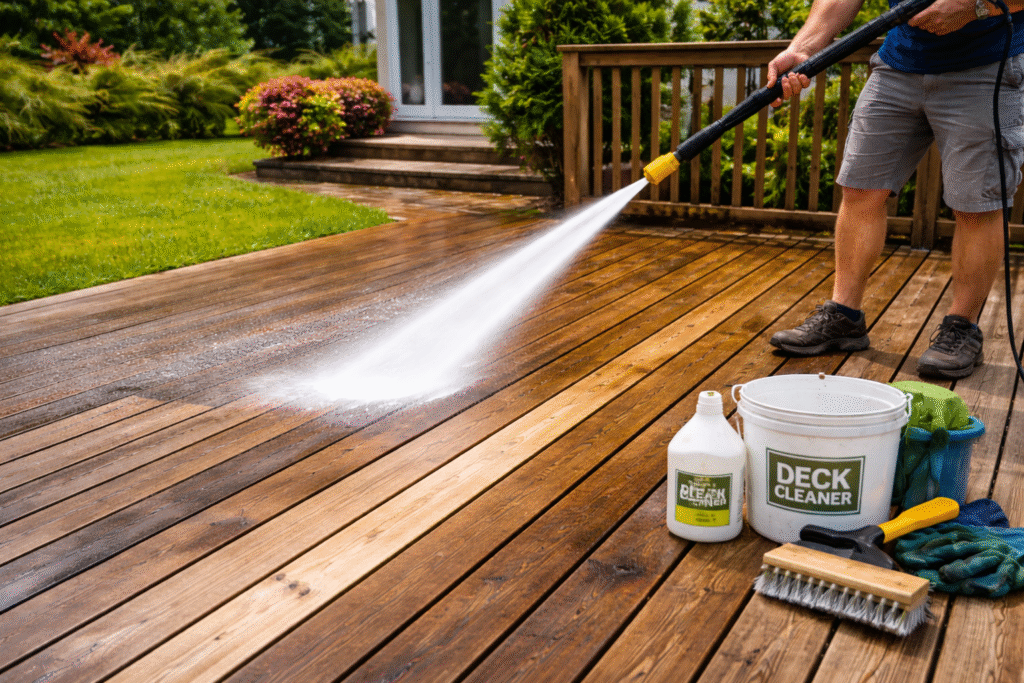
Deck Prep Guide • Wood Cleaning • Staining Preparation • Pressure Washing
Should I Pressure Wash My Deck Before Staining It? The Right Way to Prepare Wood
Should I pressure wash my deck before staining it? Often, yes—but the real goal is not “pressure washing.” The goal is to get the wood clean, dry, sound, and ready to accept the new stain without damaging the fibers you are trying to protect.
Pressure washing can be useful for removing dirt and rinsing away loosened organic buildup, but too much pressure can fur the grain, splinter boards, create wand marks, or force you to sand more aggressively before staining. In many cases, the safest process is wood cleaner first, controlled rinsing second, drying and sanding as needed, then stain according to the coating manufacturer’s instructions.
The Short Answer
Clean the Deck Before Staining—But Do Not Assume Maximum Pressure Is the Best Prep
A clean surface is essential for a good stain job. That does not mean every deck must be pressure washed the same way.
Sherwin-Williams advises that a deck should be clean, dry, and free of dirt, wood fibers, grease, and mildew before stain is applied. Their preparation process uses cleaner, scrubbing, and thorough rinsing, and it allows a pressure washer as one rinsing option when used with controlled settings and technique.
BEHR’s deck-staining guide likewise starts with cleaning, scrubbing, rinsing, and allowing the deck to dry completely before staining. If loose fibers remain, BEHR recommends light sanding before the stain goes on.
That is a more useful way to answer the search question than simply saying “yes.” You should prepare the deck before staining. Pressure washing can be part of that preparation, but it should serve the wood-cleaning process rather than replace it.
External references: Sherwin-Williams — How to Prepare a Deck for Staining and BEHR — How to Stain a Deck.
Why Prep Matters
Why You Should Clean a Wood Deck Before Staining
Deck stain performs best when it reaches the wood surface it was designed to protect. Dirt, pollen, grease, biological buildup, loose gray fibers, and remnants of old finish can interfere with absorption or adhesion.
Dirt & Dust
Surface contamination can become trapped beneath the new finish and interfere with consistent stain contact.
Organic Buildup
Green or dark biological growth needs to be removed rather than stained over.
Loose Wood Fibers
Weathered gray fibers may be weak or raised and can make the finished surface rough or uneven.
Old Finish
Previous stain or sealer may need to be cleaned, stripped, sanded, or otherwise prepared depending on its condition and the new product.
Grease & Spills
Oil or grease can interfere with stain penetration and may need targeted cleaning before the general deck wash.
Moisture
Even a perfectly clean deck should not be stained until it is dry enough for the chosen coating system.
When Pressure Washing Makes Sense
Pressure Washing Can Be a Good Deck-Prep Tool When the Wood Is Sound
Pressure washing is useful when a structurally sound deck has heavier grime, organic buildup, or cleaner residue that needs thorough rinsing. It can also make large decks faster to prepare when the operator understands how quickly wood can be damaged.
- Boards are structurally sound
- No widespread rot or soft wood
- You can control pressure and distance
- You have a wide spray pattern
- You plan to wash with the grain
- You can allow proper drying time
- You will test first
- You understand the old finish condition
If those conditions are not present, a deck cleaner plus brush and garden-hose rinse may be the better preparation method.
Know When to Stop
When You Should Not Pressure Wash a Deck Before Staining
Pressure washing cannot turn damaged lumber into stain-ready lumber.
Use extra caution or choose another preparation method when boards are rotten, badly splintered, delaminating, unusually soft, heavily checked, or already damaged by previous pressure washing.
You should also avoid aggressive washing when the deck has a decorative coating or old finish that requires a specific stripping procedure. Trying to “blast off” a stubborn coating can leave some areas bare and other areas coated, creating an even bigger preparation problem.
For broader equipment and surface-risk guidance, read our dangers of DIY pressure washing and pressure washing safety guide.
Old Stain & Sealer
Pressure Washing Alone May Not Remove the Previous Deck Finish
If the old stain is intact and compatible with the new product, the stain manufacturer may allow recoating after proper cleaning and preparation. If the old finish is peeling, patchy, glossy, incompatible, or prevents absorption, additional removal may be required.
Sherwin-Williams’ old-deck preparation guide specifically uses a stain and sealer remover on previously treated wood, followed by a brightener/neutralizing step and thorough rinsing. That is an important distinction: old coating removal is a coating-preparation process, not simply a high-pressure washing contest.
Pressure can help rinse loosened finish after the appropriate remover has done its work, but trying to force intact stain off with a narrow nozzle can gouge softer wood long before the coating disappears evenly.
External reference: Sherwin-Williams — How to Prep and Stain an Old Deck.
Pressure, Nozzle & Working Distance
What PSI Should You Use on a Wood Deck Before Staining?
There is no single PSI number that is automatically safe for every deck.
The old article divided softwoods and hardwoods into fixed PSI ranges. That can be misleading because the force reaching the wood also changes with nozzle angle, flow rate, nozzle orifice, distance, movement speed, board condition, and wood species.
Sherwin-Williams gives one useful manufacturer example: a power washer with a 45-degree tip at 1,200–1,400 PSI, held roughly 8–12 inches from the surface, spraying with the grain. That is a product-preparation guideline—not a universal guarantee for every deck.
| Factor | Safer Direction | Why It Matters |
|---|---|---|
| Spray pattern | Wider fan pattern | Spreads force over a larger area and reduces concentrated cutting action. |
| Working distance | Start farther away | Moving closer increases impact quickly. Start conservatively and approach only if needed. |
| Movement | Keep the wand moving | Lingering in one place can fur or gouge the wood. |
| Direction | Work with the grain | Helps reduce obvious cross-grain wand marks. |
| Cleaner | Let chemistry loosen soil | Reduces the need to use mechanical force as the primary cleaning mechanism. |
Never assume a 0-degree nozzle is appropriate for deck boards. Concentrated spray can damage wood very quickly.
Want the Deck Cleaned Without Turning the Prep Into a Repair Project?
Spotless Cleaning Services and More can handle exterior cleaning around your property and help you avoid the common mistake of using driveway-level pressure on delicate surfaces.
Step-by-Step
How to Prepare a Deck for Staining Without Damaging the Wood
Clear the Deck
Remove furniture, rugs, planters, grills, and loose objects. Sweep leaves, sand, and debris from the surface and between accessible board gaps.
Inspect the Wood
Check for rot, soft spots, popped fasteners, splinters, loose boards, failed coatings, and previous pressure-washing damage. Repair problems before cleaning.
Determine What Finish Is Already There
If the deck was previously stained or sealed, identify the existing coating when possible. The new stain manufacturer’s instructions should determine whether cleaning, stripping, sanding, or another preparation step is needed.
Apply a Wood-Safe Cleaner or Stripper
Use the product designed for the actual condition. A general deck cleaner is different from a stain and sealer remover. Follow label dilution and dwell-time directions and do not let the product dry unless instructed.
Scrub Where Necessary
A stiff synthetic-bristle brush can help loosen embedded grime and reduce how much pressure is needed during rinsing.
Rinse Conservatively
Use a garden hose or appropriately configured pressure washer. Work with the grain and maintain consistent distance and movement.
Brighten or Neutralize If the System Calls for It
Some wood-preparation systems use a brightener or neutralizer after stripping or cleaning. Follow the manufacturer’s product system rather than mixing unrelated chemicals.
Let the Deck Dry Completely
Do not rush from rinsing directly into staining. Weather, shade, airflow, and wood condition affect drying time.
Sand Rough Areas
Once dry, sand raised grain, loose fibers, splinters, or remaining finish as needed. Remove sanding dust before stain is applied.
Test Before Staining
Use the stain manufacturer’s readiness test when provided. Sherwin-Williams uses a simple water-drop test in some deck systems: if droplets soak in rather than bead, the wood is more receptive to stain.
Sanding
Should You Sand a Deck After Pressure Washing?
Sometimes. Pressure washing can raise the grain, especially if the wood was weathered or the operator used too much force. Light sanding after the deck dries can smooth loose fibers and improve the feel and appearance of the finished project.
Sanding may also be necessary where old stain remains, where boards have splinters, or where repairs have created uneven areas.
BEHR specifically recommends lightly sanding loose wood fibers after the deck has dried and before stain is applied. Sherwin-Williams also includes sanding in its deck-preparation guidance.
If you’re considering sanding as part of a larger restoration, see our related article: Should I pressure wash my deck before sanding?
Drying Time
How Long Should a Deck Dry After Pressure Washing Before Staining?
Do not choose a drying time from a generic blog and ignore the stain label.
Sherwin-Williams says to allow 24–48 hours of drying in one deck-staining planning guide. BEHR’s deck-staining instructions say the deck should dry completely and note that this may take about 24 hours. Those are useful planning ranges, but Florida humidity, shade, overnight dew, recent rain, board thickness, and wood species can extend drying.
The final standard should be the stain manufacturer’s requirement for a dry surface and, when specified, maximum wood moisture content.
In Southwest Florida, a deck in full sun with good airflow can dry very differently from a shaded deck surrounded by vegetation. Our guide to Florida humidity and exterior surfaces explains why local conditions matter.
External reference: Sherwin-Williams — How to Plan for Deck Staining.
New Decks
Should You Pressure Wash a Brand-New Deck Before Staining?
New wood presents a different question from an old weathered deck. The lumber may contain mill glaze, factory residue, treatment chemicals, or substantial moisture depending on the product and construction timeline.
Sherwin-Williams advises waiting 4–8 weeks after a new deck is built in one of its new-deck staining guides, then using a water-drop test to see whether the wood readily absorbs moisture before staining.
That does not mean every new deck should automatically be pressure washed. Follow the lumber supplier and stain manufacturer’s instructions. Sometimes a cleaner, brightener, light sanding, or simply additional drying time is the correct preparation.
External reference: Sherwin-Williams — How to Prep & Stain a New Wood Deck.
Avoid These Problems
9 Deck-Prep Mistakes That Can Ruin a Stain Job
1. Using Driveway-Level Pressure
Wood fibers can be damaged long before the deck looks truly clean.
2. Skipping Cleaner
Using force instead of chemistry increases the chance of raised grain and wand marks.
3. Washing Too Close
Moving closer dramatically concentrates the spray force.
4. Going Across the Grain
Cross-grain wand lines are more visible and can make damage obvious after staining.
5. Ignoring Old Finish
Peeling or incompatible stain often needs stripping or sanding rather than another cleaning pass.
6. Staining Too Soon
Moisture left in the wood can interfere with the new coating.
7. Skipping Sanding When Grain Is Raised
Loose fibers can leave the stained deck rough and uneven.
8. Ignoring Weather
Rain, direct sun, temperature, and humidity can affect both cleaning and staining.
9. Ignoring the Stain Label
The coating manufacturer—not a generic PSI chart—should control final surface preparation and application requirements.
Related Guides & Services
More Exterior Cleaning Resources
Frequently Asked Questions
Should I Pressure Wash My Deck Before Staining It? FAQ
Should I pressure wash my deck before staining it?
Often, yes, but pressure washing is only one possible cleaning method. The deck should be clean, dry, sound, and properly prepared before staining. Low-pressure rinsing after a wood-safe cleaner is generally safer than trying to remove everything with high pressure alone.
Can pressure washing damage a wood deck?
Yes. Excessive pressure, narrow spray patterns, close working distance, lingering in one spot, or washing weak wood can raise grain, fur fibers, gouge boards, or create permanent wand marks.
What PSI should I use to pressure wash a wood deck?
There is no universal PSI for every deck. Sherwin-Williams gives one manufacturer example of 1,200–1,400 PSI with a 45-degree tip, 8–12 inches from the surface, spraying with the grain. Follow your cleaner and stain manufacturer’s instructions and test conservatively.
How long should a deck dry after pressure washing before staining?
Drying time depends on weather, shade, airflow, wood species, and the stain product. Sherwin-Williams advises 24–48 hours in one deck-staining guide, while the final decision should follow the stain manufacturer’s surface-dryness or moisture requirements.
Should I sand my deck after pressure washing?
Sometimes. If washing leaves raised grain, loose fibers, splinters, or rough areas, light sanding may be needed after the wood has dried.
Do I need to strip old stain before applying new stain?
If the old finish is peeling, incompatible, patchy, or prevents the new stain from absorbing or bonding properly, stripping or sanding may be required. Follow the new stain manufacturer’s preparation instructions.
Can I stain my deck the same day I pressure wash it?
Usually not. The wood needs to dry sufficiently before stain is applied. Product instructions and weather conditions should determine when the deck is ready.
Is a garden hose enough to clean a deck before staining?
Sometimes. A wood-safe cleaner, scrubbing, and thorough garden-hose rinse may be enough for light soil. Pressure washing is not mandatory for every deck-staining project.
Can I stain over algae, mildew, or dirt?
No. The surface should be properly cleaned before staining. Dirt, biological buildup, grease, loose fibers, and failing old finish can interfere with the new coating.
Should I pressure wash a new deck before staining it?
Not automatically. New wood may need time to dry or weather, and the lumber and stain manufacturers may recommend specific preparation steps. Sherwin-Williams recommends waiting 4–8 weeks in one new-deck staining guide and then testing absorption.
Do you provide professional deck or fence cleaning?
Spotless Cleaning Services and More provides professional exterior cleaning, including fence cleaning and pressure washing services, throughout Sarasota, Bradenton, and surrounding Southwest Florida communities.
How do I request an exterior cleaning estimate?
Call Spotless Cleaning Services and More at 813-606-7589 or use our contact page.
Preparing to Refinish Part of Your Property?
If you need professional exterior cleaning before a staining, painting, or maintenance project, Spotless Cleaning Services and More can evaluate the surface and use a cleaning method appropriate for the material.

No Comments