SOFT WASHING • SODIUM HYPOCHLORITE • SARASOTA & MANATEE COUNTIES
Why Use Bleach When Pressure Washing? Sodium Hypochlorite Explained
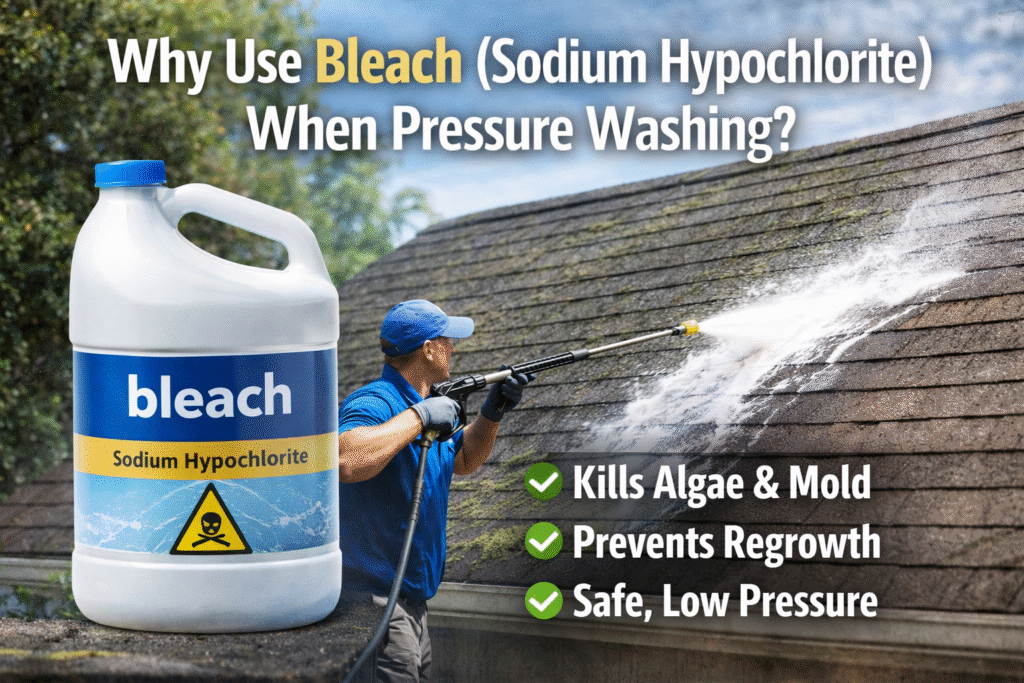
Why use bleach when pressure washing? Because water pressure alone is often not the best way to remove algae, mildew, and other biological buildup from exterior surfaces. Sodium hypochlorite can treat organic contamination chemically, allowing professionals to clean many surfaces with less aggressive mechanical pressure.
That does not mean every surface should receive the same bleach mixture. Concentration, dwell time, surface material, landscaping, runoff, weather, and manufacturer instructions all matter.
At Spotless Cleaning Services and More, we provide residential and commercial pressure washing and soft washing throughout Bradenton, Sarasota, Lakewood Ranch, Palmetto, Parrish, Ellenton, Venice, Siesta Key, and surrounding communities.
Quick Answer: Why Use Bleach When Pressure Washing?
Sodium hypochlorite is useful in professional exterior cleaning because it has antimicrobial activity and can treat biological contamination instead of relying entirely on water pressure. This is particularly valuable for soft washing roofs and house exteriors where excessive pressure can cause damage. Proper dilution, application, rinsing, surface compatibility, and landscaping protection are essential.
Sodium Hypochlorite Pressure Washing Guide
1. What Is Sodium Hypochlorite?
3. Why Pressure Alone Isn’t Always Enough
UNDERSTANDING THE CLEANER
What Is Sodium Hypochlorite?
Sodium hypochlorite is a chlorine-based compound commonly found in bleach solutions.
The CDC describes sodium hypochlorite as one of the most widely used chlorine disinfectants and notes that hypochlorites have broad antimicrobial activity.
Professional exterior-cleaning products can contain different concentrations than ordinary household bleach, which is one reason contractors should understand product labels and dilution rather than treating every bleach product as interchangeable.
Chemical Cleaning
Sodium hypochlorite can treat biological contamination chemically rather than relying entirely on mechanical force.
Water-Soluble
It is used in water-based cleaning solutions at concentrations appropriate to the application.
Powerful but Not Harmless
It can irritate skin and eyes, affect plants, discolor materials, and react dangerously with incompatible chemicals.
THE MAIN REASON
Why Use Bleach When Pressure Washing?
The biggest reason is simple: many exterior stains are biological rather than ordinary dirt.
Florida properties commonly develop dark or green discoloration associated with algae and other organic buildup. Simply blasting the visible discoloration away may clean the appearance temporarily, but mechanical pressure is not always the most appropriate tool for treating the contamination itself.
Treats Organic Growth
Cleaning chemistry can address algae, mildew, and similar biological contamination.
Reduces Reliance on High Pressure
When chemistry performs more of the cleaning work, the operator may not need aggressive mechanical force.
Useful for Soft Washing
It is commonly incorporated into low-pressure exterior-cleaning processes for compatible surfaces.
Works With Dwell Time
Professional cleaning allows an appropriate solution time to work instead of immediately increasing pressure.
Algae Does Not Have “Roots”
You may hear contractors say bleach “kills algae at the root.” That is catchy marketing language, but algae do not literally have roots. A more accurate explanation is that sodium hypochlorite chemically treats biological growth rather than merely removing visible surface discoloration.
Why Pressure Alone Isn’t Always the Best Cleaning Method
A pressure washer is a powerful tool, but pressure is only one part of professional exterior cleaning.
Using more pressure to compensate for inadequate cleaning chemistry can damage paint, wood, siding, stucco, roofing, concrete, composite materials, and other surfaces.
A better professional process asks two separate questions:
1. What Are We Cleaning?
Concrete, asphalt shingles, stucco, vinyl, pavers, painted surfaces, wood, and metal all respond differently.
2. What Are We Removing?
Dirt, algae, mildew, oil, rust, oxidation, paint, and mineral deposits do not require identical cleaning chemistry.
Read our complete
Pressure Washing vs Soft Washing Guide
.
DON’T JUST TURN UP THE PRESSURE
Let the Cleaning Method Match the Surface
Send us a photo of what needs cleaning. We’ll evaluate whether it calls for pressure washing, soft washing, specialty chemistry, or a combination.
CHEMISTRY + LOW PRESSURE
How Sodium Hypochlorite Is Used in Soft Washing
Soft washing relies far more heavily on cleaning chemistry and much less on aggressive mechanical water pressure.
A professional soft-washing process typically includes inspection, property preparation, controlled solution application, appropriate dwell time, and rinsing or another surface-specific completion method.
Inspect
Identify the surface, contamination, condition, landscaping, windows, electrical components, and runoff paths.
Select the Solution
Choose a cleaning approach compatible with the material and contamination.
Apply With Control
The goal is to coat the intended surface—not landscaping, vehicles, neighboring property, or unintended materials.
Allow Dwell Time
The solution is allowed time to interact with organic contamination instead of immediately adding more pressure.
Finish Appropriately
Rinse, monitor surrounding surfaces, and complete the process according to the material and cleaning system.
Learn more:
What Is Soft Washing?
ROOF CLEANING
Why Sodium Hypochlorite Is Used for Asphalt Roof Cleaning
Roof cleaning is one of the clearest examples of why chemistry can be preferable to mechanical pressure.
The Asphalt Roofing Manufacturers Association’s current technical guidance discusses cleaning algae discoloration with a sodium-hypochlorite-and-water solution while following the shingle manufacturer’s recommendations.
ARMA also specifically warns against using a power washer on asphalt roofing because high-pressure washing can damage the roofing surface.
This Is an Important Distinction
The goal is not to “pressure wash” asphalt shingles with bleach. It is to use a manufacturer-appropriate chemical-cleaning process without subjecting the shingles to destructive high-pressure spray.
Asphalt Roofing Manufacturers Association: Algae Discoloration of Roofs
Explore our
professional roof cleaning services
.
Why Use Bleach for House Washing?
Florida house exteriors commonly develop green or dark organic discoloration because of humidity, shade, rain, vegetation, and warm temperatures.
Attempting to remove that buildup from siding or stucco by simply increasing pressure can create unnecessary risks such as paint damage, water intrusion, or visible wand marks.
A controlled soft-washing process lets appropriate chemistry do more of the cleaning work.
Vinyl Siding
Lower mechanical pressure helps reduce unnecessary force around seams, trim, windows, and aging material.
Stucco
Paint condition, cracks, texture, repairs, and substrate condition should be evaluated before cleaning.
Soffits & Trim
These areas generally benefit from controlled application instead of concentrated high-pressure spray.
Explore our
professional house washing services
.
Is Sodium Hypochlorite Used on Concrete and Driveways?
It can be, particularly when organic contamination is part of the problem.
Professional concrete cleaning may involve pretreatment, mechanical surface cleaning, rinsing, and—depending on the job—a suitable post-treatment.
But sodium hypochlorite is not the answer to every concrete stain.
Algae / Organic Growth
A sodium-hypochlorite-based process may be useful when biological contamination is present.
Oil
Oil typically requires appropriate degreasing rather than bleach alone.
Rust
Rust usually requires specialty chemistry selected for the stain and substrate.
Explore our
concrete cleaning services,
oil stain removal,
and
rust removal services.
PROPERTY PROTECTION
Can Sodium Hypochlorite Harm Plants?
Yes. This is another area where exaggerated marketing claims should be avoided.
Sodium hypochlorite can injure landscaping when plants receive sufficient exposure. Professional cleaning is therefore about managing exposure, not pretending the cleaning solution is harmless.
Fresh water may be used before cleaning around sensitive landscaping when appropriate.
Cleaning solution should be directed at the intended surface rather than sprayed indiscriminately.
Plants and surrounding areas can be rinsed to reduce residual exposure.
Roof edges, gutters, downspouts, garden beds, slopes, and drains must be considered.
Read our detailed guide:
Will Pressure Washing With Bleach Kill Plants?
IMPORTANT SAFETY INFORMATION
Never Mix Bleach With Ammonia, Acids, or Other Cleaners
Sodium hypochlorite is useful, but it has to be handled correctly.
CDC guidance specifically warns against mixing bleach with other cleaners or disinfectants because dangerous vapors can be released.
This is particularly important in exterior cleaning because contractors may also encounter acidic rust removers, concrete cleaners, degreasers, and other chemical products.
Critical Chemical-Safety Rule
Do not casually combine sodium hypochlorite with another chemical because both products happen to be used in exterior cleaning. Read and follow product labels, Safety Data Sheets, and manufacturer instructions.
Why Sodium Hypochlorite Is Especially Useful in Florida Exterior Cleaning
Southwest Florida provides favorable conditions for exterior biological growth: warmth, humidity, rainfall, shade, vegetation, irrigation, and long periods without freezing temperatures.
That is why dark roof discoloration, green siding, shaded concrete buildup, pool-area growth, and similar exterior cleaning problems are so common throughout Sarasota and Manatee Counties.
ARMA specifically notes that algae discoloration on asphalt roofing is especially widespread in the Gulf States and other warm, humid areas.
What Sodium Hypochlorite Does NOT Automatically Fix
Using bleach intelligently also means knowing when it is the wrong chemistry.
Rust Staining
Rust generally requires an appropriate rust-removal chemistry.
Oil & Grease
Degreasers and other specialty processes may be required.
Oxidation
Oxidized siding or painted surfaces may require specialized restoration methods.
Paint Removal
Bleach is not a universal paint stripper.
Mineral Deposits
Hard-water or mineral staining can require completely different chemistry.
Damaged Surfaces
Cleaning cannot reverse etched concrete, deteriorated paint, damaged shingles, or structural deterioration.
RIGHT SURFACE • RIGHT CHEMISTRY • RIGHT PRESSURE
Professional Exterior Cleaning Starts With Identifying the Problem
Send photos of your roof, siding, driveway, pool area, pavers, commercial building, or other exterior surface for a free estimate.
Why Hire Spotless Cleaning Services and More?
Residential & Commercial
Exterior cleaning for homes, businesses, HOAs, storefronts, warehouses, restaurants, roofs, and more.
Pressure Regulation
The goal is not maximum PSI. Equipment and technique should be adjusted for the actual material.
Soft Washing Knowledge
We use chemistry and lower-pressure processes where aggressive mechanical pressure is inappropriate.
Landscaping Consideration
Plant exposure, runoff, gutters, downspouts, and surrounding surfaces are considered as part of the job.
Specialty Cleaning
Oil, rust, graffiti, roof staining, concrete buildup, and ordinary organic growth may require different chemistry.
Fully Insured
Insurance is an important consideration when hiring a company to work around expensive homes and commercial property.
Read more about
what makes Spotless Cleaning Services and More different
.
Soft Washing & Pressure Washing in Bradenton, Sarasota & Lakewood Ranch
Spotless Cleaning Services and More provides professional residential and commercial exterior cleaning throughout Sarasota and Manatee Counties.
Our service area includes Bradenton, Sarasota, Lakewood Ranch, Palmetto, Parrish, Ellenton, Venice, Siesta Key, and surrounding Southwest Florida communities.
Explore our
Manatee County service area
and
Sarasota County service area.
Related Exterior Cleaning Guides
FREQUENTLY ASKED QUESTIONS
Why Use Bleach When Pressure Washing? FAQ
Why do professionals use bleach when pressure washing?
Sodium hypochlorite can chemically treat algae, mildew, and other biological contamination so cleaning does not have to rely entirely on high mechanical pressure.
Is sodium hypochlorite the same as bleach?
Sodium hypochlorite is the active chlorine compound used in many liquid bleach products. Actual concentration varies by product.
Does bleach kill algae?
Sodium hypochlorite has antimicrobial activity and is commonly used in exterior-cleaning processes to treat algae and other biological contamination.
Does bleach prevent algae from ever coming back?
No. Cleaning can treat existing growth, but future algae can return when environmental conditions such as humidity, shade, rainfall, and moisture remain favorable.
Is bleach safe for asphalt shingles?
ARMA guidance discusses sodium-hypochlorite-based cleaning for algae discoloration on asphalt roofing while instructing homeowners to follow the shingle manufacturer’s recommendations. High-pressure power washing should not be used on asphalt shingles.
Is bleach safe for stucco and siding?
Compatibility depends on the specific surface, coating, condition, cleaner concentration, dwell time, and application process. Surfaces should be evaluated before cleaning.
Can sodium hypochlorite damage plants?
Yes. Sufficient exposure can damage vegetation. Professional cleaning should include application control, fresh-water rinsing, runoff awareness, and landscaping protection.
Can you mix bleach with other pressure-washing chemicals?
You should never casually mix bleach with other chemicals. Bleach can react dangerously with ammonia, acids, and incompatible cleaners. Product labels and Safety Data Sheets should be followed.
Is sodium hypochlorite useful for oil or rust?
It is not the primary chemistry for every contaminant. Oil often requires degreasing, while rust generally requires specialty rust-removal chemistry.
Why not just use more pressure?
More pressure can damage surfaces. Appropriate chemistry can allow organic contamination to be treated without relying on excessive mechanical cleaning force.
Do you offer sodium-hypochlorite soft washing in Sarasota and Bradenton?
Spotless Cleaning Services and More provides residential and commercial exterior cleaning throughout Sarasota and Manatee Counties, including professional soft washing where appropriate.
How do I get a free pressure-washing or soft-washing estimate?
Call or text Spotless Cleaning Services and More at
(813) 606-7589
or
request a free estimate online.
SPOTLESS CLEANING SERVICES AND MORE
Professional Cleaning Is About More Than Water Pressure
Get a free estimate for residential or commercial soft washing, pressure washing, roof cleaning, house washing, concrete cleaning, paver cleaning, or specialty exterior cleaning.

No Comments