Florida Sidewalk Cleaning Guide • Sarasota • Bradenton • Lakewood Ranch
Black Stains on Sidewalk? What Causes Them, How to Remove Them & How to Keep Concrete Cleaner
Black stains on sidewalk surfaces are one of the most common exterior-cleaning complaints we see in Southwest Florida. A sidewalk that started bright gray can gradually develop dark patches, streaks, green-black growth, dingy edges and slippery-looking areas—especially where shade, irrigation and moisture keep the concrete damp.
This guide explains what those stains may be, why Florida sidewalks discolor so quickly, which cleaning methods make sense, what pressure washing can and cannot remove, how professional sidewalk cleaning differs from blasting concrete with a pressure washer, and when a “black stain” is actually a specialty stain that needs a different treatment.
Complete Sidewalk Cleaning Guide
Quick Answer
Why Is My Sidewalk Turning Black?
In Southwest Florida, dark sidewalk staining is frequently associated with a combination of moisture, shade, airborne and landscape debris, organic buildup and biological growth on the concrete surface.
That does not mean every dark mark should automatically be called “black mold” or “black algae.” A photograph alone may not establish exactly which organism or contaminant is present. What matters for cleaning is recognizing the pattern, understanding the surface, identifying obvious specialty stains, and choosing a method that cleans the concrete without unnecessarily damaging it.
Concrete is porous and textured. It catches soil, plant material, irrigation residue and organic contamination. In Florida, surfaces can remain damp long enough for discoloration to return faster than homeowners in drier climates might expect. The U.S. EPA repeatedly emphasizes the relationship between moisture and mold growth; while its homeowner guidance focuses mainly on buildings and indoor environments, the underlying moisture principle helps explain why damp exterior environments can support biological growth too.
If your sidewalk is broadly dark, greenish, blotchy or dirty rather than marked by a clearly defined orange rust stain or oily spot, professional sidewalk cleaning may be the logical place to start.
Diagnose Before You Clean
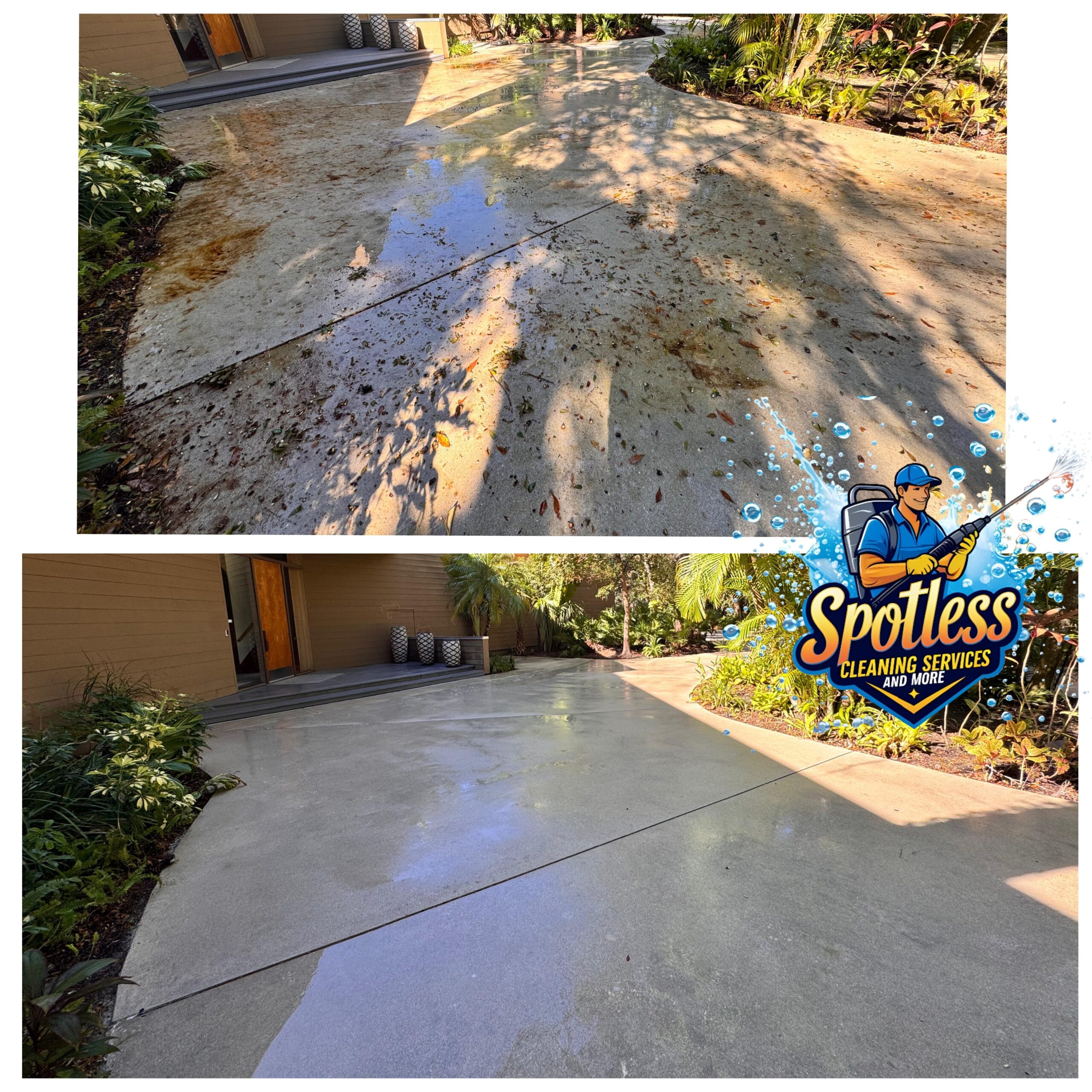
7 Common Causes of Black, Green and Dark Stains on Sidewalks
“Black sidewalk stain” is a useful search phrase, but it is not a laboratory diagnosis. Several different conditions can create a dark-looking sidewalk.
1. Organic Growth
Moist concrete can support biological growth and surface films that appear green, brown, gray or nearly black. Shaded sidewalk sections often show heavier discoloration than areas receiving strong direct sun.
2. Mildew or Mold-Like Discoloration
Mold and mildew are commonly blamed for every dark exterior stain, but visual identification is imperfect. Moisture is a major factor in mold growth, and recurring dampness can help create conditions where biological contamination persists.
3. Soil and Landscape Debris
Mulch, dirt, grass clippings, decaying leaves and runoff can create dark films along sidewalk edges. These areas can stay damp because nearby landscaping reduces airflow and sunlight.
4. Leaf and Plant Tannins
Leaves, berries, flowers and other plant matter can leave brown or dark discoloration after sitting wet on porous concrete. Some plant stains behave differently from ordinary surface dirt.
5. Tire and Rubber Marks
Where sidewalks cross driveways, rubber transfer and vehicle traffic can create black streaks. These marks are not the same as algae and may respond differently to cleaning.
6. Oil or Automotive Residue
Dark spots near driveways may be petroleum-based stains rather than organic growth. For those, see our oil stain removal service.
7. Embedded or Specialty Staining
Rust, irrigation minerals, paint, fertilizer, chemicals and other contaminants can discolor concrete. A different color does not always mean a different level of dirt—it may mean an entirely different cleaning chemistry is required.
Florida Conditions
Why Sidewalks Get Dirty So Fast in Sarasota, Bradenton and Southwest Florida
The simplest explanation is that Florida gives exterior surfaces plenty of opportunities to get wet—and plenty of organic material to collect on them.
Rain, irrigation, humid air, shaded landscaping and dense vegetation can all contribute to recurring dampness. Sidewalks next to hedges, fences, north-facing walls, tree canopies and heavily irrigated lawns often dry differently from open concrete in full sun.
Moisture alone does not tell you exactly what organism is on a sidewalk, but moisture is central to biological growth. The EPA states that mold will not grow without water or moisture and identifies moisture control as the key to mold control. Its guidance is primarily about homes, so we use it here for the general moisture principle—not as a claim that a particular sidewalk stain is a specific species of mold.
Florida’s growing season also means landscaping can continually deposit pollen, leaf fragments, grass clippings, soil and other organic material. Add foot traffic, irrigation and vehicle crossover areas and a sidewalk can develop several types of contamination at the same time.
Stain Identification
Before Pressure Washing a Sidewalk, Look at the Pattern
The pattern often tells you more than the color.
| What You See | Possible Explanation | What It Means for Cleaning |
|---|---|---|
| Broad green-black or gray film | Organic buildup or biological growth | Often suited to a general concrete-cleaning process using appropriate chemistry and controlled mechanical cleaning. |
| Darker area under trees or beside hedges | Shade, moisture and plant debris | Cleaning can restore appearance, but the shaded area may naturally soil faster again. |
| Orange or reddish-brown arcs | Rust or iron-related irrigation staining | Do not assume more pressure is the answer. See our rust removal services. |
| Dark greasy spot near driveway | Oil or automotive fluid | May require degreasing or specialty treatment; complete removal is not always possible. |
| Black streak where tires cross | Rubber transfer / tire marks | Can require targeted cleaning beyond ordinary organic-growth treatment. |
| Brown shapes beneath leaves | Plant tannins or organic staining | May improve with cleaning but can behave differently from loose dirt. |
| White haze or crystalline deposit | Mineral deposit or efflorescence-like condition | Not a “black stain” problem; identify the material before treating it. |
| Dark line that follows a crack | Moisture, trapped debris or growth in/around crack | Cleaning may improve appearance, but cleaning does not repair the crack. |
Do not keep increasing pressure just because a stain remains. If the surrounding concrete is clean and the stain is still present, the problem may require different chemistry rather than additional force. Excessive or poorly controlled pressure can etch concrete and leave permanent wand marks.
Professional Process
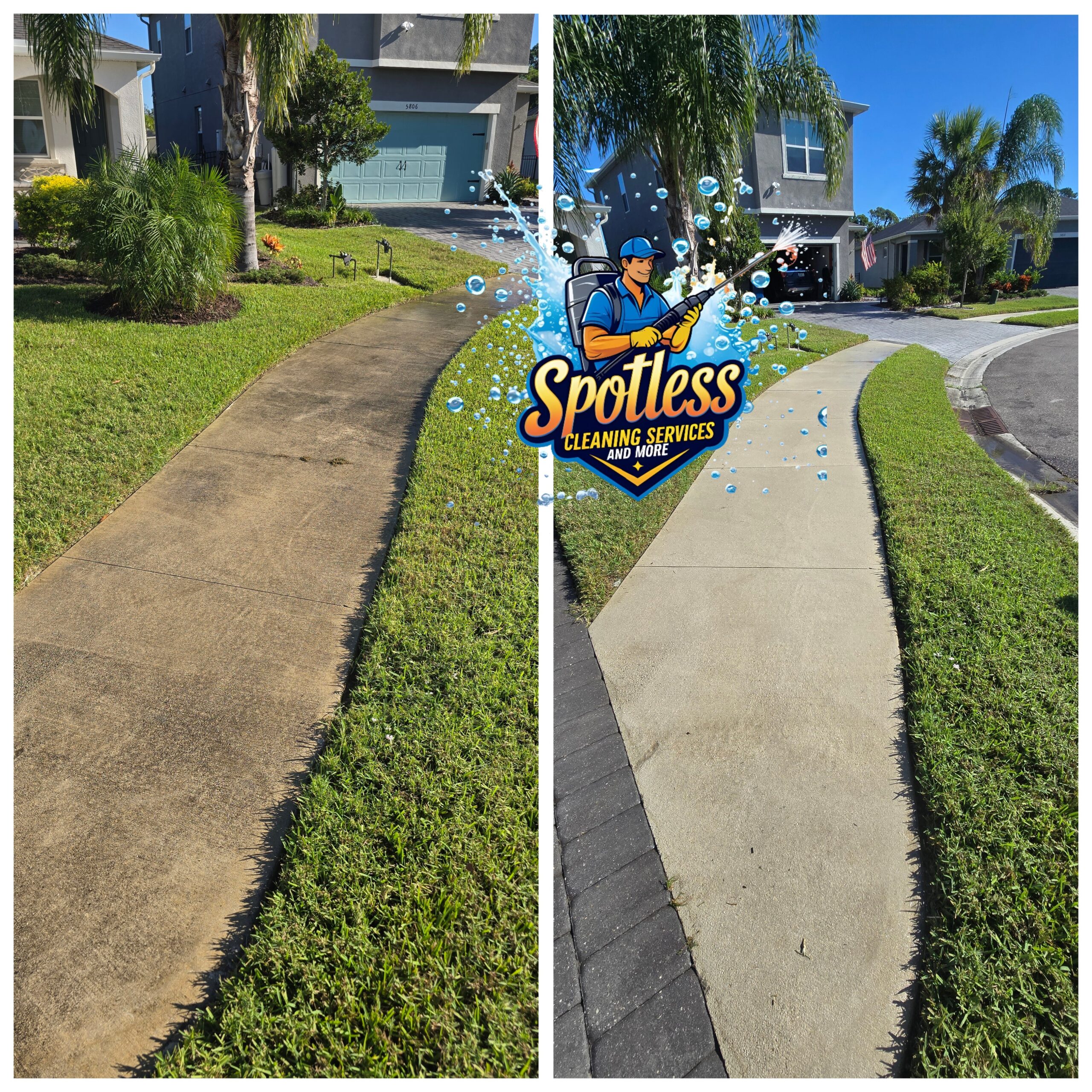
How Professional Sidewalk Cleaning Works
Good concrete cleaning is a process, not a contest to see who can use the highest PSI.
We begin by looking at the sidewalk and surrounding property. Is the surface standard broom-finished concrete, decorative concrete, pavers, a coated surface or something else? Are there cracks, weak areas, loose joint material, painted markings, nearby plants, drainage concerns or specialty stains? Those details affect how the job should be approached.
For compatible concrete, the process may include an appropriate cleaning solution to address organic contamination, controlled pressure and/or professional surface-cleaning equipment, detailed rinsing, and a post-treatment when appropriate for the surface and conditions. The objective is even cleaning without unnecessary striping or damage.
A surface cleaner is useful because it helps apply cleaning action more evenly across broad flatwork. But equipment alone does not replace judgment. Edges, corners, expansion joints, adjacent landscaping, walls and runoff paths still require attention.
For a service-specific overview, visit our sidewalk cleaning services page. If the project includes larger flatwork areas, our concrete cleaning services page explains the broader service.
Pressure + Chemistry + Technique
Is Pressure Washing the Best Way to Remove Black Stains From a Sidewalk?
For durable, compatible concrete, pressure is often an important part of professional cleaning—but “pressure washing” is only one piece of the job.
A common DIY approach is to put a narrow pressure-washer tip close to the concrete and slowly draw lines across the sidewalk. That can remove visible material, but it can also produce zebra stripes, etched lines and uneven cleaning. Concrete is strong, but its finished surface can still be damaged by concentrated pressure, especially when the operator is too close or uses an inappropriate nozzle.
Professional cleaning aims for a more even result. Cleaning solutions can help loosen or treat organic contamination so the operator does not have to rely exclusively on mechanical force. A surface cleaner can distribute cleaning action across a wider area. Rinsing removes loosened contamination and residue. A suitable post-treatment may be used after mechanical cleaning when appropriate.
Our related guide, can pressure washing damage concrete?, goes deeper into why technique matters. You can also read our guide to pressure, PSI and concrete cleaning.
Why “maximum PSI” is the wrong goal
Cleaning power is influenced by pressure, water flow, nozzle selection, distance, dwell time, chemistry, temperature, equipment and the contaminant being removed. A higher number on the machine does not automatically produce a better result. In fact, using excessive concentrated pressure can turn a cleaning problem into a surface-damage problem.
Why post-treatment can matter
Mechanical cleaning removes visible buildup from the surface. Depending on the contamination and surface, an appropriate post-treatment can help address remaining organic material and improve the uniformity of the finished appearance. No treatment should be described as making a sidewalk permanently maintenance-free. Exterior concrete will be exposed to weather, moisture, landscaping and foot traffic again.
Pressure washing vs. soft washing sidewalks
These terms are often treated as opposites, but a professional may use elements of both approaches. Standard uncoated concrete may tolerate controlled mechanical cleaning, while coated, painted or otherwise sensitive surfaces can require lower pressure and different chemistry. The correct method follows the surface—not a one-size-fits-all slogan. For more background, see our pressure washing vs. soft washing guide.
Black Sidewalks Hurting Your Curb Appeal?
You do not have to guess which nozzle, chemical or pressure setting to use. Send Spotless Cleaning Services and More photos of the sidewalk and surrounding area, or call us for a free estimate.
DIY Sidewalk Cleaning
Can You Clean Black Sidewalk Stains Yourself?
Some homeowners can successfully clean small areas of ordinary concrete themselves, but there are several reasons a professional job can look different. Consumer pressure washers often have lower water flow than professional equipment, making large flatwork slower to clean evenly. Inexperienced operators may compensate by moving the nozzle closer, which increases the risk of visible lines.
DIY cleaning also becomes more complicated when chemicals are involved. Product labels, dilution instructions, personal protective equipment, nearby plants, painted surfaces, metals, runoff and storage all matter. Never mix cleaning chemicals unless the product manufacturer explicitly directs it. In particular, never mix chlorine bleach with acids or ammonia-containing products because dangerous gases can be produced.
If you decide to clean a small concrete sidewalk yourself, start by identifying the surface and stain, remove loose debris, read equipment and chemical labels, protect surrounding property, test an inconspicuous area and use the least aggressive effective method. Avoid concentrating a narrow jet in one place.
Our article on the dangers of DIY pressure washing covers additional considerations. For homeowners trying to understand the equipment itself, see PSI vs. GPM explained.
Not Every Stain Is Organic
What If the Black or Dark Sidewalk Stain Does Not Come Off?
Once ordinary surface contamination has been removed, a remaining stain deserves a second diagnosis.
Rust & Irrigation Stains
Orange, reddish or brown mineral staining often requires specialty treatment. Visit our professional rust removal services page or our guide on whether pressure washing removes rust.
Oil & Grease
Petroleum stains can penetrate porous concrete. Cleaning can often improve them, but stain age, material and depth matter. See oil stain removal.
Paint & Coatings
Paint transfer or old coatings are not ordinary sidewalk dirt. Aggressive pressure can remove more than intended. Read can pressure washing remove paint?.
Graffiti
Spray paint and marker can require dedicated products and procedures. For commercial or residential surfaces, see our graffiti removal services.
Pavers
A paver walkway has joints, possible sealer and a different surface system from poured concrete. Visit our paver cleaning services.
Unknown Discoloration
If the stain cannot be identified confidently, avoid making it worse with random acids, solvents or maximum pressure. Send clear photos and describe what happened before the stain appeared.
Sidewalk Safety & Appearance
Dirty Sidewalks Are More Than a Curb-Appeal Problem
For homeowners, a dark sidewalk can make an otherwise clean driveway, lawn and entryway look neglected. The contrast is especially noticeable after the driveway or house has been cleaned. Because the sidewalk creates a visual path toward the front door, it contributes heavily to the first impression of the property.
There is also a practical reason to pay attention to walking surfaces. Wet organic buildup can feel slick underfoot. OSHA’s walking-working-surface rules apply to workplaces rather than private residential sidewalks, but OSHA’s broader safety framework recognizes slippery walking surfaces as a hazard employers should address. That makes routine cleaning especially relevant for businesses, storefronts, restaurants and other properties with customer and employee foot traffic.
Cleaning cannot guarantee a slip-proof surface, and many factors affect traction—including the concrete finish, slope, water, footwear, oils and other contaminants. Still, allowing visible buildup to accumulate on a frequently used walkway is not a good maintenance strategy.
Keeping Concrete Cleaner
How to Slow Down Black Stains From Returning
No exterior sidewalk stays freshly cleaned forever, but property conditions can influence how quickly dark buildup returns.
- Redirect sprinkler overspray when practical
- Remove wet leaves and plant debris
- Keep mulch and soil from washing across concrete
- Trim vegetation that traps moisture against walkways
- Address drainage problems and standing water
- Clean high-shade areas before buildup becomes heavy
- Keep automotive fluids off sidewalk crossover areas
- Use appropriate periodic professional cleaning
1. Look at irrigation coverage
If sprinkler heads repeatedly soak the same strip of sidewalk, adjusting the spray pattern may reduce unnecessary wetting. Irrigation systems should still be configured to meet landscape needs; the goal is simply to avoid watering concrete when it serves no purpose.
2. Keep organic debris moving
Leaves and grass clippings hold moisture and break down on the surface. Blowing or sweeping sidewalks after yard maintenance can reduce the amount of organic material left to decompose on concrete.
3. Watch heavily shaded sections
Two sidewalk panels on the same property can age very differently. The section beneath a large tree or beside dense shrubs may stay wet longer and need attention sooner than an open section receiving full sun.
4. Do not wait for the sidewalk to become nearly black
Routine maintenance is generally easier than restoring years of accumulated contamination. The ideal schedule depends on shade, trees, irrigation, traffic and the owner’s appearance standards—not an arbitrary calendar date.
5. Clean connected surfaces together when it makes sense
A bright sidewalk beside a dark driveway—or a clean driveway beside a black sidewalk—can make the uncleaned surface look worse by comparison. Homeowners often combine driveway cleaning, sidewalk cleaning and patio cleaning for a more consistent exterior appearance.
Businesses & Managed Properties
Commercial Sidewalk Cleaning for Storefronts, Restaurants, HOAs and High-Traffic Properties
Commercial sidewalks face a different mix of contamination than many residential walkways. Foot traffic, food and beverage spills, gum, vehicle exhaust, landscaping, carts, dumpster-area traffic and recurring customer use can all affect appearance. A business entrance may also be judged more critically because it is part of the customer’s first impression.
For restaurants and retail properties, sidewalk cleaning can be coordinated with other exterior cleaning needs. Spotless Cleaning Services and More offers plaza and storefront cleaning, restaurant exterior cleaning and gas station cleaning services.
Commercial projects should be planned around access, customer traffic, runoff, signage, surrounding materials and the type of contamination present. Oil, grease, gum and specialty stains may require different expectations than ordinary organic buildup.
A Better Way to Think About Sidewalk Cleaning
Clean the Contaminant Without Sacrificing the Concrete
One of the biggest misconceptions in exterior cleaning is that a stubborn stain always needs more pressure. In reality, professional cleaning is often about matching the process to the contaminant. Organic growth, oil, rust, paint and mineral deposits do not respond identically because they are not the same material.
The same is true of the surface. Broom-finished concrete, exposed aggregate, stamped concrete, painted concrete, sealed pavers and pool-deck coatings may all be walked on, but they should not automatically receive the same cleaning process.
This is why we recommend treating the phrase “pressure washing” as a category of exterior cleaning rather than a command to use maximum pressure. If you want a deeper explanation of the two major approaches, our complete pressure washing guide and soft washing guide explain the differences.
For black stains on ordinary concrete sidewalks, the objective is usually straightforward: remove the accumulated contamination, produce an even appearance, rinse the area thoroughly and avoid leaving visible cleaning damage. When specialty staining remains, change the diagnosis instead of simply escalating the force.
Sidewalk Cleaning Near Me
Professional Sidewalk Cleaning in Sarasota, Bradenton & Surrounding Areas
Spotless Cleaning Services and More serves homeowners and businesses across Sarasota and Manatee County communities.
Sidewalk Cleaning Bradenton FL
Sidewalk Cleaning Lakewood Ranch FL
Sidewalk Cleaning Siesta Key FL
Sidewalk Cleaning Palmetto FL
Sidewalk Cleaning Parrish FL
Sidewalk Cleaning Ellenton FL
Sarasota County Service Area
Manatee County Service Area
We also serve additional communities listed on our complete service areas page. If you are unsure whether your property is in our current service area, call 813-606-7589.
Related Resources
Learn More About Concrete, Moisture, Mold and Exterior Cleaning
Florida Humidity
Read our guide to the effects of Florida humidity on exterior surfaces.
Why Algae Grows Quickly
See our local article on why mold and algae grow quickly in Sarasota.
Concrete Damage
Learn how poor technique can affect concrete in our pressure and concrete damage guide.
External references: The U.S. Environmental Protection Agency’s mold and moisture guide explains the central role moisture plays in mold growth. For workplace walking-surface safety, see the Occupational Safety and Health Administration’s walking-working surfaces guidance. These resources are provided for general educational context; EPA’s cited mold guidance primarily addresses buildings/indoor environments, and OSHA requirements concern workplaces.
Frequently Asked Questions
Black Stains on Sidewalk & Sidewalk Cleaning FAQ
Why is my sidewalk turning black in Florida?
Dark discoloration is often associated with recurring moisture, shade, organic debris, soil and biological growth on the surface. However, color alone does not identify the exact contaminant, so rust, oil, rubber and other specialty stains should be considered too.
Are black stains on a sidewalk definitely black mold?
No. It is better not to diagnose an exterior stain solely by appearance. Dark staining can come from multiple sources. A cleaning contractor can evaluate the pattern and surface, but laboratory identification would be required to conclusively identify a particular microorganism.
How do you remove black stains from a concrete sidewalk?
For compatible ordinary concrete, professional cleaning may combine appropriate cleaning chemistry, controlled mechanical cleaning or a surface cleaner, thorough rinsing and post-treatment when appropriate. Specialty stains may need a different process.
Will pressure washing remove black algae from concrete?
Pressure washing can remove many types of visible organic buildup, but professionals generally consider chemistry and technique as well as pressure. The exact organism should not be assumed from color alone.
Can pressure washing damage a sidewalk?
Yes. Excessively concentrated pressure, an inappropriate nozzle, poor distance control or repeated passes can etch concrete and create visible cleaning lines. More PSI is not always better.
Why are my sidewalk stains worse in the shade?
Shaded surfaces can remain damp longer because they receive less direct sun. Nearby vegetation can also contribute organic debris and reduce airflow, creating conditions where surface buildup returns more quickly.
Why does the sidewalk near my sprinklers get dirty faster?
Repeated wetting can keep concrete damp and may carry soil or minerals onto the surface. If the discoloration is orange or reddish rather than green-black, consider whether it could be an iron-related irrigation stain.
Will sidewalk cleaning remove rust?
General sidewalk cleaning may remove surrounding dirt and organic buildup but can leave rust behind. Rust is a specialty stain and may require dedicated rust-removal chemistry.
Will sidewalk cleaning remove oil stains?
Oil stains may improve with degreasing and specialty treatment, but complete removal cannot be guaranteed because oil can penetrate porous concrete. Age, depth and prior treatments all affect the result.
How often should sidewalks be professionally cleaned in Florida?
There is no universal schedule. Properties with heavy shade, irrigation overspray, trees or high foot traffic may need cleaning sooner than open, sunny sidewalks. Appearance and traction conditions are better indicators than an arbitrary date.
Does post-treatment keep sidewalks clean forever?
No. Appropriate post-treatment can help address remaining organic contamination, but exterior concrete is continuously exposed to weather, moisture, landscaping and airborne material. Future maintenance will eventually be needed.
Can you clean sidewalks at commercial properties?
Yes. We provide exterior cleaning for compatible commercial sidewalks and walking areas, including projects associated with storefronts, restaurants and other managed properties.
Do you provide sidewalk cleaning in Sarasota and Bradenton?
Yes. We provide sidewalk cleaning in Sarasota, Bradenton, Lakewood Ranch, Siesta Key, Palmetto, Parrish, Ellenton and surrounding service areas.
Can I combine sidewalk cleaning with driveway cleaning?
Yes. Combining connected concrete surfaces can create a more consistent finished appearance and may be convenient when multiple exterior areas need maintenance.
How do I get a free sidewalk cleaning estimate?
Call Spotless Cleaning Services and More at 813-606-7589 or use our contact page. Photos of the sidewalk and any unusual stains are helpful.
Deep-Dive Cleaning Guide
What a Professional Looks at Before Cleaning a Concrete Sidewalk
Concrete age and condition
Not every slab is in the same condition. Older sidewalks can have cracks, worn cream layers, exposed aggregate, previous repairs and areas weakened by years of weathering. New concrete also deserves caution because curing and finishing conditions matter. A responsible cleaner does not assume that because one sidewalk tolerated a certain process, every sidewalk should receive exactly the same treatment.
Expansion joints, cracks and edges
Joints and cracks collect dirt and biological material, which can make them appear much darker than the slab. They can also channel water. Cleaning can improve their appearance, but it does not repair structural movement, settlement or cracking. Along edges, nearby mulch and soil can wash back onto freshly cleaned concrete if the landscaping is not considered during rinsing.
Adjacent materials
A sidewalk rarely exists in isolation. It may touch painted curbs, pavers, asphalt, garage coatings, decorative stone, metal gates, stucco, plants and turf. Cleaning chemistry and runoff that are appropriate for plain concrete may interact differently with those materials. This is one reason an on-site assessment is more valuable than simply choosing a chemical based on a social-media video.
Drainage and runoff
Water needs somewhere to go. Low areas can hold dirty rinse water, while slopes can send runoff toward landscaping, streets or neighboring surfaces. A professional cleaning plan considers how to work with the property’s drainage rather than moving contamination from one problem area to another.
The stain’s history
Knowing when a stain appeared can be extremely useful. A dark mark that appeared after a vehicle leak suggests something different from a slowly spreading shaded patch. Orange spots after lawn fertilization suggest a different mechanism from a black band beneath a hedge. If you know what happened before the stain appeared, tell the cleaner. That information can save time and reduce unnecessary trial-and-error treatment.
Common Cleaning Mistakes
What Not to Do When Trying to Remove Black Stains From Concrete
Do Not Chase the Stain With a Zero-Degree Tip
A highly concentrated jet can cut a visible line into the surface. If a stain requires specialty chemistry, concentrating more force on it can damage the concrete while leaving the chemical stain behind.
Do Not Randomly Mix Chemicals
Household and commercial cleaners can react dangerously. Follow labels exactly and never improvise chemical mixtures. Bleach should never be mixed with acids or ammonia-containing products.
Do Not Assume Every Orange Stain Is Dirt
Rust and iron-related staining often need a different treatment from organic growth. General cleaning may reveal the stain more clearly without removing it.
Do Not Ignore Nearby Plants
Exterior cleaning happens in a living landscape. Product choice, application, rinsing and plant protection should be considered before treatment begins.
Do Not Promise Permanent Results
Florida weather continues after the cleaning appointment. If shade, moisture and irrigation remain, organic buildup can return. Maintenance is realistic; “never dirty again” is not.
Do Not Confuse Cleaning With Repair
Pressure washing can reveal cracks, spalling, old repairs and discoloration that were hidden by dirt. Cleaning improves cleanliness; it does not restore structurally damaged concrete.
Whole-Property Curb Appeal
Why Sidewalk Cleaning Often Makes the Biggest Difference When Paired With Other Exterior Cleaning
A sidewalk is part of a visual system. From the street, people see the driveway, sidewalk, front walk, house exterior, roof line, landscaping and entry together. Cleaning only one heavily soiled component can create contrast that makes neighboring surfaces look dirtier.
For example, if the sidewalk and driveway share the same age and concrete finish, cleaning both can produce a more uniform approach to the home. If the sidewalk leads to a dirty patio or pool deck, those areas can be evaluated during the same estimate. If the concrete is clean but the house exterior has green or dark organic buildup, house washing may make a larger overall difference.
That does not mean every customer needs every service. Good estimating should separate what is necessary from what is optional. A customer who only wants a sidewalk cleaned should be able to request exactly that. But when several connected surfaces are visibly dirty, discussing them together can help the homeowner decide which combination gives the best improvement for the property.
Other commonly paired services include pool deck cleaning, fence cleaning and roof cleaning. Each surface should still receive the cleaning method appropriate to that material.
For Homeowners Comparing Quotes
Questions to Ask a Sidewalk Cleaning Company
If you are comparing sidewalk-cleaning estimates, price matters, but it is not the only useful question. Ask how the company plans to clean the surface and whether the estimate includes treatment for ordinary organic buildup. If you have orange rust, oil, paint or another specialty stain, point it out before the job so expectations can be discussed in advance.
Ask whether the company distinguishes between poured concrete, pavers and coated surfaces. Ask how nearby landscaping is considered. If you are concerned about visible pressure lines, ask whether professional flat-surface equipment is used where appropriate. For a larger property, ask what areas are included so the driveway, front walk, public sidewalk and curb are not confused with one another.
It is also reasonable to ask what the company cannot guarantee. Deep oil, rust, paint, fertilizer staining, concrete discoloration and pre-existing damage do not always disappear simply because the surface is professionally cleaned. A trustworthy estimate should distinguish routine contamination from specialty restoration issues.
Spotless Cleaning Services and More provides free estimates for compatible exterior cleaning projects. Call 813-606-7589 or send us your project information. Clear photos are especially helpful when unusual stains are involved.
Want Your Sidewalk to Look Like Part of the Property Again?
Whether the concrete has gradually turned dark from Florida conditions or you are dealing with a stubborn specialty stain, we can help you determine the right next step. Request a free estimate for sidewalk and concrete cleaning in Sarasota, Bradenton, Lakewood Ranch and surrounding service areas.

No Comments