
Concrete Cleaning Guide • Driveways • Sidewalks • Patios • Pool Decks
Can Pressure Washing Damage Concrete? How to Clean It Without Etching the Surface
Can pressure washing damage concrete? Yes. A pressure washer can permanently etch, stripe or erode concrete when the operator uses excessive concentrated pressure, the wrong nozzle, works too close, stays in one place too long, or cleans concrete that is already weak or deteriorated.
But that does not mean concrete should never be pressure washed. Properly performed professional concrete cleaning can remove heavy dirt, organic buildup and traffic contamination while reducing the risk of surface damage. The key is understanding that PSI alone does not determine whether concrete is cleaned safely.
The Short Answer
Yes—Pressure Washing Can Permanently Damage Concrete
Concrete is durable, but the finished surface is not indestructible.
A high-pressure stream can remove more than dirt. If the spray is concentrated enough, it can wear away the cement-rich surface paste and expose aggregate below it. That can leave lighter lines, rough patches or permanent stripes that remain visible after the concrete dries.
The original version of this article gave fixed PSI ranges as though one pressure number could determine safety. That is too simple. Two machines operating at the same PSI can clean very differently depending on nozzle orifice, spray angle, gallons per minute, working distance, surface-cleaner setup and how quickly the operator moves.
The condition of the concrete also matters. A healthy broom-finished driveway can tolerate cleaning differently from decorative concrete, weak paste, old spalling concrete, previously etched concrete or a sealed surface.
Worried About Etching Your Driveway or Patio?
We clean residential and commercial concrete throughout Sarasota and Manatee Counties using a process matched to the surface and contamination.
How Damage Happens
Pressure Washer Damage Is Usually a Force-and-Technique Problem
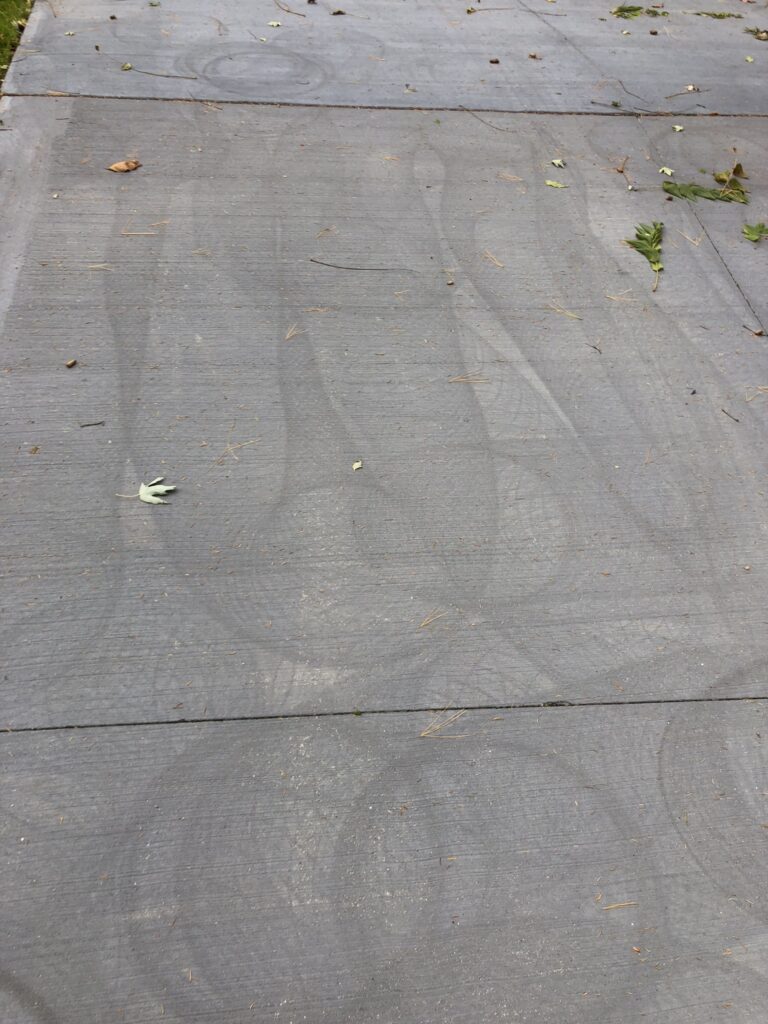
Etching
A narrow or overly aggressive water stream can cut visible lines into the cement paste. Once the surface profile has been changed, ordinary cleaning will not restore it.
Zebra Striping
Uneven wand passes can create alternating clean and over-cleaned lines. Some striping is simply uneven cleaning, while deeper lines can represent actual etching.
Exposed Aggregate
If enough surface paste is removed, more stone becomes visible. On concrete that was not designed as exposed aggregate, that change can be permanent.
Pitting & Weak Surface Loss
Deteriorated paste, scaling or previous damage can break away under aggressive cleaning and leave pits or rough areas.
Joint & Crack Damage
Pressure can dislodge weak material along cracks, control joints and repairs. Cleaning does not fix existing cracking.
Coating or Sealer Removal
Sealed, painted or decorative concrete can lose coating under aggressive pressure. The coating may be damaged even when the concrete underneath is not.
After Cleaning
What Pressure Washer Damage on Concrete Looks Like
If concrete looks strange immediately after washing, wait for the slab to dry completely before assuming it is damaged. Wet concrete can look darker and uneven.
- ✓ Permanent wand lines
- ✓ Bright or pale streaks
- ✓ Rough sandpaper-like texture
- ✓ Exposed stones or aggregate
- ✓ Small pits or chipped weak areas
- ✓ Uneven etched arcs
- ✓ Changed texture beside untouched concrete
- ✓ Sealer or coating removed in patches
Deep etching usually cannot be “washed out.” Making the surrounding concrete equally aggressive simply damages a larger area. Depending on severity, cosmetic repair can involve resurfacing, coatings, grinding or other concrete restoration work.
PSI Isn’t the Whole Story
What PSI Is Safe for Pressure Washing Concrete?
There is no universal PSI number that is automatically safe for every concrete slab.
The existing article recommended fixed ranges such as 2,000–3,000 PSI for general cleaning and cautioned against consistently exceeding 3,500 PSI. Those numbers can be useful as rough context, but they should not be treated as a guarantee.
Concrete Network advises moderate pressure—typically under 3,000 PSI—for older concrete while maintaining distance and steady movement. That is useful consumer guidance, but the correct professional setup still depends on surface condition and equipment.
A 3,000 PSI machine with a narrow tip very close to the slab can be more damaging than the same machine using a wider pattern or properly sized surface-cleaner nozzles at an appropriate distance.
Water flow matters too. Professional cleaning often relies on higher gallons per minute to move contamination efficiently rather than trying to compensate for low flow by putting the nozzle closer to the concrete.
External reference: Concrete Network — Cleaning and Caring for Older Concrete.
Nozzles & Working Distance
A Narrow Spray Pattern Concentrates Force Into a Smaller Area
The farther the nozzle is from the surface, the more the spray pattern expands and the less concentrated the impact becomes. That is why starting farther away and moving closer only when necessary is safer than beginning inches from the slab.
High-pressure water can also seriously injure people. OSHA incident records document pressure-washer streams causing penetrating and laceration injuries, including incidents around 3,000 PSI.
External safety reference: OSHA — Pressure Washer Injury Case.
New Concrete
Can Pressure Washing Damage New Concrete?
Yes. Fresh concrete is still developing strength and should not be treated like a fully mature slab.
Concrete Network notes that new concrete typically takes about 28 days to reach the commonly referenced full-cure milestone. The American Concrete Institute also treats curing as central to concrete performance and durability.
That does not mean day 28 is a magic point where every slab suddenly becomes safe for aggressive cleaning. Mix design, weather, slab thickness, finish, curing conditions and contractor instructions all matter. For new concrete, follow the installer or concrete supplier’s guidance before pressure washing.
If a new slab becomes dirty before aggressive washing is appropriate, a hose, mild concrete-safe cleaner or gentler method may be preferable.
External references: Concrete Network — New Concrete Care and American Concrete Institute — Concrete Curing Resources.
Older Concrete
Old Concrete Can Be Strong—or Already Deteriorated
Age by itself does not determine whether concrete can be pressure washed. Some decades-old driveways remain extremely hard, while newer slabs can have weak surfaces because of placement, finishing, curing or environmental conditions.
- Spalling or flaking
- Loose repairs
- Existing exposed aggregate
- Deep cracks
- Scaling
- Powdery or weak surface paste
- Previous pressure-washer lines
If material is already loose, high-pressure cleaning can remove it. That does not mean the washer created the original deterioration, but aggressive technique can make the condition more visible or remove additional weak material.
Professional Flatwork Equipment
Why Surface Cleaners Usually Produce More Even Concrete Cleaning
A professional surface cleaner uses rotating spray bars inside a round housing to distribute cleaning action across a larger, consistent area. This can dramatically reduce the obvious wand marks that appear when someone cleans an entire driveway freehand.
But a surface cleaner is not damage-proof. If the tips are incorrectly sized, the machine is mismatched to the pressure washer, the operator walks too slowly, or the concrete is weak, it can still create circles, lines or surface wear.
Inspect
Identify cracks, coatings, weak spots, rust, oil and pre-existing damage.
Pretreat
Use appropriate cleaning chemistry so mechanical force does not have to do all the work.
Surface Clean
Use correctly configured equipment and consistent walking speed.
Detail
Address edges without concentrating pressure excessively.
Rinse
Move loosened contamination and cleaning residue appropriately.
Post-Treat When Appropriate
Organic contamination may benefit from appropriate post-treatment rather than repeated high-pressure passes.
Worried About Etching Your Driveway?
Professional concrete cleaning is not about using the strongest pressure possible. Spotless Cleaning Services and More evaluates the surface, contamination and existing condition before choosing the cleaning process.
When More Pressure Is the Wrong Answer
Some Concrete Stains Need Chemistry, Not More PSI
Rust
Orange or reddish-brown staining often needs specialty rust removal treatment.
Oil
Petroleum can penetrate porous concrete. See our oil stain removal service.
Organic Buildup
Dark or green contamination may respond better to appropriate chemistry plus controlled surface cleaning than repeated aggressive passes.
Tire Marks
Rubber transfer can require targeted cleaning and may not respond the same way as dirt or biological growth.
Paint
Paint removal is not routine concrete washing. Read whether pressure washing removes paint.
Unknown Staining
If everything around a stain is clean but the spot remains, stop escalating pressure and identify the stain.
Sealed & Decorative Concrete
Can Pressure Washing Damage Concrete Sealer or Decorative Finishes?
Yes. Sealed concrete introduces another layer that can be worn, dulled, lifted or stripped before the concrete itself is visibly damaged.
Stamped concrete, stained concrete, painted coatings and topical sealers deserve a more conservative assessment because the finish may be the most vulnerable component.
Read our detailed guide: will pressure washing remove concrete sealer?
Professional Concrete Cleaning
How We Approach Driveways, Sidewalks, Patios & Pool Decks
The objective is simple: remove the contamination without unnecessarily changing the concrete underneath it.
At Spotless Cleaning Services and More, we clean residential and commercial exterior flatwork throughout Sarasota, Bradenton, Lakewood Ranch, Palmetto, Parrish, Ellenton, Siesta Key, Venice and surrounding communities.
Related Concrete Guides
Build Out Your Concrete Cleaning Knowledge
Frequently Asked Questions
Can Pressure Washing Damage Concrete? FAQ
Can pressure washing damage concrete?
Yes. Excessive concentrated pressure, a narrow nozzle, working too close, lingering in one area or cleaning weak concrete can etch or erode the surface.
What does pressure washer damage on concrete look like?
Typical signs include wand lines, zebra striping, rough or lighter patches, exposed aggregate, pitting or a visibly changed surface texture.
What PSI is safe for concrete?
There is no universal PSI that is safe for every slab. Concrete condition, strength, finish, nozzle angle, water flow, working distance and dwell time all affect cleaning force.
Is 3,000 PSI safe for concrete?
It can be appropriate for some sound concrete when used with the correct nozzle, distance and technique, but the number alone does not guarantee safety.
Can a zero-degree pressure washer nozzle damage concrete?
Yes. A zero-degree nozzle concentrates water into a very small area and significantly increases the risk of etching and personal injury.
Can pressure washing damage new concrete?
Yes. New concrete continues gaining strength during curing. Concrete Network notes that concrete typically takes about 28 days to reach the commonly referenced full-cure milestone, but follow the installer or supplier’s guidance.
Can pressure washing damage old concrete?
Yes. Older concrete may already have spalling, weak paste, exposed aggregate, cracks or repairs that can be worsened or made more visible by aggressive cleaning.
Does a surface cleaner prevent concrete damage?
A surface cleaner can distribute cleaning action more evenly and reduce wand striping, but it does not make excessive pressure harmless.
Can pressure washing make cracks worse?
Aggressive cleaning can dislodge weak material around cracks or joints. Pressure washing does not repair structural cracking.
Can pressure washing remove concrete sealer?
It can weaken or remove some topical sealers, particularly when the sealer is already deteriorated. Sealed concrete should be evaluated before cleaning.
Will pressure washing remove oil stains?
It can remove surface contamination, but oil can penetrate porous concrete and may require degreasing or specialty treatment.
Will pressure washing remove rust from concrete?
Pressure alone often does not fully remove rust because rust is a chemical stain. Specialty rust-removal treatment is usually more appropriate.
Why does my driveway have lines after pressure washing?
Lines can come from uneven overlapping passes, a nozzle held too close, inconsistent working distance or actual etching.
Do you provide professional concrete cleaning in Sarasota and Bradenton?
Yes. Spotless Cleaning Services and More provides concrete, driveway, sidewalk, patio and pool deck cleaning in Sarasota, Bradenton and surrounding Southwest Florida communities.
How do I get a concrete cleaning estimate?
Call Spotless Cleaning Services and More at 813-606-7589 or use our contact page.
Clean the Concrete—Not the Concrete Surface Away
If your driveway, sidewalks, patio or pool deck need cleaning, we can evaluate the concrete and recommend a process based on its actual condition instead of relying on maximum pressure.

No Comments